
Enemy at the Gate: How National Crises Shape the Digital Divide
Enemy at the Gate: Evolution of Twitter User's Polarization During National Crisis
This study investigates political polarization and nationalistic discourse among Indian and Pakistani Twitter users during the February 2019 military crisis. Using a dataset of 30.75 million tweets, the authors employ retweet network analysis and hashtag co-occurrence graphs to demonstrate how national crises temporarily decrease polarization while fueling long-term nationalistic sentiment and election strategies.
TL;DR
In a world where social media acts as both a town square and a battlefield, how does a literal military standoff change the way we talk? This paper analyzes the 2019 Indo-Pakistani crisis to reveal a counter-intuitive truth: while a crisis makes us more nationalistic, it momentarily forces us out of our digital echo chambers, leading to a temporary drop in polarization before it is weaponized for political elections.
The Paradox of Polarization in Crisis
Most political literature suggests that polarization is a static or increasing ailment of digital platforms. However, when the "enemy is at the gate," the internal logic of social media changes. The authors identify a gap in our understanding of South Asian digital politics, a region with high linguistic diversity and volatile political climates. They seek to understand if the threat of war bridges the gap between internal political rivals or simply creates a new, unified front.
Methodology: Mapping the Retweet Mindset
To capture these dynamics, the researchers didn't just look at what people said, but who they amplified.
- Political Labeling: By manually labeling 171 high-influence accounts (Government vs. Opposition), they propagated a "political score" across the entire network based on retweet behavior.
- Hashtag Co-occurrence: Because South Asia uses a mix of English, Hindi, Urdu, and regional languages, traditional sentiment analysis fails. Instead, the authors looked at which hashtags appeared together (e.g.,
#NationFirstpaired with#GeneralElection2019).
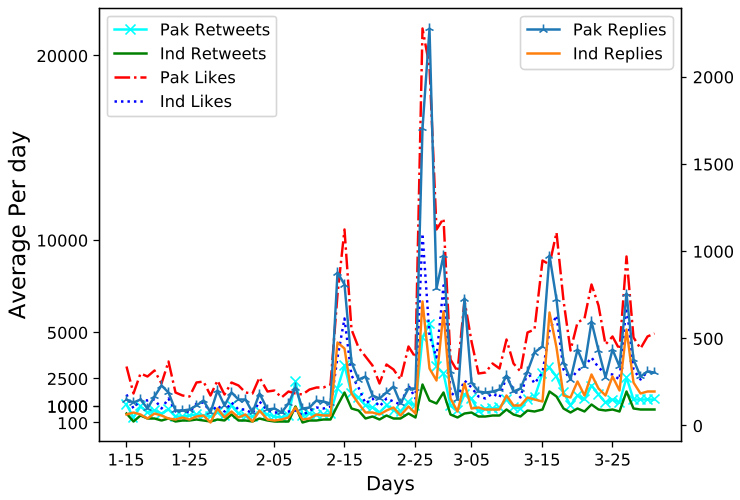 Fig 1: The sharp peaks in Feb and March highlight how real-world kinetic events directly drive digital engagement volume.
Key Insight: The "Unity" of Crisis
The most striking finding is the Evolution of Polarization. Using probability distributions of political scores, the authors found that on the most "critical" days of the crisis—such as the Balakot airstrikes—the polarization curve flattened.
- Why? During a crisis, the need for information and the shared sense of national urgency forces users to interact with government accounts and news sources they might usually ignore.
- The Result: For a brief moment, the "echo chamber" cracks. However, this is not a permanent peace; the data shows polarization returning to baseline levels within days of the tension subsiding.
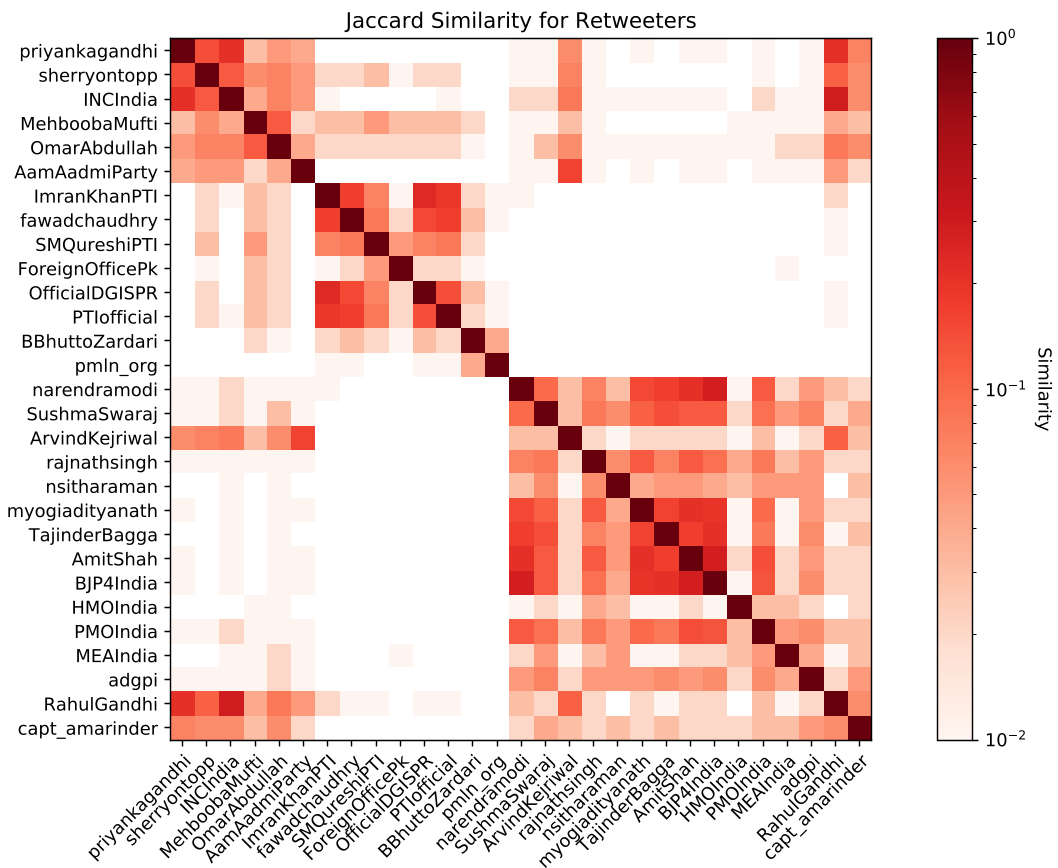 Fig 2: Retweet patterns show that while partisan users stay loyal to their leaders, government/ministerial accounts attract a much broader, less polarized audience during emergencies.
From Battlefield to Ballot Box
The timing of the crisis (February) and the Indian General Election (April) allowed the authors to observe Nationalism as a Campaign Tool.
The Hashtag Co-occurrence Graphs (Fig 4) reveal that the ruling BJP party was far more effective at "clustering" the crisis with their election narrative. They successfully associated the opposition (INC) with "terrorist sympathy" or "Pakistan friendship" through high-centrality hashtags like #rahullovesterrorists.
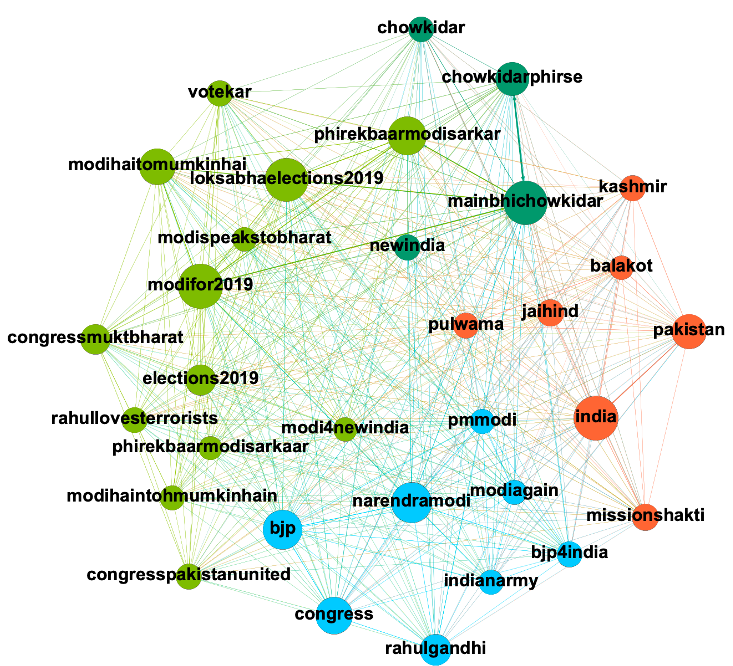 Fig 4: BJP's hashtag network is more dense and successfully links the February crisis (red cluster) to broader election sentiments, whereas the INC network remains more fragmented.
Critical Perspective & Takeaways
Summary: This research proves that national crises are not just interruptions to political life—they are transformative events that redefine the boundaries of digital communities.
- Strategic Takeaway: In the context of "Computational Politics," the volume of discourse during a crisis is a leading indicator of election performance. The BJP’s ability to dominate the hashtag landscape post-crisis served as a digital precursor to their electoral victory.
- Limitations: The study relies heavily on accounts that provide location metadata, which may exclude a significant portion of privacy-conscious users. Additionally, "retweeting" is used as a proxy for "agreement," which doesn't account for "hate-retweeting" or "quote-tweeting" with disagreement.
Future Outlook: As we move toward 2026, understanding how external shocks (wars, pandemics, climate disasters) reshape our polarized internal politics will be the most critical tool for defending democratic discourse.