
Cloud-Native Social D2D: Transcending the Energy Barriers of 5G Smart Cities
Energy-Aware Cloud Architecture for Intense Social Mobile (Device to Device) 5G Communications in Smart City
The paper proposes an "Energy-Aware Cloud Architecture" for 5G Device-to-Device (D2D) communications in Smart Cities. By offloading the computation of social ties and Sensor Encounter Records (SER) to a universal cloud platform, the method aims to eliminate the high energy overhead associated with traditional beacon-based social discovery.
TL;DR
As we approach a world with 35 billion D2D users, the traditional method of establishing social connections via radio beacons is becoming an energy nightmare. This paper introduces a Cloud-Integrated Social-Aware Architecture that offloads the heavy lifting of social network analysis to the cloud, theoretically reducing local device energy consumption to near-negligible levels.
The "Beacon" Bottleneck: Why Current 5G D2D Fails
In current 5G implementations, for your device to know it can share data with a nearby "socially linked" peer, it must constantly scream its presence using periodic beacons (typically every 6.67 seconds).
The researchers identify three critical "energy leaks" in this status quo:
- Blind Broadcasting: Energy is spent regardless of whether a recipient is there to listen.
- Collision Waste: In dense smart cities, beacons collide, leading to retransmissions and massive energy dissipation.
- Computational Overhead: Mobile devices are not optimized for the complex clustering algorithms needed to identify "social bridges" between moving communities.
Methodology: Shifting the Intelligence to the Cloud
The core insight of this paper is the decoupling of Social Awareness from Radio Proximity. Instead of the device "searching" for neighbors, it simply updates its Sensor Encounter Record (SER) to a universal cloud application upon becoming active.
The Unified Architecture
The proposed framework utilizes a hierarchical structure:
- The Device Layer: Focuses purely on low-power D2D data transfer via RAN.
- The Fog/Edge Layer: Uses localized routers to act as bridges for low-latency social updates.
- The Regional Cloud: Houses the "Heavy Machinery"—efficient clustering algorithms that map social ties and identify the best "Relay Leaders."
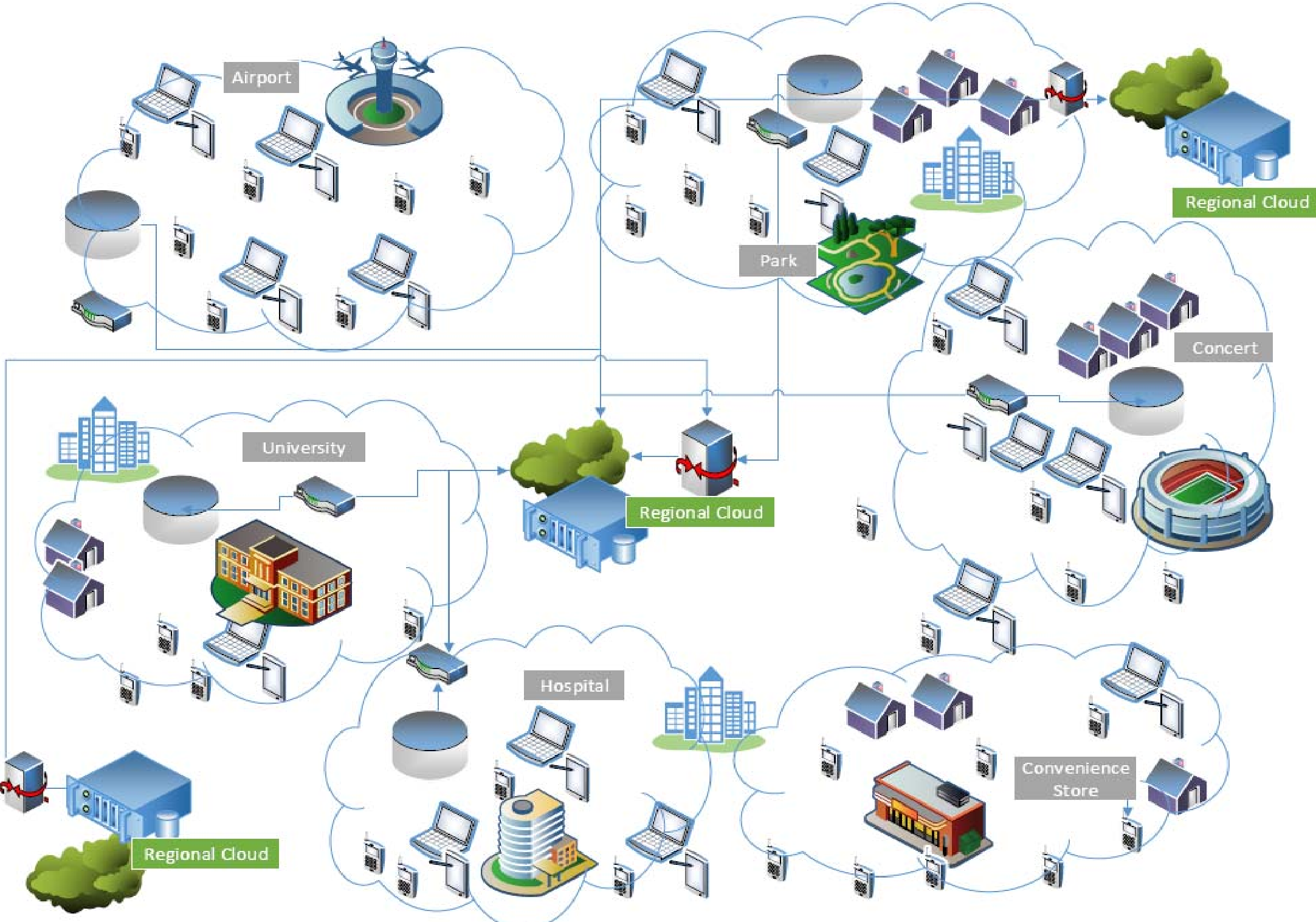 Figure 1: The proposed architecture integrating Mobile Devices, Fog Routers, and Regional Clouds.
Experiments & Analytical Evaluation
The authors present a compelling mathematical intuition for why their approach scales better than traditional Radio Access Networks (RAN). They define the energy cost function as:
In a traditional RAN-only setup, increasing any of these variables results in a linear or super-linear spike in battery drain. However, by moving to a Distributed Cloud environment with fiber-optic backbones:
- Signal Strength constraints are bypassed through intelligent relay selection.
- Storage costs on-device are minimized through cloud-based content matching and caching.
Performance Comparison
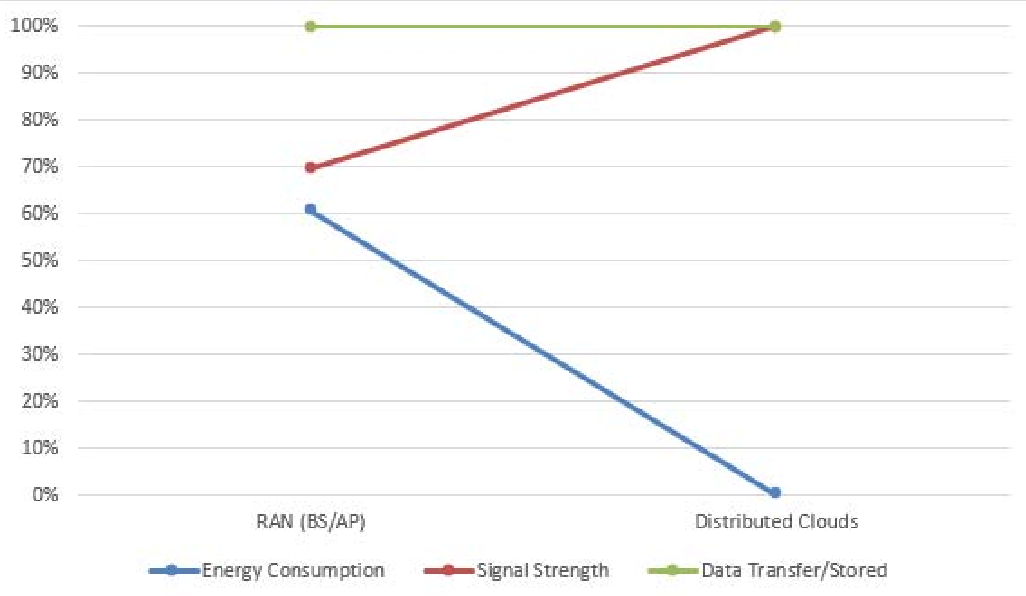 Figure 2: Comparing Energy Consumption with Data Efficiency. The Distributed Cloud maintains high efficiency while energy costs approach the zero-axis.
Critical Insight: The "Musical Concert" Scenario
To illustrate the vision, the authors describe a musical concert. In a legacy system, 5G devices would only start "bonding" upon arrival at the venue, wasting energy finding each other. In the Energy-Aware Cloud model:
- The cloud identifies the social group weeks in advance via registration data.
- As users move toward the venue, the cloud pre-calculates the D2D social graph.
- On-site, the devices immediately switch to high-efficiency D2D localized sharing based on "Cloud-Instructions," bypassing the discovery phase entirely.
Conclusion & Future Outlook
This work marks a shift from "Ad-hoc" D2D to "Orchestrated" D2D. By treating the social context as a cloud-computed resource rather than a radio-discovered signal, we can unlock the true potential of 5G in Smart Cities without killing the mobile battery.
Key Takeaways for Researchers:
- Energy Harvesting alone isn't enough: We must reduce the need for communication (the discovery phase).
- Fog Computing is the glue: It provides the necessary low-latency link between the high-level cloud social-map and the physical radio layer.
Limitations: The paper primarily focuses on architectural theory. Future work will need to address the privacy implications of storing SER data on a universal cloud platform and real-world packet loss in high-mobility scenarios.