
E2A2: Reducing Battery Drain via Crowdsourced Location Sharing
Energy efficient and accuracy aware (E2A2) location services via crowdsourcing
The paper introduces E2A2 (Energy Efficient and Accuracy Aware), a crowdsourcing-based location service that reduces mobile battery consumption by grouping co-located devices. It uses a shared "group location" proxy instead of requiring every device to independently activate power-hungry GPS sensors, achieving SOTA energy efficiency for multi-user scenarios.
TL;DR
The E2A2 (Energy Efficient and Accuracy Aware) system tackles the "GPS Battery Drain" problem by grouping co-located mobile devices. Instead of everyone's phone pinging GPS simultaneously, devices share location updates, allowing others to turn off their high-power sensors. This approach saves up to 33% battery life while keeping location accuracy within acceptable bounds for modern apps.
Background: The Price of Precision
Modern mobile applications—from social networking to transit tracking—demand high-accuracy location data. However, the GPS sensor remains one of the most significant power consumers on a smartphone. While prior research explored low-power sensors (like accelerometers) or stationary detection, they often ignored a critical opportunity: social proximity. When people walk together or ride the same bus, their location data is redundant. E2A2 exploits this redundancy through a crowdsourcing-based negotiation hub.
The Core Insight: Locations as a Shared Resource
The researchers behind E2A2 realized that location sensing shouldn't be a solo endeavor. By partitioning devices into groups and appointing an "active updater" for the group, the system creates a "Group Location" proxy.
The paper formalizes this as an optimization problem: minimizing the sum of energy costs across all devices while ensuring that the "error" (the distance between a device's true position and its group proxy) never exceeds a threshold. Since this is an NP-Hard problem (reducible to the Uncapacitated Facility Location Problem), E2A2 implements an efficient heuristic.
Methodology: How E2A2 Works
The system architecture is split into two primary components:
- Co-location & Grouping: This module handles the "Geography." It uses a
GroupRadiusto determine if a device is close enough to join an existing group andTgroupto expire old groupings. - Group Location Management: This module handles the "Negotiation." When an app requests a location, E2A2 checks two parameters:
Tself: How long ago did this device last update?Tothers: How long ago did someone else in the group update?
If a recent update exists, the requester gets the group location and keeps its GPS off.
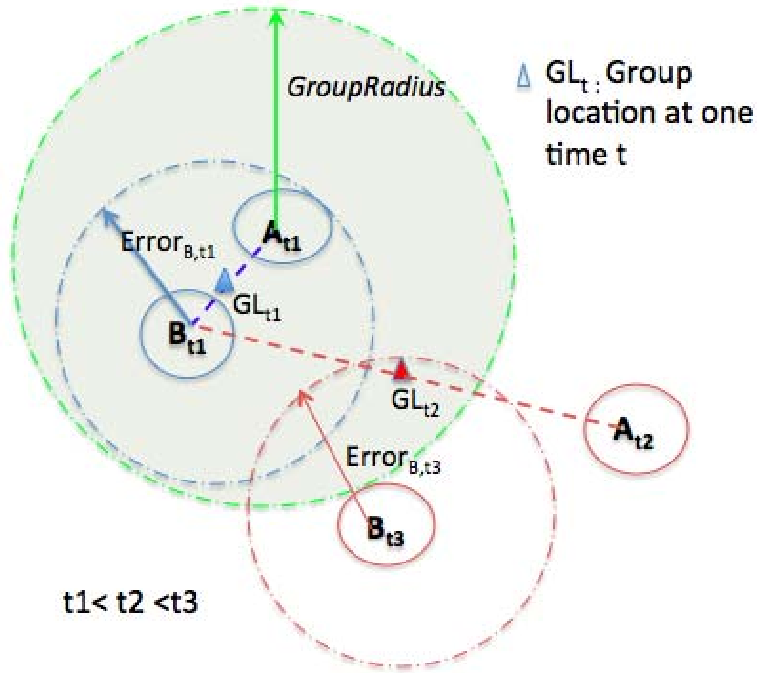 Figure 1: The dual-component workflow of E2A2, managing grouping and location proxying.
Experimental Proof: Walking and Bus Riding
The authors tested E2A2 in diverse mobility patterns using Android prototypes:
- The Star Pattern: Four users walk to a center point, meet, and disperse. As the "Number of Groups" dropped from 4 to 1, battery savings surged.
- The Bus Scenario: Four users boarding a bus at different stops. Even with the high speed of a vehicle, the system maintained an error range of 12.9m to 47.8m—well within the useful range for transit apps.
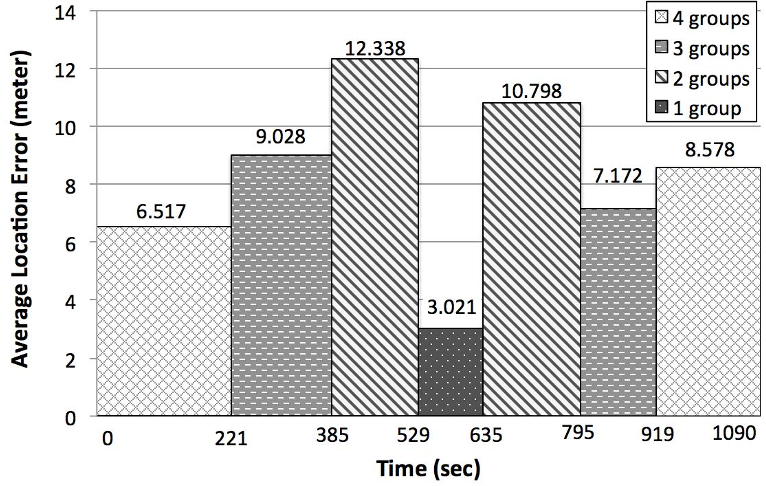 Figure 2: Battery usage trends in the Star walking pattern. Individual consumption drops significantly as devices merge into a single group.
Deep Insight: Scalability and Real-World Impact
One of the most compelling parts of the study is the analysis of transit load data from Pittsburgh. By analyzing a day's worth of passenger counts, the authors estimated that if all riders used E2A2, a single bus could save its riders over 25 hours of aggregate battery life in one day.
The performance scales linearly with group size: the larger the group, the less frequent each individual device needs to work. As shown below, location error actually improves as group size increases because the group location is refreshed more frequently by various members.
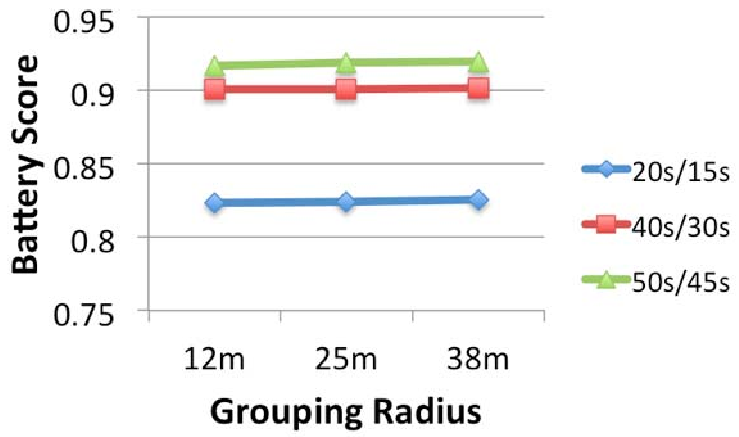 Figure 3: Counter-intuitive but logical—larger groups can lead to lower average error due to higher aggregate sampling rates.
Conclusion and Future Outlook
E2A2 proves that "inter-device cooperation" is a powerful tool for energy management. By shifting the perspective from individual optimizations to a crowdsourced service, we can achieve substantial power savings without losing situational awareness.
Limitations: The current prototype relies on a central server, and as the authors note, privacy remains a hurdle. Future iterations would likely need to incorporate decentralized protocols or differential privacy to encourage wider adoption in public spaces.