
Intelligent Duty-Cycling: Balancing Battery Life and Accuracy in Smartphone Activity Recognition
Energy-Efficient and Context-Aware Smartphone Sensor Employment
This paper introduces a generic framework for Human Activity Recognition (HAR) on smartphones using a Discrete-Time Inhomogeneous Hidden Semi-Markov Model (DT-IHS-MM). It achieves a 40% reduction in sensor power consumption while maintaining an 85-90% accuracy ratio through adaptive duty-cycling and sampling rate management.
TL;DR
Mobile Human Activity Recognition (HAR) is a notorious battery killer. This paper presents a sophisticated framework that uses Inhomogeneous Hidden Semi-Markov Models (DT-IHS-MM) and Constrained Markov Decision Processes (CMDP) to dynamically adjust sensor sampling. By "sensing less" when user behavior is stable (detected via entropy analysis) and "sensing more" during transitions, the system slashes power consumption by 40% while keeping recognition accuracy between 85-90%.
The Core Challenge: The Power-Accuracy Tug-of-War
Modern smartphones are packed with sensors, but keeping them active for real-time context awareness (e.g., detecting if you are walking, sitting, or running) is computationally and electrically expensive. Prior works like EEMSS or Jigsaw attempted to save energy using fixed duty cycles (periodic on/off states).
However, human behavior is stochastic and non-stationary. A fixed duty cycle either wastes energy when you are sitting still for hours or misses critical transitions when you suddenly start running. The authors identified that the key to efficiency isn't just "sampling less," but sampling smarter based on the stability of the current context.
Methodology: Inhomogeneity & Entropy
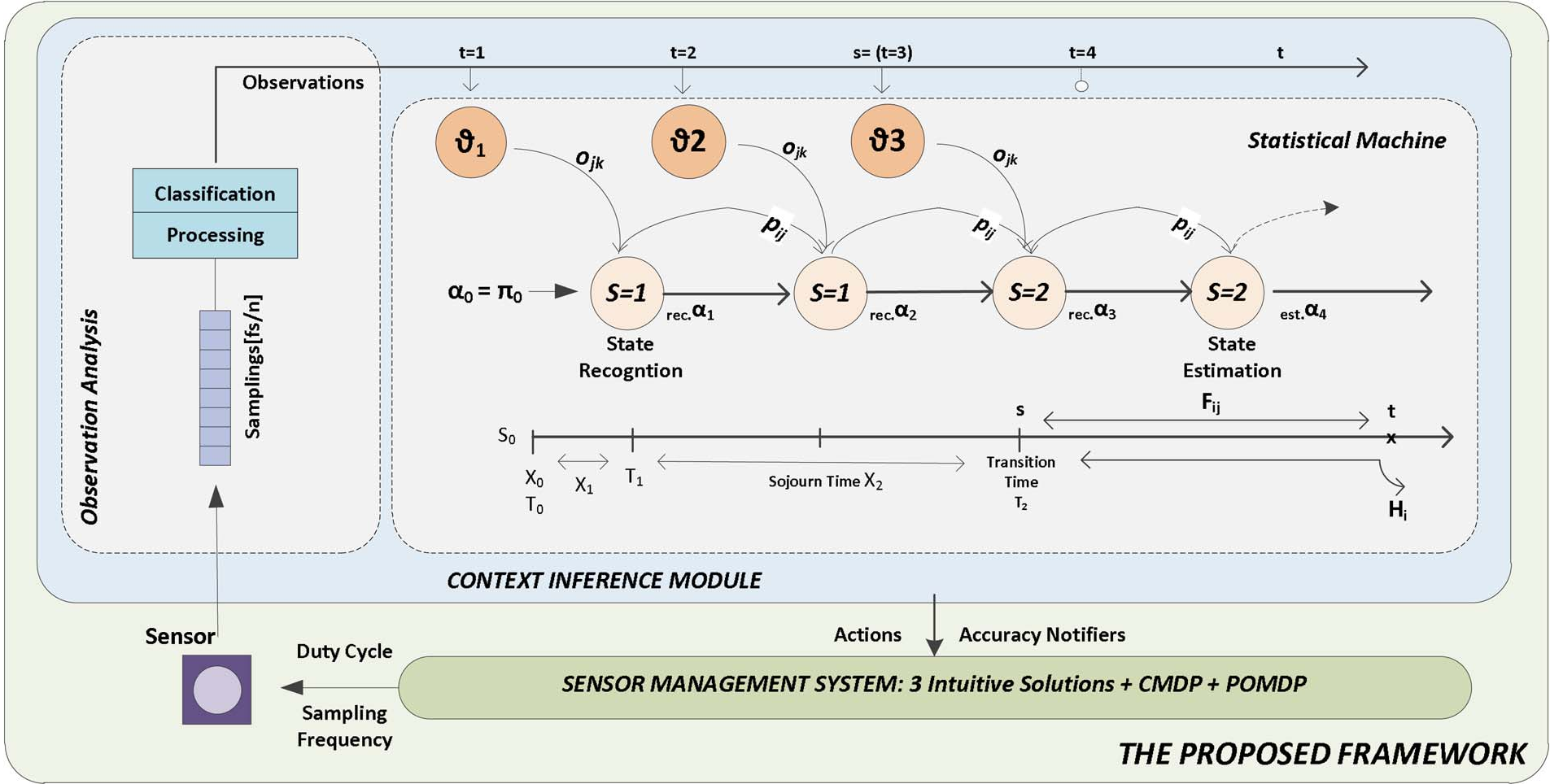
The researchers broke the problem into two interoperated modules: Context Inference and Sensor Management.
1. The Statistical Machine (DT-IHS-MM)
Traditional Hidden Markov Models (HMM) assume stationary transition probabilities. This paper rejects that, moving to an Inhomogeneous model where transition rates change over time to reflect real-world user volatility.
- Semi-Markovian Property: This allows the model to handle aperiodic intervals (missing data) caused by power-saving "off" cycles.
- Entropy Production Rate: This is the "secret sauce." The system calculates the entropy of the current state. If entropy converges, it suggests the user’s behavior is stable, signaling the sensor manager to transition to a lower-power state.
2. Optimal Sensing via CMDP and POMDP
The framework treats sensor management as an optimization problem. It defines an Action Set:
- Decrease Power: Reduce frequency/duty cycle (used when behavior is stable).
- Preserve: Maintain current settings.
- Increase Power: Higher sampling (used when entropy is unstable or transitions are detected).
Using CMDP (Constrained Markov Decision Process), the system minimizes accuracy loss subject to a strict power budget. Alternatively, a POMDP approach is used to handle the inherent uncertainty of "hidden" user states when sensors are effectively blind during idle periods.
Experimental Results: Proving the Efficiency
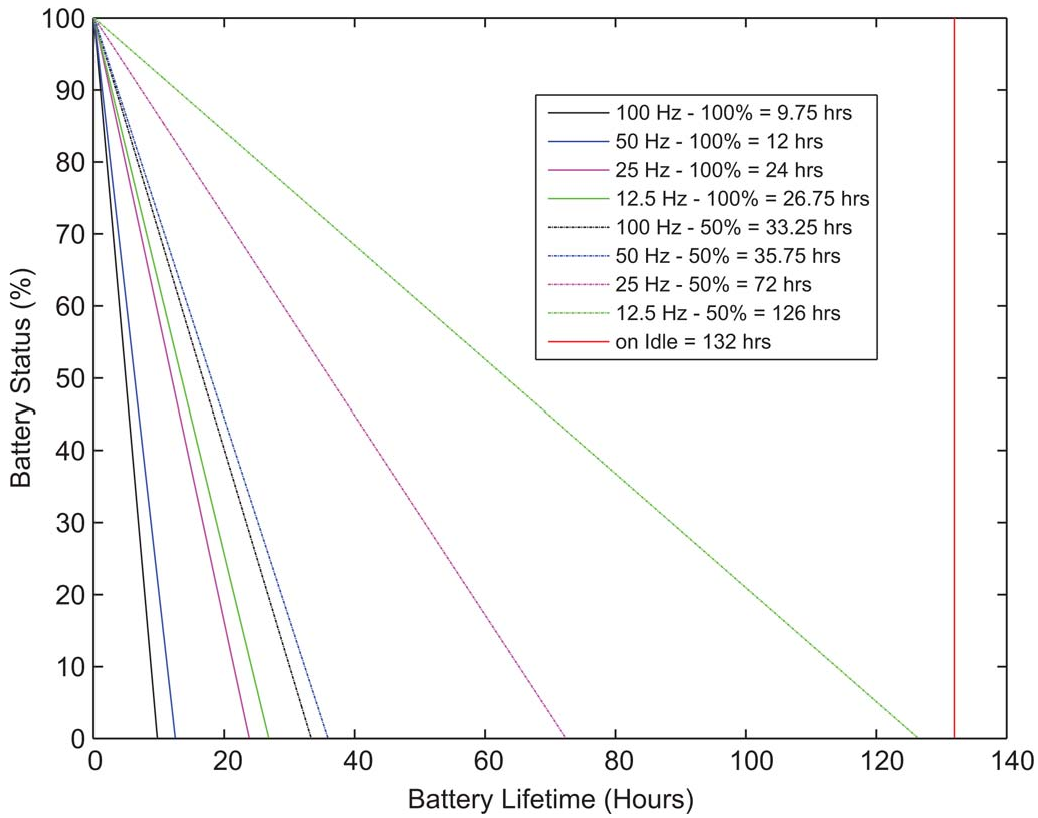
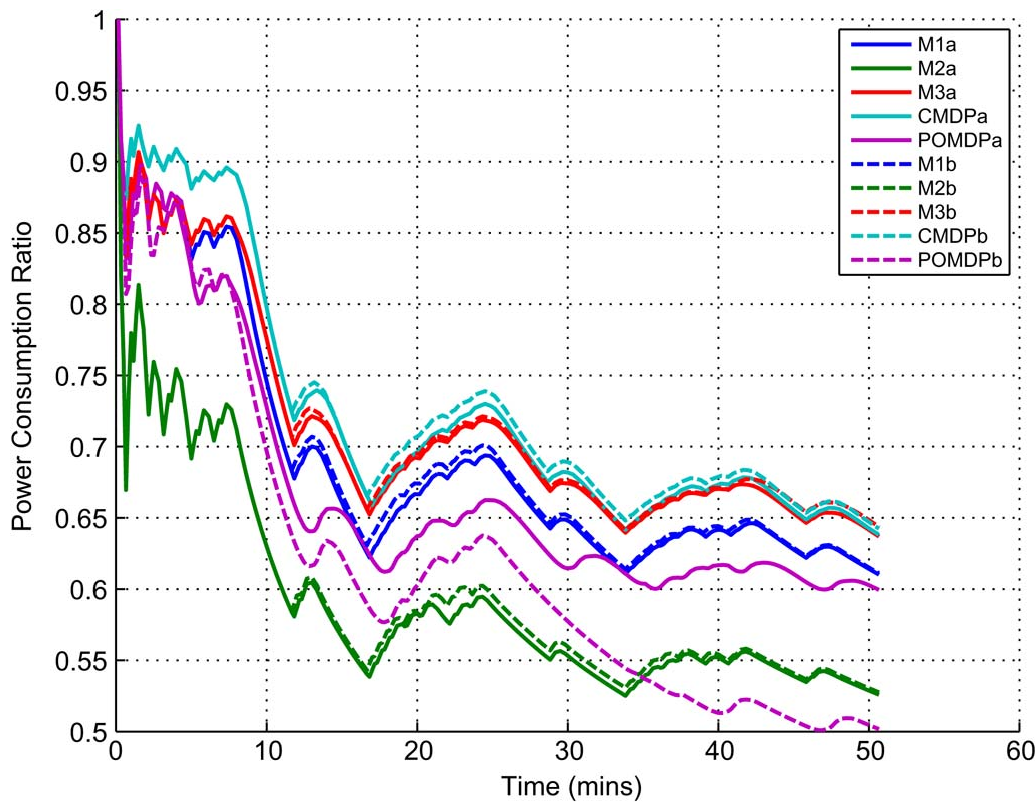
The authors tested the framework on a Blackberry Storm II with five participants. They compared three intuitive methods against the optimal Markovian strategies.
Key Performance Metrics:
- Power Efficiency: A 40% overall reduction in physical sensor power.
- Accuracy Retention: Despite dropping sampling rates significantly during stable periods, the accuracy remained above 85%.
- Adaptation: The system initially shows high error rates but "learns" the user's profile within minutes, after which the accuracy stabilizes even as power consumption drops.
Critical Insight: Why This Matters
What sets this work apart is the shift from hardware-centric power management to context-centric management. Instead of the sensor being a dumb data pipe, it becomes an active participant in the inference loop. By utilizing the Entropy Production Rate as a feedback trigger, the system mimics a human-like "patience"—if nothing interesting is happening, it "dozes off" to save energy, but wakes up instantly when the "entropy" of the environment spikes.
Conclusion & Future Work
This paper proves that the cost of context-aware services on mobile devices can be significantly mitigated through adaptive statistical modeling. Future research could extend this logic to Multi-Modal Sensing, where the system decides whether to use a low-power accelerometer or a high-power GPS based on the confidence of the current hidden state.
Takeaway: In the era of ubiquitous sensing, the most energy-efficient sensor is the one that knows exactly when it doesn't need to look.