
Energy-Efficient MSNs: Balancing Social Ties and Physical Links for Scalable Video D2D
Energy-Efficient Cooperative Scalable Video Distribution and Sharing in Mobile Social Networks
This paper introduces an energy-efficient video distribution framework for Mobile Social Networks (MSNs) using D2D multicast and Scalable Video Coding (SVC). The core method utilizes a Chinese Restaurant Process (CRP) based clustering algorithm to select optimal Cluster Head Users (CHUs), achieving significant reductions in Base Station (BS) load and energy consumption.
TL;DR
Mobile video traffic is projected to dominate 79% of data usage by 2022, placing immense pressure on Base Stations (BS). This paper presents a novel D2D multicast strategy that leverages Scalable Video Coding (SVC) and Social Attributes to turn mobile devices into active relays. By selecting Cluster Head Users (CHUs) based on both physical proximity and social reliability, the system achieves a 51% boost in energy efficiency and a 45% increase in throughput.
The Bottleneck: Why Standard D2D Multicast Fails
Existing Device-to-Device (D2D) research often treats users as uniform, static nodes. In reality:
- Dynamic Mobility: Users move, causing D2D links to be fragile and transient.
- Quality Diversity: Not every user needs 4K; hardware capabilities and preferences vary.
- Social Selfishness: Users are reluctant to share data if it drains their battery without a social "incentive" or tie to the requester.
The authors identify that the key to offloading the BS is not just proximity, but predictive stability—finding nodes that are likely to stay together because they share social interests or common behavioral patterns.
Methodology: Social-Physical Fusion & SVC
The proposed framework relies on two technical pillars:
1. CRP-Based Cluster Head Selection
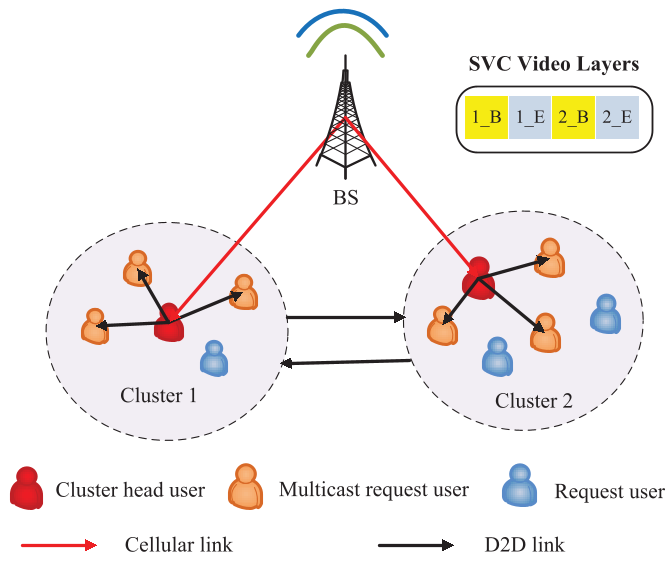
The system uses the Chinese Restaurant Process (CRP), a stochastic process, to determine the probability of a node becoming a CHU. Unlike simple distance-based selection, the weight factors in:
- Physical: Distance to BS and achievable transfer rate.
- Social: Contact frequency (), contact duration (), and interest similarity ().
By selecting heads with high social similarity to their peers, the system ensures higher willingness to cooperate and more stable D2D multicast groups.
2. Scalable Video Coding (SVC) and Zipf Distribution
Instead of sending a single monolithic file, the BS multicasts a Base Layer (BL) (essential quality) to everyone and sends Enhancement Layers (ELs) to the CHUs.
- Zipf Distribution: Models video popularity; popular videos are cached and shared more aggressively at the edge.
- Personalized Quality: Edge users share ELs based on their specific quality preferences , preventing the transmission of unwanted data.
Experimental Results
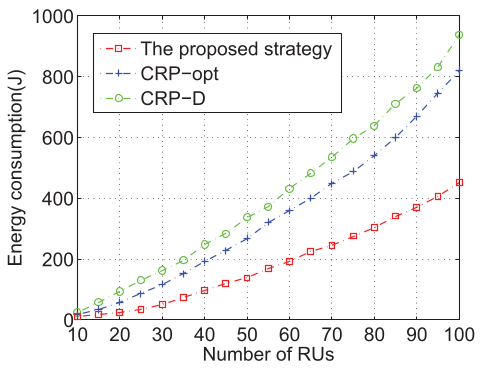
The researchers evaluated their strategy against two baselines: CRP-D (Physical only) and CRP-opt (Early social iteration).
Energy and Throughput Gains
As the number of Request Users (RUs) increases, the opportunity for edge collaboration grows.
- Efficiency: The proposed mechanism outperformed baselines by up to 51% in energy saving because the BS only needs to transmit the heavy ELs once to the CHUs.
- Stability: By considering social contact duration, the links remained stable longer, leading to a 45.1% throughput improvement.
Critical Insight: Social Correlation as an Inductive Bias
The brilliance of this work lies in treating Social Information as a proxy for Channel Stability. In mobile environments, social ties (like friends at a concert) are much better predictors of link persistence than momentary signal strength.
Limitations: While social attributes improve willingness, they don't fully solve the "selfishness" problem in purely anonymous environments. The authors acknowledge that future work must involve explicit Incentive Mechanisms (like virtual credits or tokens) to supplement social ties.
Conclusion
This paper shifts the D2D paradigm from a purely physical-layer problem to a socio-technical one. By combining the mathematical flexibility of the CRP for clustering with the modular efficiency of SVC, it provides a blueprint for next-generation mobile video distribution that is both energy-aware and user-centric.