
Synergizing Social and Technological Networks: A Cross-Layer Blueprint for Energy-Efficient WMNs
Energy-Efficient Cross-Layer Design of Wireless Mesh Networks for Content Sharing in Online Social Networks
This paper proposes an energy-efficient cross-layer design for Wireless Mesh Networks (WMN) tailored for content sharing in Online Social Networks (OSN). It introduces "Composite Betweenness," a novel metric that integrates OSN social patterns with WMN topology to optimize content caching and routing, achieving state-of-the-art energy efficiency.
TL;DR
This research pioneers a cross-layer methodology that treats Wireless Mesh Networks (WMNs) not just as physical hardware, but as a technological reflection of Online Social Networks (OSNs). By introducing Composite Betweenness, a metric that maps social friendships onto physical routing paths, the authors achieve a 40% reduction in total energy consumption and a massive boost in battery efficiency for mobile clients.
The Problem: The "Socially Blind" Network
Most current wireless networks are architected with a "blind" approach to user behavior. They treat every data packet and every node with the same priority, ignoring the fact that in the real world, data flows along the lines of social trust and friendship.
The authors argue that this lack of social-awareness leads to:
- Inefficient Routing: Packets take paths that ignore frequent communication pairs.
- Suboptimal Caching: Content is stored in locations that don't align with social "hotspots."
- Energy Waste: Mobile clients (MCs) drain battery life by acting as data sources too frequently when the network backbone could have cached the content closer to the consumer.
Methodology: The Cross-Layer Architecture
The paper proposes a holistic design spanning from the physical layer to the application layer.
1. PHY & MAC Layers: Power Control and Interference Management
Instead of transmitting at Maximum Allowable Transmit Power (MATP), the system uses an adaptive power control scheme. It calculates the minimum power required to meet a Bit-Error-Ratio (BER) threshold. In the MAC layer, an Interference-Constrained-Channel-Reuse algorithm ensures that multiple nodes can share the same channel without degrading the Signal-to-Interference-plus-Noise Ratio (SINR).
2. The Core Innovation: Composite Betweenness
While "Singular Betweenness" only looks at the mesh backbone topology, Composite Betweenness factors in:
- OSN Topology: Who is friends with whom (The Social Graph).
- User Mobility: The probability of a user being associated with a specific Mesh Router (MR).
- Routing Logic: The optimal paths (Dijkstra-aided) taken between social friends.
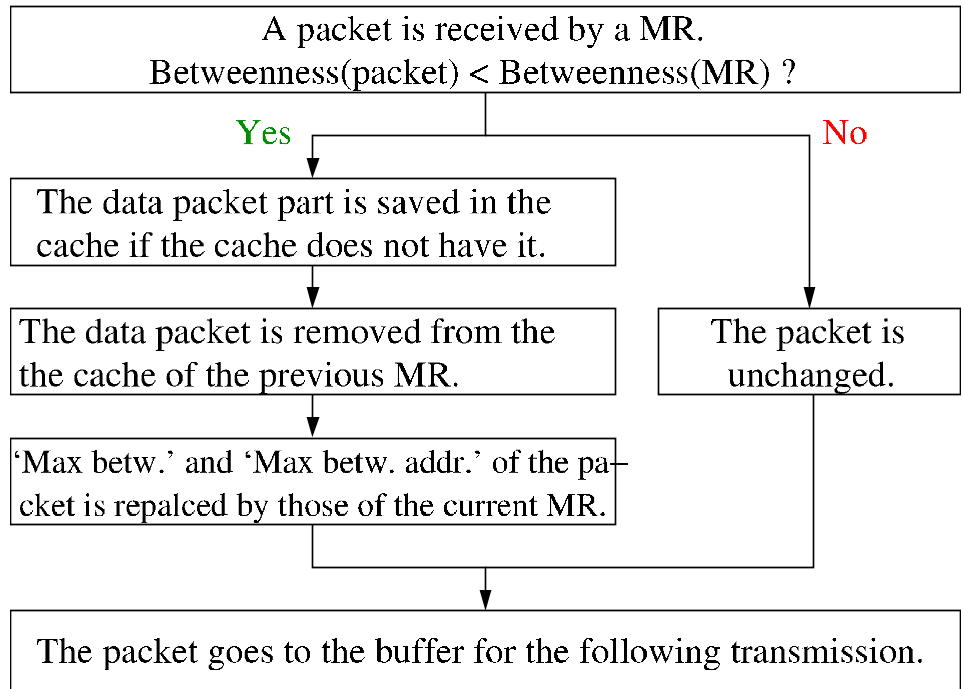 Figure: The process of caching based on betweenness values, ensuring content moves to the most strategically important nodes.
Experiments & Results: Real-World Social Graphs
The researchers validated their model using the Karate Club Social Graph, a famous complex network dataset.
Key Findings:
- Energy Savings: The use of Composite Betweenness for caching reduced total energy dissipation by 40%.
- Client Longevity: The Real-time Composite Betweenness strategy was particularly effective for mobile devices, reducing their energy burden by 35% compared to traditional topology-only methods.
- Routing Efficiency: The Minimum-Energy-Dissipation (MED) routing was confirmed to be significantly more power-friendly than the Minimum-Number-of-Hops (MNH) approach.
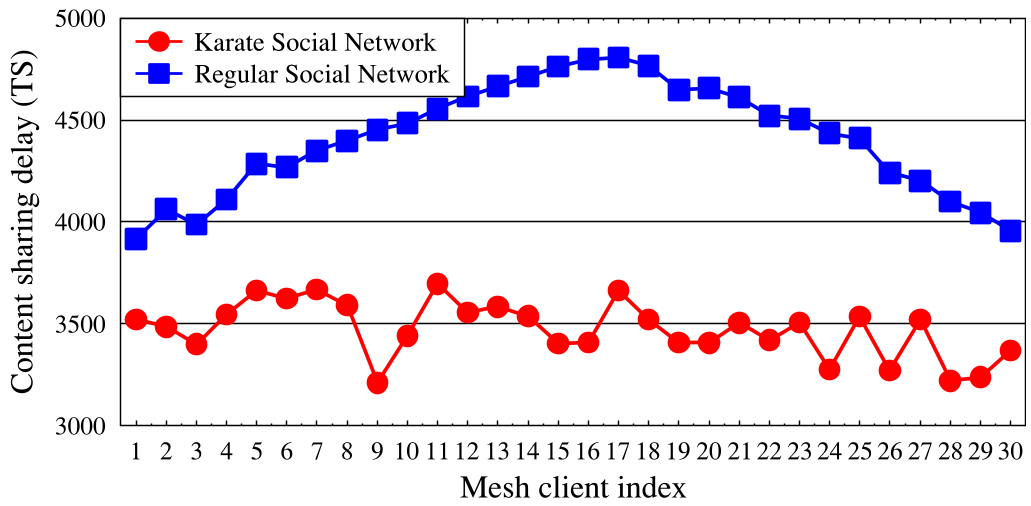 Figure: Comparison of total energy consumption between various betweenness-based caching strategies.
Critical Insight & Future Outlook
The brilliance of this work lies in its recognition that logical friendships drive physical traffic. By embedding social intelligence into the mesh backbone, the network transitions from a passive pipeline to an active, predictive host.
Limitations: The model assumes a fairly static social graph and focuses on unweighted relationships. In a real-world setting, social ties have varying "weights" (e.g., best friends vs. acquaintances), which would further complicate the composite betweenness calculation.
Conclusion: This paper serves as a foundation for context-aware 5G/6G architecture. As we move toward ultra-dense networks, the ability to "socially optimize" the technological bearer will be the difference between a network that thrives under high load and one that collapses under its own energy requirements.