
iEncrypt: Turning Foes into Friends for Secure Multimedia Broadcasting
Energy Efficient Multimedia Content Broadcasting in a Risky Mobile Social Network with Adversarial Users
The paper introduces iEncrypt, a credit-based fragmentation and encryption scheme for energy-efficient multimedia broadcasting in risky Mobile Social Networks (MSNs) where adversarial users exist. It balances security and delivery efficiency by forcing malicious nodes to participate in data relaying to acquire content.
TL;DR
In a disaster or crisis, communication infrastructures often fail, leaving us reliant on phone-to-phone "carry-and-forward" social networks. But how do you broadcast large multimedia files when your neighbor might be a malicious actor? This paper proposes iEncrypt, a strategy that doesn't just block adversarial users—it tricks them into helping the network while keeping the data secure through clever fragmentation and credit-based exchanges.
Problem & Motivation: The Dilemma of the Risky Network
In a Mobile Social Network (MSN), nodes rely on human movement to meet and exchange data. In a "risky" environment, adversarial users aim to:
- Filch: Eavesdrop on private content.
- Sabotage: Stop relaying data to others to destroy network efficiency.
Previous solutions generally chose one of two extremes:
- No Protection: Fast and energy-efficient but highly insecure.
- Full Encryption (CenEncrypt): Highly secure but requires a central server for keys, causing massive latency and energy drain in infrastructure-free zones.
The authors' insight is simple: Malicious nodes want the data too. If we make the data useless unless they prove they've helped others, we can convert a threat into a relay resource.
Methodology: The iEncrypt Mechanism
1. Fragmentation as a Shield
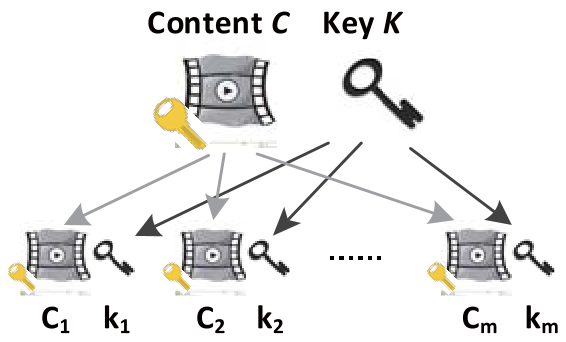
Instead of one large file, iEncrypt breaks the multimedia content (C) and the RSA public key (K) into segments. To decrypt the file, an adversary must collect every single fragment of both the data and the key.
2. The Credit-Based "Tug of War"
To force interaction, the system uses a credit-based forwarding strategy:
- Earning Credits: Every time User A gives a fragment to User B, User B provides an encrypted digital receipt, boosting User A's credit.
- The Power Shift: When two users meet, the one with the higher credit can demand all missing fragments from the lower-credit user. The lower-credit user can only request one fragment.
- Incentive for Malice: For a malicious user to quickly gather all fragments to satisfy their curiosity, they must accumulate credits by relaying fragments to others. If they stay silent, they stay fragment-poor.
Experiments & Results: Efficiency Meets Security
Using the Infocom 06 real-world mobility trace, the authors compared iEncrypt against NoEncrypt and CenEncrypt.
Breaking the Trade-off
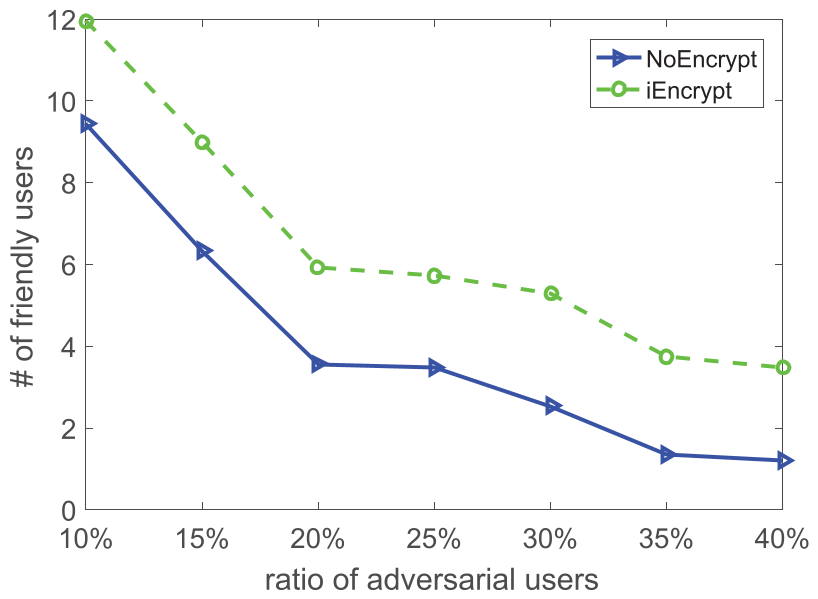
As shown in the charts below, iEncrypt significantly delays the point at which an adversarial user can finally "crack" the content, allowing more friendly users to receive the broadcast first.
Latency and Energy
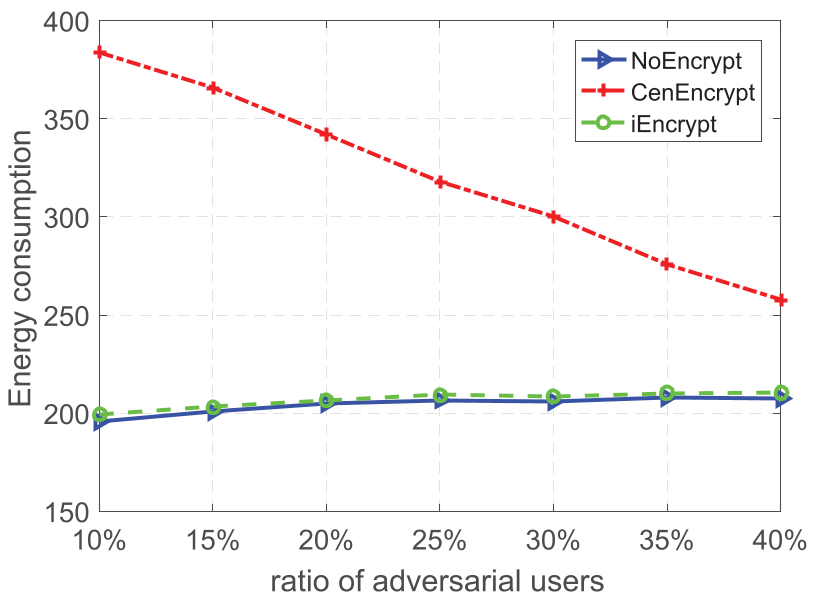
Crucially, iEncrypt doesn't sacrifice performance for security. While CenEncrypt (the central server approach) sees latency skyrocket as the number of malicious users grows, iEncrypt remains stable and nearly as fast as having no security at all.
Critical Analysis & Conclusion
Takeaway: iEncrypt successfully balances the "Golden Triangle" of MSNs: Energy, Security, and Delay. By using the adversaries' own greed as a catalyst for relaying, the network becomes more resilient the more "active" the adversaries are.
Limitations:
- Collusion: The paper assumes limited knowledge among peers. If adversarial users form a large, coordinated "dark network" to share fragments among themselves without relaying to friendly nodes, the credit system might be bypassed.
- Storage: Multimedia fragments still occupy space; on extremely storage-constrained devices, the constant exchange policy might lead to buffer overflows.
Future Work: The authors suggest refining the data exchange rules to handle coordinated attacks, potentially integrating social-trust metrics to further isolate high-risk nodes.