
MTBSC: Exploiting Social Patterns for Green Multimedia in Heterogeneous Networks
14315_Energy-efficient multimedia transmissions through base station cooperation over heterogeneous cellular networks exploiting user behavior.
Summary
Problem
Method
Results
Takeaways
This paper proposes MTBSC (Multimedia Transmission through Base Station Cooperation), a novel energy-efficient framework for Heterogeneous Cellular Networks (HCN). By exploiting social "user behavior" patterns and the Gini coefficient, the method optimizes multicast and patching unicast delivery between macrocells and small cells to maximize energy efficiency (EE).
## TL;DR
The surge in mobile video consumption is pushing cellular energy costs to unsustainable levels. This paper introduces **MTBSC**, a cooperative transmission framework that uses the **Gini coefficient** to quantify user social behavior. By coordinating Macro and Small cells to handle multicast and "patching" unicast respectively, the authors achieve up to an **89% energy efficiency boost** over traditional methods.
## The Motivation: Why Current Networks Waste Energy
Mobile video traffic is growing at a compound annual rate of 75%. In traditional networks, if ten users in the same mall watch the same trending video, the base station often sends ten separate unicast streams. This is akin to ten people driving ten cars to the same destination—it is an energy nightmare.
While **multicasting** (one stream for many) exists, it has a "arrival time" problem: if you join a multicast stream late, you miss the beginning. Traditional "batching" makes users wait until a window expires, ruining the User Experience (QoE). The challenge is: how do we use multicast for energy saving without making users wait?
## The Insight: Social Convergence & The Gini Coefficient
The authors observe that user requests aren't random; they exhibit **convergent patterns** in space and time. They borrow the **Gini Coefficient**—traditionally an economic tool for income inequality—to measure "traffic inequality."
A high Gini coefficient ($h$) indicates that traffic is highly concentrated in specific "service groups" (hotspots). By quantifying this, the network can mathematically decide when it is more energy-efficient to trigger a multicast session versus staying with unicast.
## Methodology: The MTBSC Paradigm
The proposed architecture splits the task between two tiers of the Heterogeneous Cellular Network (HCN):
1. **Macrocell (MBS)**: Handles wide-area coverage and initiates the primary **Multicast Stream**.
2. **Small-cell (SBS)**: Located in hotspots, the SBS handles the **Patching Streams**.
### The "Catch-up" Mechanism
When a second user ($A_2$) requests a video already being multicasted to user ($A_1$), they immediately join the ongoing multicast. To fill the "gap" (the part they missed), the SBS delivers a high-speed unicast "patch" simultaneously.
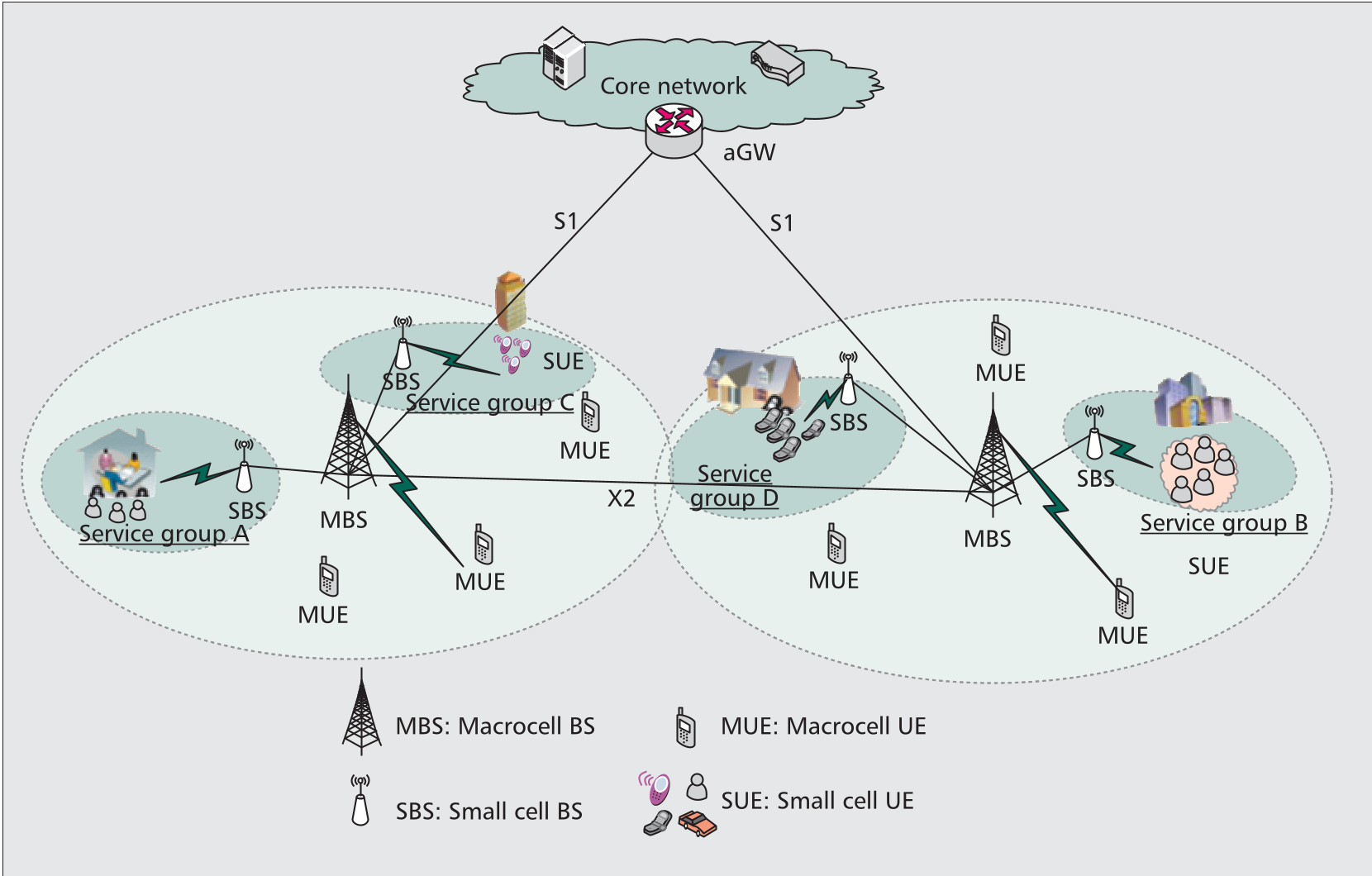
The system optimizes the **Multicast Time Window ($t_w$)** and bandwidth allocation ($W_{Mu}, W_{Mm}, W_{Su}$) to maximize the Energy Efficiency (**EE**) equation:
$$EE = \frac{Throughput}{Power}$$
## Experimental Results: Quantitative Gains
The researchers compared MTBSC against Unicast Multimedia Transmission (UMT) and Traditional Multicast (TMMT).
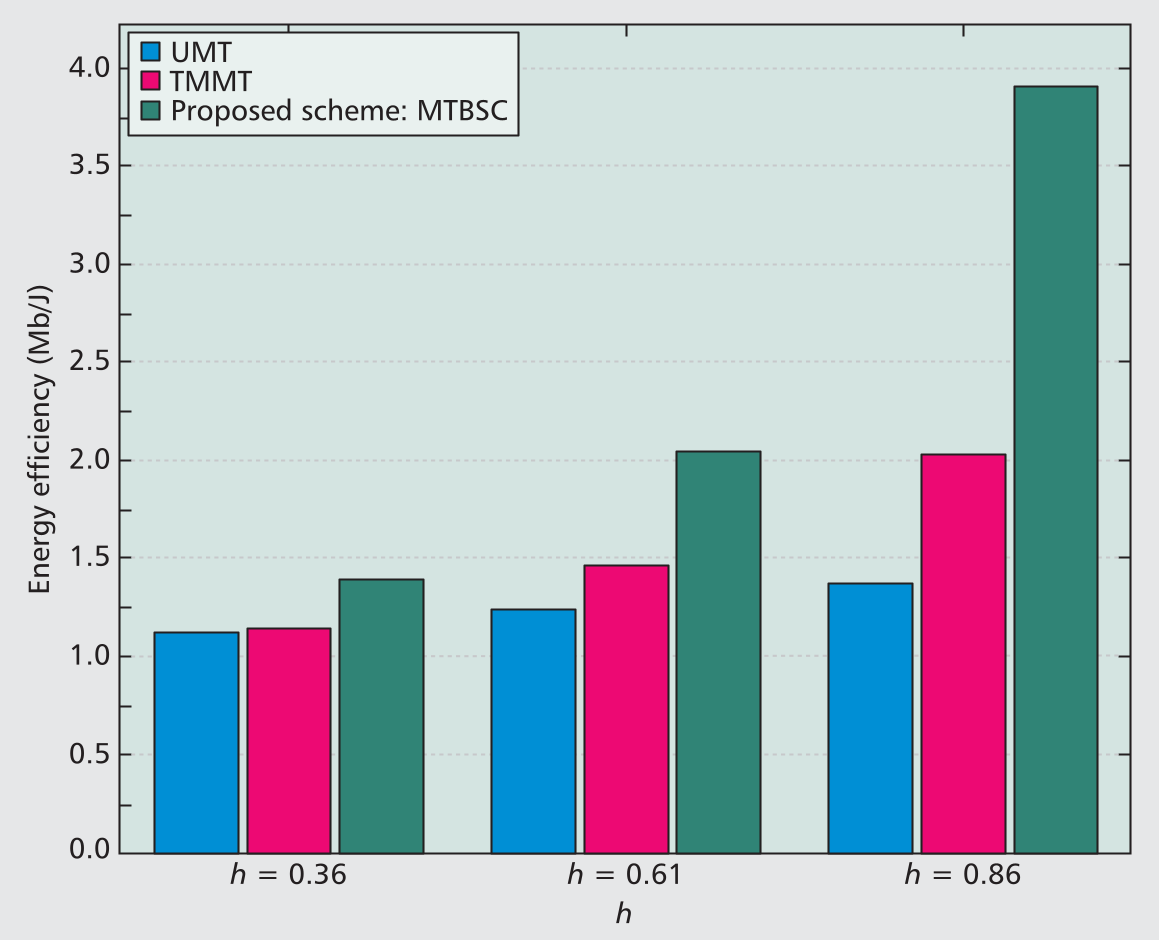
- **Social Impact**: As user behavior becomes more "social" (higher $h$), the efficiency of MTBSC skyrockets. At $h=0.86$, it proves significantly more sustainable than TMMT.
- **Optimal Window**: The study found a "sweet spot" for the multicast window ($t_w$). If the window is too short, you don't catch enough users; too long, and the patching power exceeds the savings.
## Critical Analysis & Future Outlook
The beauty of this work lies in its **Inductive Bias**: it assumes that human social behavior (watching the same viral content) is a resource to be harvested.
**Limitations**:
- **Backhaul Assumptions**: The model assumes a high-capacity, low-latency Xn interface (fiber-like) between the MBS and SBS, which might not be present in all legacy deployments.
- **Content Dynamism**: The model works best for pre-recorded "hot" content (VoD) rather than unpredictable live-streaming.
**Conclusion**:
MTBSC marks a shift from "bit-pipes" to "intelligent content delivery." By treating the network as a socially-aware entity, we can move closer to the goal of "Green Communications" without sacrificing the high-speed multimedia experience users demand.