
TRF: Revolutionizing Precision Agriculture with Intelligent Fuzzy-Based Routing
An Energy Efficient Routing Algorithm for WSNs Using Intelligent Fuzzy Rules in Precision Agriculture
The paper introduces Terrain-based Routing using Fuzzy rules (TRF), a novel energy-efficient routing protocol designed for Wireless Sensor Networks (WSNs) in precision agriculture. The method utilizes fuzzy inference systems to optimize Terrain Head (TH) election and relay node selection, achieving superior network longevity compared to Region-Based Routing and ECHERP protocols.
TL;DR
To address the premature death of sensor nodes in agricultural monitoring, researchers have proposed Terrain-based Routing using Fuzzy rules (TRF). By partitioning the field into segments and using multi-criteria fuzzy logic for data relaying, the protocol reduces energy consumption by approximately 30% compared to traditional methods, significantly extending the operational life of the network.
Background: The Energy Crisis in the Field
In the context of Precision Agriculture (PA), Wireless Sensor Networks (WSNs) are the "eyes" of the irrigation system. However, these nodes are often powered by irreplaceable batteries. The primary energy drain isn't the actual sensing of soil moisture or temperature—it's the wireless transmission. If a routing protocol is inefficient, certain "bottleneck" nodes will die early, creating blind spots in the field.
The authors identify a core limitation in prior work: many protocols choose the shortest path or nodes with the highest energy without considering the network topology (node degree) and the relative distance to the base station, leading to unbalanced exhaustion.
Methodology: The Intelligence of Fuzzy Logic
The TRF protocol introduces a three-layered approach to maximize efficiency:
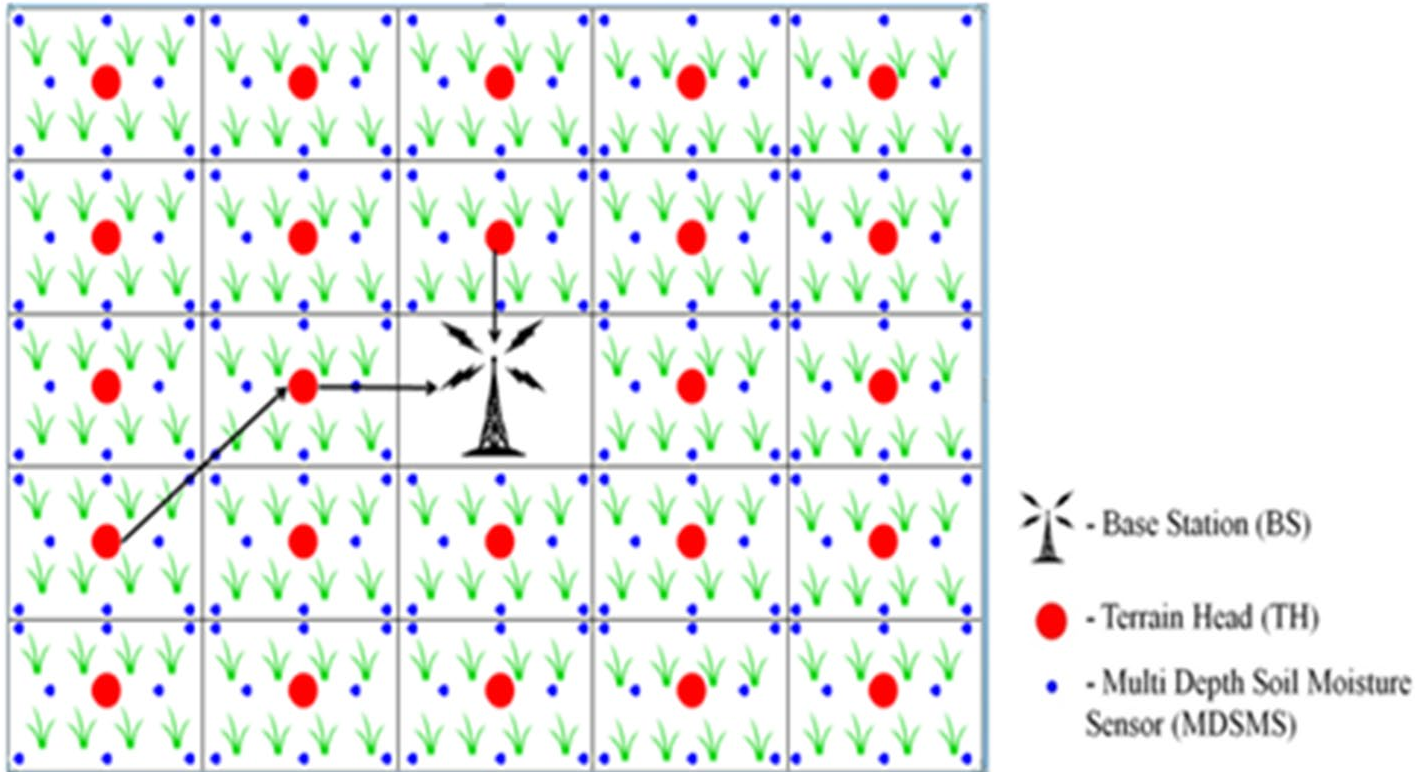
1. Spatial Partitioning (Terrain Formation)
The farmland is divided into equal-sized units called terrains. This ensures uniform coverage and simplifies the management of nodes.
2. Intelligent Head Election
Instead of a random rotation, TRF uses a Fuzzy Inference System (FIS). It takes two inputs to decide which node should manage the terrain:
- Distance to Base Station: Nodes closer to the sink shouldn't always be heads because they already handle heavy relay traffic.
- Remaining Energy: Only "healthy" nodes are promoted.
3. Multi-Factor Relay Selection
When moving data from a Terrain Head (TH) to the Sink, the next "hop" is chosen via 27 fuzzy rules (Table 2 in the paper). This system balances three critical factors:
- Residual Energy (Longevity)
- Distance to Sink (Efficiency)
- TH Degree (Congestion Avoidance)
Experimental Validation
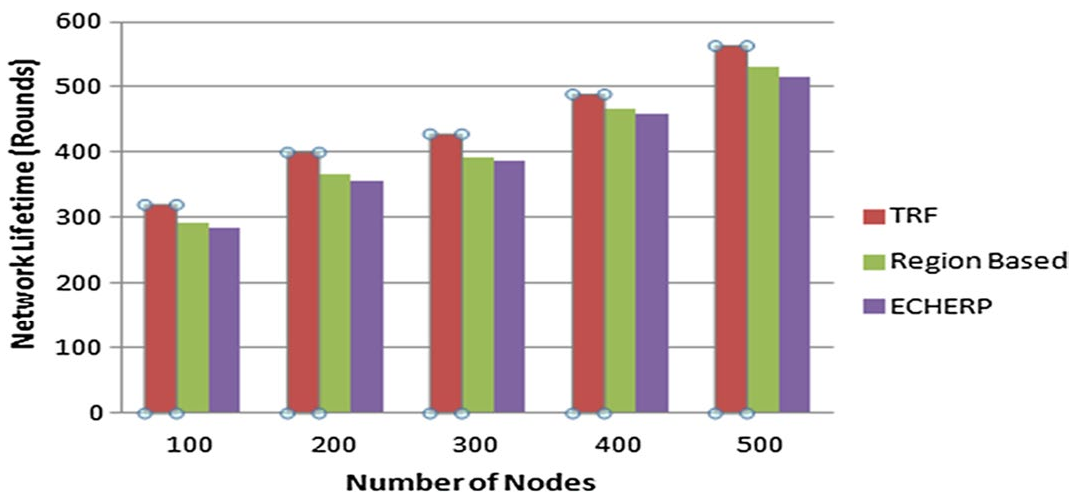
Using a simulation area of 200x200m with up to 1000 nodes, the authors compared TRF against Region-Based Routing and ECHERP.
- Energy Balance: While other algorithms used over 80% of their energy budget within 1000 rounds, TRF utilized only 57.32%, leaving a significant buffer for continued operation.
- Node Survival: TRF kept 91% of nodes alive after 1000 rounds, whereas Region-Based Routing saw a massive dropout, ending with only 64% survival.
Critical Insight: Why Fuzzy Logic?
The beauty of the Fuzzy Inference System (FIS) in this context is its ability to handle non-linear trade-offs. Routing in a dynamic environment isn't a simple "if energy > X" problem. It's a heuristic challenge where "fairly close to the sink" and "moderately high energy" must be weighed against "low degree of connectivity." TRF's rules (e.g., if Distance is Near and Energy is Peak, Priority is Very Large) mimic human-like decision-making to optimize the network's health globally.
Conclusion & Outlook
TRF proves that a terrain-based approach combined with fuzzy intelligence is superior for the rigorous demands of agricultural monitoring.
Future Work: The authors suggest the introduction of Fuzzy Temporal Rules. Adding a time-dimension to the logic could allow the network to adapt to seasonal needs—perhaps saving energy during rainy seasons when moisture sensing is less critical, further extending the "smart" in smart farming.
Main Achievement: 30% reduction in energy utilization and significant extension of First Node Dies (FND) and Last Node Dies (LND) metrics.