
Crowdsourcing Intelligence: A Collaborative Shield Against Mobile Energy Drain
An energy-saving framework for mobile devices based on crowdsourcing intelligences
This paper introduces a crowdsourcing-based energy-saving framework designed to detect and resolve energy-waste instances on mobile devices. By combining coarse-grained heuristics with human feedback (crowdsourcing intelligence), the system identifies energy bugs and achieves a significant extension of battery life, reaching a 30%-70% increase in prototype evaluations.
TL;DR
Mobile battery life remains a primary frustration for users worldwide. This paper presents an innovative framework that doesn't just rely on static code analysis; instead, it leverages Crowdsourcing Intelligence to identify real-world energy wastes. By combining simple heuristic monitoring with aggregated user feedback, the system can extend battery life by up to 70% and provide developers with actionable insights to fix "energy bugs."
Problem & Motivation: Why Current Tools Fail
Traditional energy-saving solutions are often "siloed." Static analyzers can find common mistakes like unreleased WakeLocks, and profiling tools can measure power in a lab, but they fail to account for the "In-the-Wild" complexity.
The authors point out a critical gap: many energy problems are context-dependent. For instance, a navigation app consuming high power in the background is "correct behavior," while a puzzle game doing the same is an "energy bug." Prior work lacks the semantic context to tell the difference. This framework solves this by treating the user base as a distributed intelligence network.
Methodology: The Hybrid Intelligence Loop
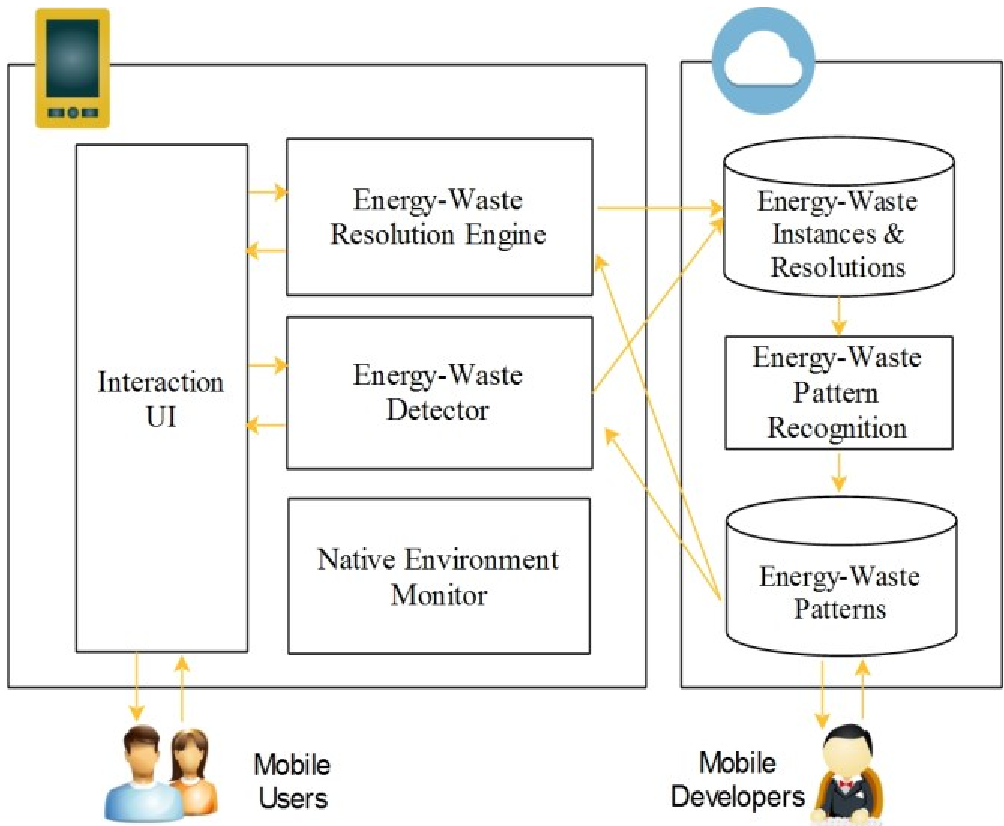
The framework operates as a collaboration between a mobile client and a cloud-based backend.
1. The Detection-Notification Cycle
The system starts with coarse-grained heuristics. It monitors:
- Running modes (Foreground vs. Background)
- Sensor acquisition (GPS, Accelerometer)
- Energy consumption trends per app
If an app behaves suspiciously (e.g., backgrounded but still draining high power without releasing sensors), the system generates a warning.
2. Reducing User Fatigue: Selected Notification
A core innovation is how they handle "False Positives." To avoid annoying users with incorrect warnings, the backend uses a Selected Notification strategy:
- It waits until a specific warning reaches a threshold (e.g., 100 users).
- It only notifies 10% of those users initially.
- Only if that subset confirms the energy waste does the system notify the remaining 90%.
3. Knowledge Extraction
Once confirmed, these instances are uploaded to the cloud to extract Energy-Waste Patterns. This refined knowledge is then pushed back to users for better detection and to developers for code-level bug fixing.
Experiments & Results: Massive Efficiency Gains
The prototype, built as an Android app with an IBM Bluemix backend, underwent initial evaluations to test its real-world impact.
- Longevity: The framework demonstrated the ability to extend the lifetime of a mobile device by 30% to 70% on a single charge.
- Accuracy: By utilizing crowdsourced feedback, the system successfully filtered out legitimate background processes (like GPS), significantly reducing the false-positive rates inherent in simple heuristic-only models.
(Note: Visual evidence from the paper suggests a robust improvement in discharge curves when the resolution engine is active.)
Critical Analysis & Conclusion
The Takeaway
The true value of this work lies in its scalability. By moving the problem of energy debugging from the developer's lab to the user's pocket, it creates a self-improving ecosystem. it effectively turns "user frustration" into "diagnostic data."
Limitations & Future Work
While impressive, the framework still relies on user manual confirmation, which can be a point of friction. Future versions could benefit from:
- Automated Pattern Mining: Using Big Data techniques to recognize patterns without explicit user prompts.
- Privacy-Preserving Crowdsourcing: Ensuring that detailed app usage data being sent to the cloud is anonymized and secure.
This research reminds us that sometimes, the best way to solve a technical bottleneck is not just a better algorithm, but a better way to harness the collective intelligence of the ecosystem itself.