
Beyond the Influencer Myth: Why Energy-Saving Information Fails to Go Viral
Energy saving information cascades in online social networks: An agent-based simulation study
This study presents an agent-based simulation model to analyze energy-saving information cascades in online social networks. Using a variance-based Global Sensitivity Analysis (GSA), the authors investigate how network density and initiator connectivity influence the depth of information diffusion, ultimately finding that these structural attributes have a surprisingly limited impact on cascade depth.
TL;DR
Despite the massive scale of modern online social networks, information regarding energy conservation rarely penetrates deeper than two or three levels of connection. This research utilizes Agent-Based Modeling and Global Sensitivity Analysis (GSA) to prove that "architectural" factors—like how many followers an initiator has or how dense a network is—matter far less than the psychological and behavioral attributes of the individual users involved.
Background & Positioning
In the quest for energy independence, behavioral change among building occupants is as critical as technological innovation. While online social networks (OSNs) are touted as the ultimate low-cost vehicle for large-scale behavioral contagion, the "Epidemic" vs. "Limited Diffusion" debate continues to divide the academic community. This paper positions itself as a quantitative arbiter, using simulation to test if the "massive structure" of OSNs actually helps energy-saving tips travel further.
The Core Motivation: The Structural Illusion
Many policymakers assume that if we simply recruit a "celebrity" or an "opinion leader" with thousands of followers, energy-saving behaviors will cascade through the network. The authors challenge this research intuition. They argue that the structural properties of online networks (low density, scale-free distribution) might actually work against the deep propagation of non-viral, "boring" but necessary information like energy conservation.
Methodology: ABM Meets Global Sensitivity Analysis
The researchers built an information cascade model where each node represents a user with specific attributes. The information flow is governed by a multi-stage logic:
- Homophily Check: Does the recipient share enough similarity with the sender?
- Social Influence (SI) Calculation: A function of the sender's influence, the recipient’s susceptibility, and the strength of their relationship.
- Threshold Triggering: If SI exceeds a specific threshold (1.825), the information passes.
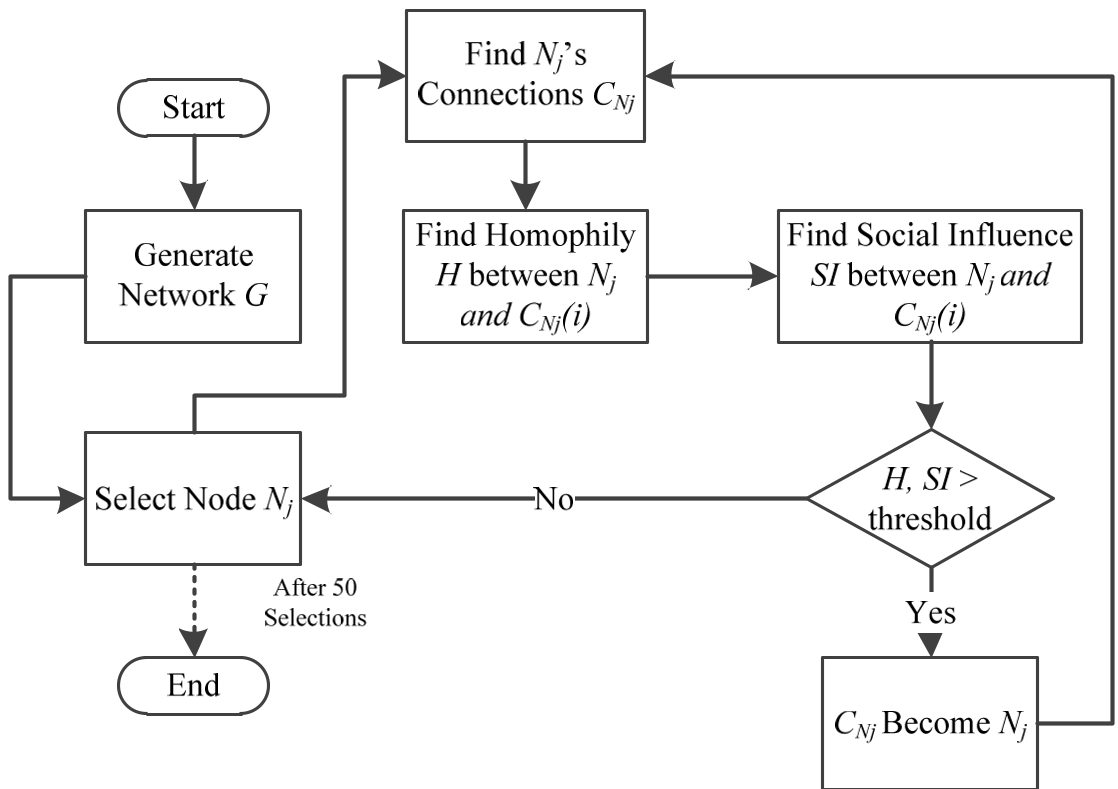
The genius of the paper lies in its use of Variance-Based Global Sensitivity Analysis (GSA). Instead of just changing one variable at a time, GSA explores the entire parameter space to see which factor actually drives the uncertainty in the results.
Experimental Results: The 10% Limitation
The results provide a sobering reality check for digital advocacy:
- The Depth Barrier: In the base model, information only traveled an average of 2.26 steps. It essentially dies out after passing from a friend to a friend-of-a-friend.
- Sensitivity Ranking: Network Density (Si < 0.015) and the number of connections of the initiator (Si ≈ 0.08) were the weakest predictors of success.
- The Real Drivers: Homophily (the degree of similarity between users) was the most influential factor, accounting for nearly 29% of the variance.
(Note: Table 2 in the paper highlights that Homophily is twice as important as Tie Strength and nearly four times as important as the number of an initiator's connections.)
Critical Insights & Conclusion
The study concludes that "Massive network structures and a large number of potential recipients do not engender deep cascades."
Key Takeaways for the Future:
- Quality over Connectivity: Governments shouldn't just look for "highly connected" users; they need "credible and passionate" communicators who share deep similarities with their target audience.
- The Content Gap: Energy-saving information lacks the inherent "stickiness" of viral media. To bridge this, the information must be made more "intriguing" to lower the social influence threshold required for transmission.
- Limitations: The study utilizes a scale-free network model (Barabási-Albert) which, while representative of many OSNs, may not capture the specific "echo chamber" dynamics of modern algorithmic feeds.
Ultimately, this research serves as a warning against "technological determinism" in social change. A bigger network doesn't mean a bigger impact—human behavioral barriers remain the bottleneck.