
Beyond Connectivity: Balancing Energy Efficiency and Social Fairness in Multi-Hop Wireless Networks
Energy and Social Cost Minimization for Data Dissemination in Wireless Networks: Centralized and Decentralized Approaches
This paper investigates multi-hop data dissemination in wireless networks, proposing both centralized (MILP) and decentralized (Game Theoretic) approaches. The core methods, MC-MRC and SV-MRC, leverage Maximal-Ratio Combining (MRC) and account for circuitry power to optimize either network energy efficiency or social cost fairness.
Executive Summary
TL;DR: This work addresses the critical challenge of efficient data dissemination in wireless networks by moving beyond simple radio-link optimization. By integrating Maximal-Ratio Combining (MRC) and a realistic circuitry power model, the authors propose a game-theoretic framework that minimizes either total network power or the "social cost" incurred by nodes requiring incentives.
Positioning: This paper acts as a bridge between pure communication theory and multi-agent systems, shifting from centralized "ready-to-collaborate" models to decentralized, incentive-compatible architectures suitable for the IoT and 5G era.
The "Circuitry" Blind Spot: Motivation
Most classical algorithms, such as Broadcast Incremental Power (BIP), focus exclusively on the radio link power—the energy needed to push a signal through the air. However, in modern micro-sensors and IoT devices, the circuitry power (energy for mixers, DACs, and signal processing) is often comparable to, or even exceeds, the transmission power.
Furthermore, in human-centric networks, nodes are "selfish." They won't re-transmit data unless they receive a fair incentive. This paper tackles the dual problem: How to minimize energy when everyone cooperates, and how to minimize costs when nodes demand payment?
Methodology: The Power of MRC and Game Theory
The authors propose a breakthrough by allowing receivers to combine signals from multiple transmitters using MRC. This is not just a hardware trick; it changes the underlying optimization logic.
1. The Cost-Sharing Game (CSG)
The problem is modeled as a non-cooperative game where every receiving node (player) chooses its Parent Nodes (PNs).
- Marginal Contribution (MC): Used for energy minimization. A node's cost reflects the actual power it imposes on the network.
- Shapley Value (SV): Used for social fairness. It ensures that the fixed costs (circuitry) and variable costs (radio link) are distributed fairly among all nodes benefiting from a multicast transmission.
2. Physical Intuition of the Model
Unlike standard models, here, receiving from multiple parents costs more in terms of "reception circuitry power" because the node stays active over more time-slots. This creates a natural "tension" in the optimization: MRC reduces transmission power but increases reception power.
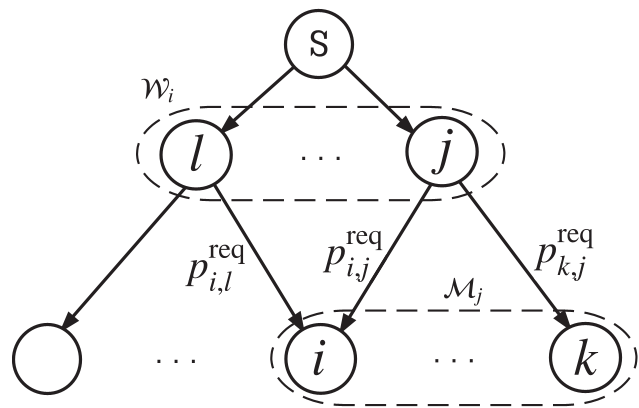 The transmission flow forms a Directed Acyclic Graph (DAG), ensuring data travels from the source to all nodes without loops.
Experiments and Results
The authors compared their decentralized game-theoretic approach against GreedyMRC (a centralized benchmark) and a global optimum derived via Mixed-Integer Linear Programming (MILP).
Key Findings:
- Circuitry Awareness: When circuitry power is high (100mW), the proposed algorithm drastically outperforms GreedyMRC because it avoids unnecessary hops that would trigger high circuitry overhead.
- The MRC Advantage: In low-power IoT scenarios, MRC allows nodes to reach the SNR threshold by combining weak signals, saving up to 20% total energy compared to single-parent (OPN) approaches.
- Convergence: Despite the decentralized nature, the game consistently converges to a stable Nash Equilibrium, proving its practicality for real-world deployment.
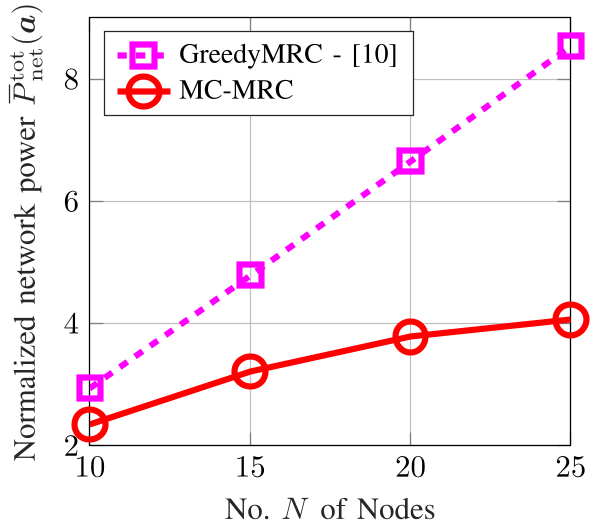 Comparison showing the impact of circuitry power on network energy consumption across different node densities.
Critical Insight & Conclusion
Takeaway: The "fairness" of the Shapley Value isn't just a philosophical choice; it provides a mathematically robust way to ensure node participation in selfish environments. The paper's most significant contribution is proving that social cost minimization is mathematically equivalent to network transmit power minimization under budget-balanced schemes.
Limitations: The model assumes a scheduled, interference-free environment (TDMA-like). In highly congested unlicensed spectrums, the impact of interference could complicate the potential game formulation.
Future Work: This framework opens doors for applying Cryptocurrencies (Virtual Tokens) to automate these payments in a trustless, decentralized ad-hoc network.