
Beyond "Friends Only": Semantic and Semi-Decentralized Access Control in Social Networks
Enforcing access control in Web-based social networks
This paper proposes a rule-based access control mechanism for Web-based social networks (WBSNs) that utilizes relationship type, path depth, and trust levels to specify access policies. It introduces a semi-decentralized architecture where access control enforcement is performed client-side and verified via double-signed relationship certificates.
TL;DR
This seminal work addresses the lack of granularity in social network security. It replaces the "all-or-nothing" friendship model with a sophisticated system that evaluates the type, depth, and trustworthiness of social links. By moving enforcement to the client-side and using a semi-decentralized certificate architecture, it shifts power from the platform back to the user.
Context & Positioning
Published during the rise of giants like Facebook and LinkedIn, this paper recognized early on that centralized Social Network Management Systems (SNMSs) are a privacy bottleneck. In the academic landscape, this work bridges the gap between Trust Management Systems (like PolicyMaker) and the Semantic Web, specifically leveraging FOAF (Friend of a Friend) structures to build a verifiable web of trust.
The Core Problem: The Flexibility-Privacy Paradox
Existing WBSNs (as of the study) suffered from two major flaws:
- Rigidity: You couldn't say "allow access to friends-of-friends, but only if they are colleagues and I trust them at level 0.8."
- Opacity: Centralized servers handle all permissions. If the server is compromised or the provider is malicious (e.g., the Facebook Beacon controversy mentioned in the text), the user has no recourse.
Methodology: How it Works
The system treats the social network as a directed labeled graph .
1. Relationship-Based Policies
The authors define Access Conditions (AC) as a tuple: .
- Example: To see my private photos, you must be connected to Me () via a Friend () relationship, at most 2 hops away (), with a trust score of 0.9 ().
2. Semi-Decentralized Enforcement
Unlike OAuth where a server says "Yes," here the Requestor must provide a Proof.
- Step 1: Requestor asks the Certificate Server (CS) for the shortest certificate paths.
- Step 2: CS returns signed certificates (verifying the path exists).
- Step 3: Requestor uses a reasoner (Cwm) to generate a formal proof.
- Step 4: Resource Owner verifies the proof and the signatures.
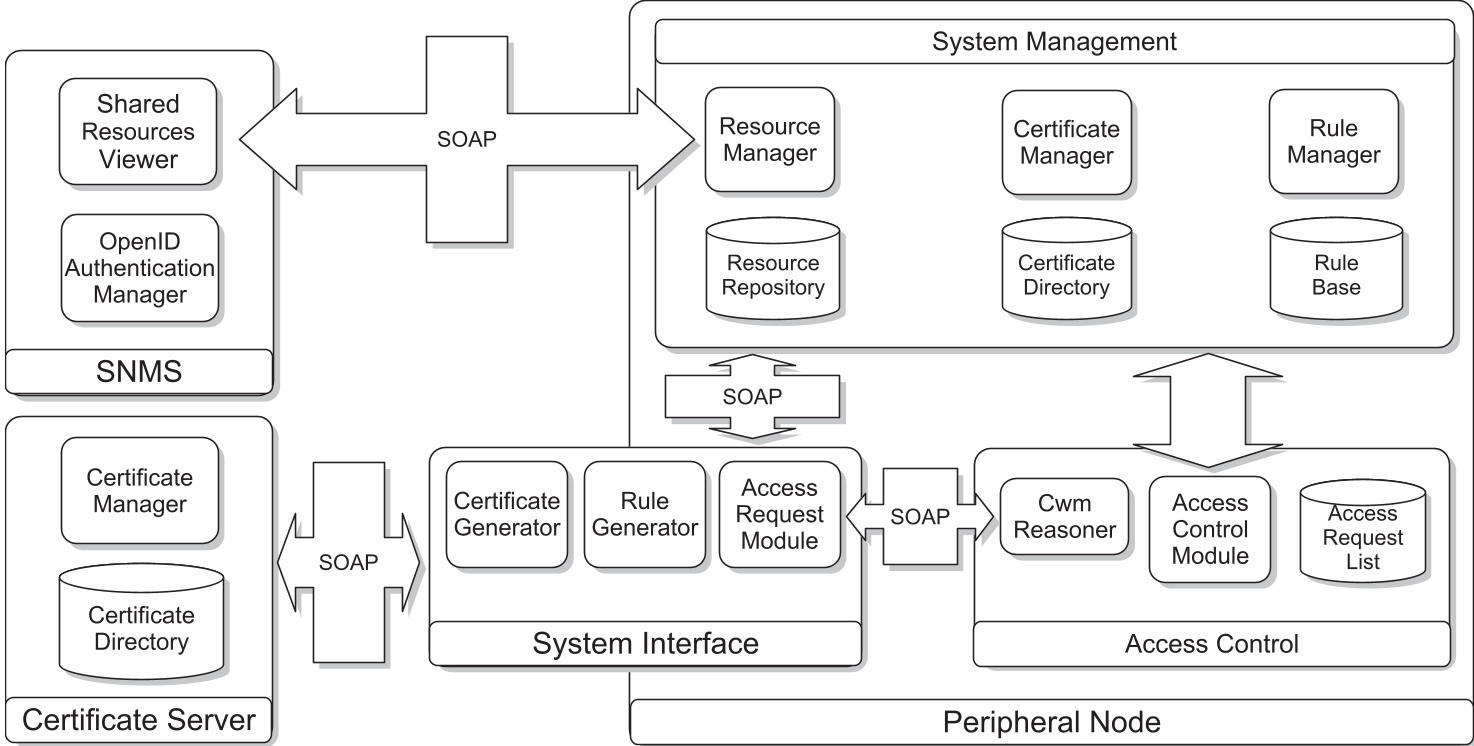 Figure 1: The semi-decentralized architecture showing the interaction between the Certificate Server, SNMS, and peripheral nodes.
3. Trust Calculation
Trust is not just a direct value; it is transitive. The authors use a recursive formula to calculate trust across paths, ensuring that "stronger" paths define the maximum possible trust threshold, preventing attackers from cherry-picking weak links to gain access.
Experimental Validation
The authors tested their prototype, ACSoNet, to ensure that the burden of client-side reasoning doesn't ruin the user experience.
| Task | Scale/Complexity | Performance |
|---|---|---|
| Path Discovery | 6,000 nodes | ~1.0 second |
| Assertion Gen | 100,000 certs | ~0.2 seconds |
| Proof Validation | 10 conditions | ~1.0 second |
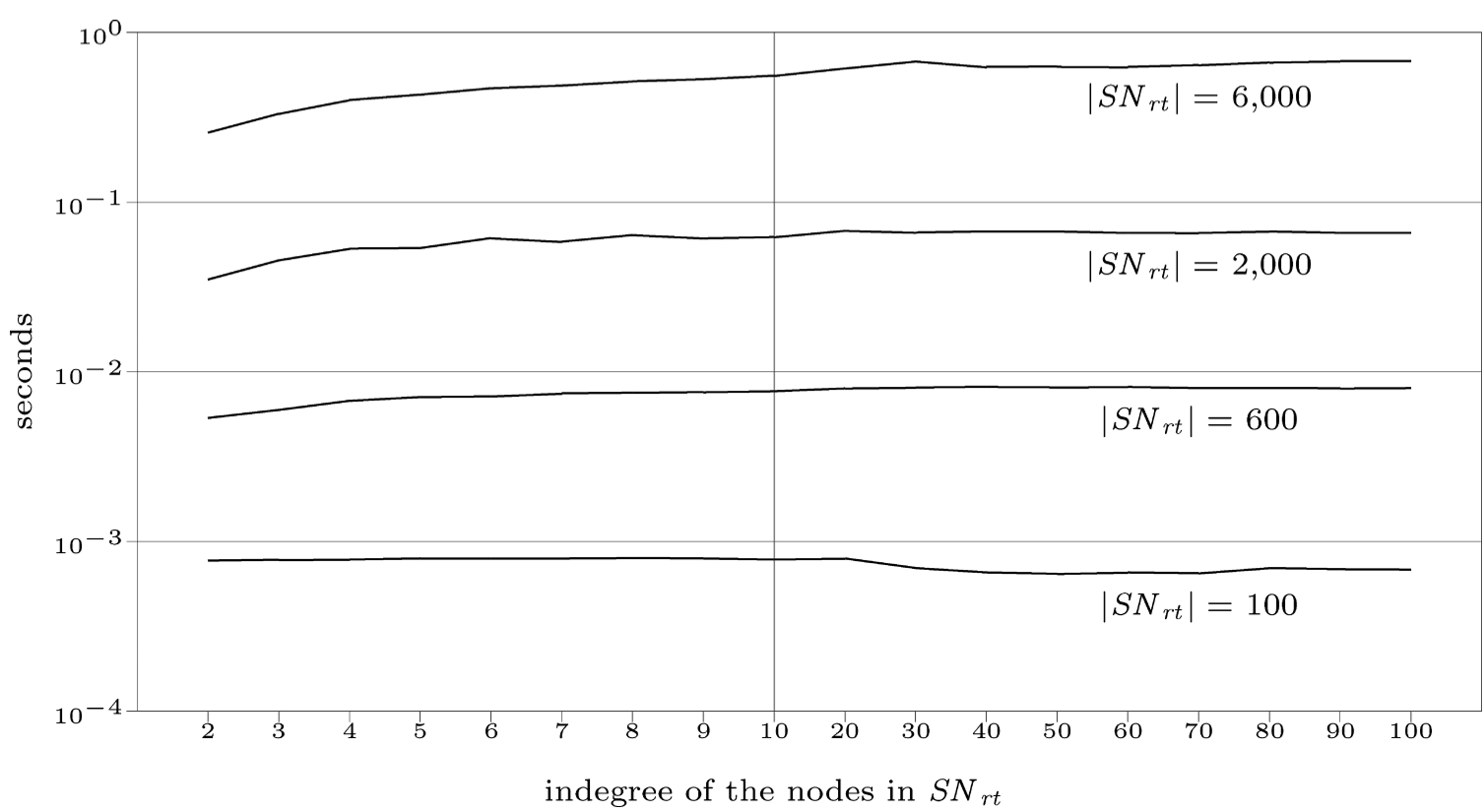 Figure 2: Performance of certificate path discovery relative to the number of nodes.
Critical Insight & Analysis
The "Semi" in semi-decentralized is the most critical design choice. A fully decentralized system (P2P) would make searching for paths across millions of users computationally impossible for a mobile or web client. By using a Certificate Server, the authors keep the heavy graph-traversal search centralized while keeping the authority (the keys and the decision-logic) in the hands of the users.
Limitations
- Trust Dynamics: The model assumes trust is relatively static. In real social networks, trust decays or changes rapidly.
- Certificate Revocation: Managing a Certificate Revocation List (CRL) in a decentralized environment remains a classic "hard problem" that still relies on the CS being online.
Conclusion
This work was ahead of its time, pre-dating the modern "Self-Sovereign Identity" (SSI) movement. It proves that we don't have to trade privacy for functionality in social networks. By using Semantic Web logic, we can create a machine-readable, verifiable, and highly granular security layer for the social internet.