
Beyond the Feed: Why Your Facebook Habits Follow a U-Shaped Curve for Well-being
Engagement and Well-being on Social Network Sites
2015-02-24
Summary
Problem
Method
Results
Takeaways
Abstract
This research investigates the complex relationship between Social Network Site (SNS) engagement and psychological well-being (vitality). By utilizing a survey of 289 Facebook users, the study introduces "Mindfulness" and "Content Production" as dual lenses to explain contradictory findings in previous social computing literature, identifying a non-linear relationship between usage and mental health.
## TL;DR
Does spending time on Facebook make you happier or more stressed? According to A.K.M. Najmul Islam and Sameer Patil, the answer isn't a simple "yes" or "no"—it’s a curve. By distinguishing between **Mindless Use** (habitual scrolling) and **Content Production** (active posting), this study reveals that while active participation boosts your mood, mindless scrolling only helps up to a point before it starts dragging you down.
**Academic Positioning**: This work serves as a critical "theoretical bridge" in the CSCW community, reconciling years of conflicting data regarding the psychological impact of Social Network Sites (SNS).
## Problem & Motivation: The Linear Fallacy
For years, the academic world has been divided. Early studies suggested Facebook increased social capital and life satisfaction, while later research (e.g., Kross et al., 2013) linked it to declines in subjective well-being.
The authors identified two major flaws in these prior works:
1. **Metric Oversimplification**: Judging "usage" solely by hours spent online ignores *how* the user is engaged.
2. **The Linear Assumption**: Researchers assumed that "more use" either always meant "better" or "worse," failing to account for the possibility of an optimal "sweet spot."
## Methodology: Measuring the Mind and the Act
The researchers surveyed 289 Facebook users in Finland, focusing on three core constructs:
* **Facebook Vitality**: The feeling of being "alive" and "energetic" during use.
* **Mindless Facebook Use**: "Running on automatic," where users check updates without conscious awareness.
* **Content Production**: Active behaviors like updating statuses, tagging photos, and commenting.
They also looked at **Number of Friends** as a potential stressor (the "Information Overload" and "Context Collapse" factors).
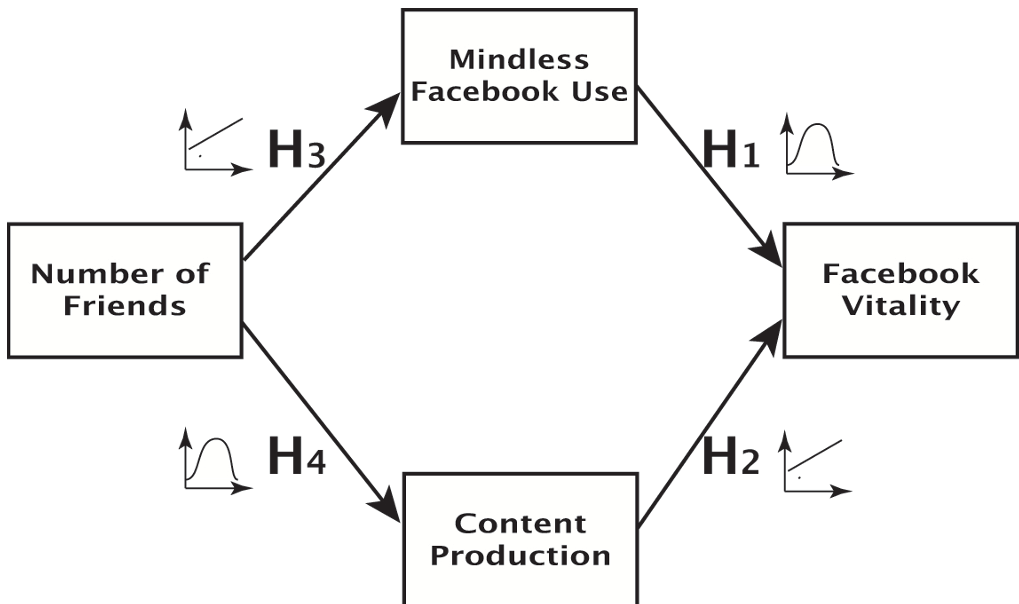
*Figure 1: The hypothesized relationships between SNS User Engagement, Well-being, and Number of Friends.*
## Key Insights: The Anatomy of an Inverted U
Using Ordinary Least Squares (OLS) regression, the study uncovered several groundbreaking patterns:
### 1. The Paradox of Mindlessness
The relationship between Mindless Use and Vitality is an **Inverted U**.
* **The Rise**: Initially, habitual use actually *increases* vitality. Why? Because routine tasks require little mental effort, "freshening" the mind and keeping cognitive resources free.
* **The Fall**: Once mindless use crosses a threshold, it becomes a burden. Users lose interest, feel "drained," and their psychological vitality drops.
### 2. Content is King (But Friends are a Double-Edged Sword)
Active Content Production (posting/liking) has a **linear positive** relationship with well-being. Getting "likes" and comments validates the user and boosts self-esteem.
However, the **Number of Friends** acts as a constraint. As your friend count increases, your content production initially goes up, then crashes.
* **Context Collapse**: When you have too many "friends" (bosses, parents, old classmates), you self-censor more and post less to avoid social friction.
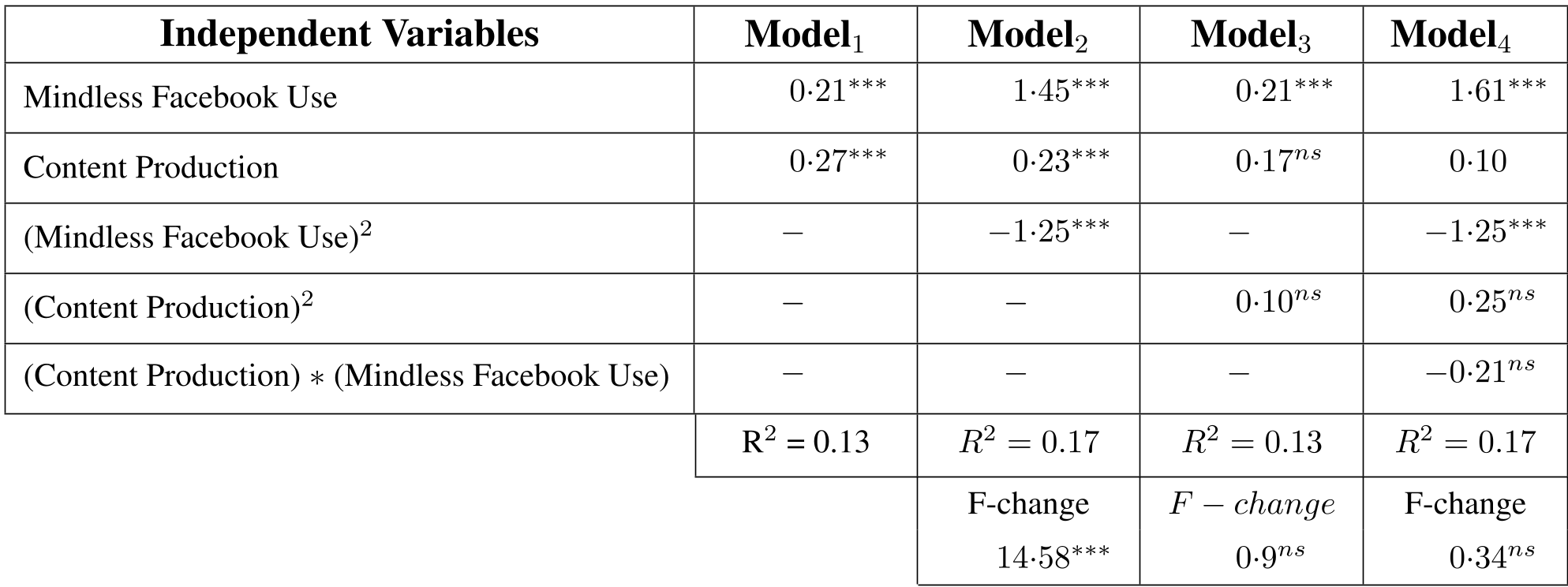
*Table 4: Statistical validation showing Model 2 (the quadratic/U-shaped model) as the best fit for vitality.*
## Critical Analysis & Conclusion
This paper provides a sophisticated framework for understanding our digital lives. It tells us that **the middle ground is the healthiest.**
* **Practical Implications**: For social media designers, this suggests a move away from "infinite scroll" mechanics that encourage excessive mindless use. Instead, platforms should use ML to detect when a user is slipping into a "low vitality" zone and suggest they take a break or engage in more mindful activities.
* **Limitations**: The study is based on self-reported data from a specific demographic (Finnish students). Future research needs to see if these "U-curves" hold true across different cultures and age groups (e.g., the elderly).
**The Takeaway**: To maximize your well-being on social media, be an active producer rather than a passive consumer, and mind your friend count—more isn't always merrier.