
Beyond Passive Viewing: How Social Film-Making Decodes Complex STEM Concepts
Engaging students in creative learning tasks with social networks and video-based learning
This paper presents an integrated educational framework combining Video-based Learning and Computer Supported Collaborative Learning (CSCL) through a dedicated social network platform. The study demonstrates how collaborative film-making on a customized social network facilitates the mastery of "threshold concepts" (TCs) in STEM subjects.
TL;DR
Videos are a staple of modern education, but watching a video isn't the same as understanding a concept. This research introduces a social-network-based approach where students don't just watch videos—they create them. By collaborating on films that explain "Threshold Concepts" through real-world analogies, students move from passive consumption to deep, reflective mastery of abstract engineering principles.
Background: The Problem of "Troublesome Knowledge"
In STEM education, students often hit a wall called Threshold Concepts (TCs). These are ideas—like Inheritance in Object-Oriented Programming—that are difficult to grasp initially but "transform" a student's understanding once mastered.
The authors argue that two current trends are failing to help:
- Passive Video Learning: Platforms like Khan Academy are great, but the student remains a spectator.
- Generic Social Networks: Using Facebook or Twitter for class often results in "social noise" rather than academic signal.
Methodology: The Three Dimensions of Social Learning
To bridge this gap, the researchers built a platform designed around three core interactions:
- Transmit: Students educate and inspire peers via video sharing.
- Collaborate: Private group workspaces for script design and creative decision-making.
- Receive: Knowledge gain through viewing, peer-rating, and structured commenting.
The Platform Architecture
Built on the Elgg social engine, the platform (ClipIt) integrates tools specifically requested by teachers, such as group-private forums and file sharing.
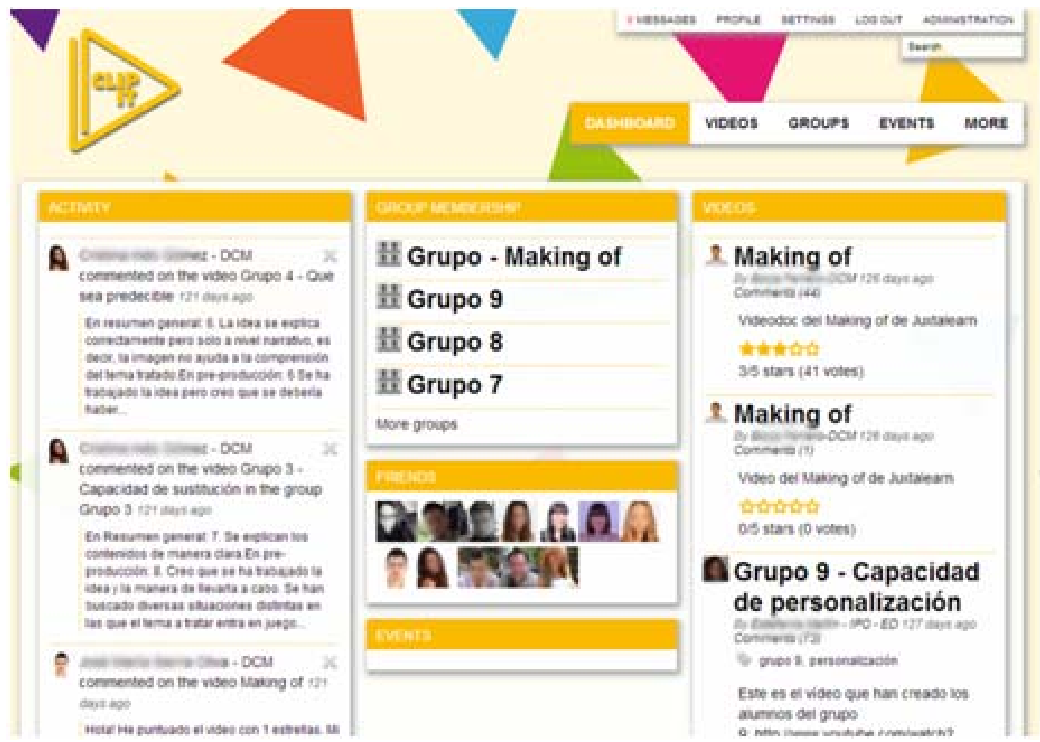 Figure 1: The ClipIt Dashboard, emphasizing the timeline, workgroups, and shared media.
The "Aha!" Moment: It’s the Script, Not the Camera
The experiment challenged Computer Science students to explain Inheritance without using a single line of code. They had to find real-world analogies (e.g., a "Vehicle" general class vs. a "Car" specialized subclass).
The results revealed a fascinating pedagogical insight: The technical act of video editing was considered minor. The real learning happened during the script design phase. To explain a concept creatively to a peer, the student must first "deconstruct" and then "reconstruct" the concept in their own mind.
Performance and Usability Analysis
The study quantified which social features actually worked in an academic setting:
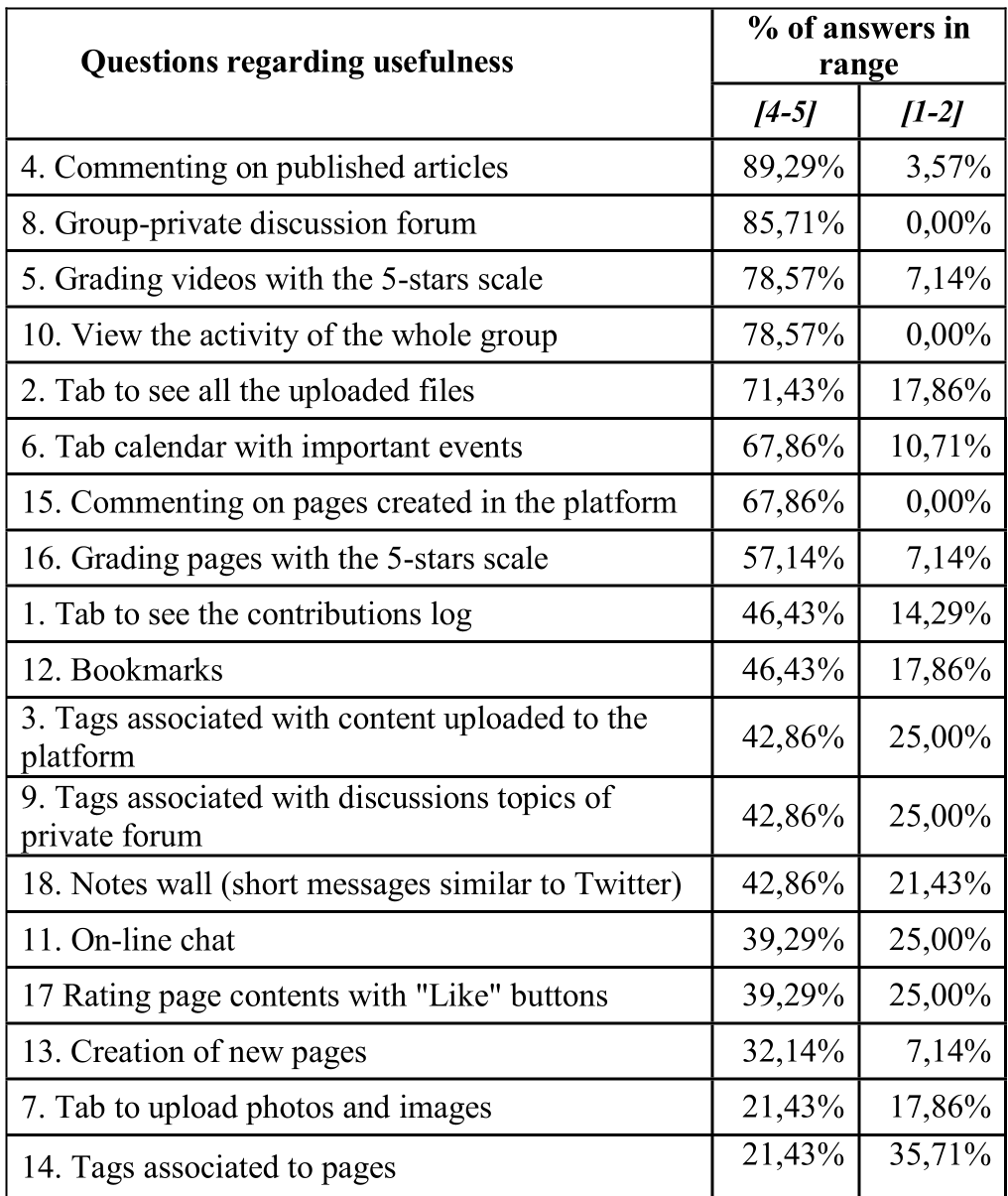 Table 1: Student ratings of platform features. Note the high value placed on commenting and private forums.
Critical Insight: Education is not Facebook
One of the most striking findings was the rejection of "Low-Stakes" social tools. While students use "Like" buttons and chats daily on personal social media, they rated them poorly for learning. Instead, they preferred:
- Five-Star Scales: They viewed this as a more "objective" measurement of quality.
- Lengthy Comments: They valued constructive feedback from peers they knew.
- Anonymity in Content, Identity in Comments: Students wanted to submit videos anonymously to reduce pressure but wanted to know exactly who was giving them feedback.
Conclusion & Future Outlook
This work demonstrates that for STEM education, the "Social" in Social Network should stand for Collaborative Construction rather than just Connectivity.
Key Takeaways for Educators:
- Restrict the Toolkit: Forcing students to avoid technical jargon (no code) forces deeper conceptual understanding.
- Focus on the Narrative: High production value is less important than a logically sound script.
- Structure the Feedback: Replace "Likes" with rubrics or multi-point scales to maintain academic rigor.
While the platform suffered from some hosting slowness, the underlying methodology—Collaborative Film-making—is a SOTA-caliber approach for turning "troublesome knowledge" into "permanent mastery."