
Engineering Social Success: How Control Theory Transforms E-Learning
Engineering Social Networks Using the Controllability Approach Applied to E-learning
The paper introduces a "social network engineering" approach for E-Learning in industrial settings, leveraging control theory and bipartite graph matching. By strategically matching trainees to tutors based on weighted affiliations, the method optimizes communication networks to significantly enhance learning outcomes.
TL;DR
In industrial E-Learning, who you learn with is as important as what you learn. This paper treats a social network as a controllable system, using bipartite graph matching and weighted affiliations (like language and industry sector) to group trainees with the right tutors. The result? A significant jump in average test scores (from 81% to 88%) and a drastic reduction in student failure rates.
Background: Does Your Position in a Network Determine Your Grade?
Previous research has shown a stark reality: trainees who are "isolated" in the communication network—meaning they have a low node degree or zero communication with tutors—are almost guaranteed to perform poorly. In a setup where students are randomly assigned to groups, these "problematic nodes" are hard to predict and even harder to save once the course has started.
The author's insight is to treat the E-Learning participant pool not as a list of names, but as an affiliation network that can be engineered.
The Core Logic: Controllability and Matching
The paper borrows from Control Theory, which defines a system as "controllable" if you can move it from an initial state to a desired target state via external inputs. In this context:
- Initial State: A group of unassigned, potentially isolated trainees.
- Target State: An efficient communication network where every trainee is actively engaged and scoring >75%.
- Input/Mechanism: A Maximum Matching Algorithm applied to a bipartite graph.
The "Star" Topology
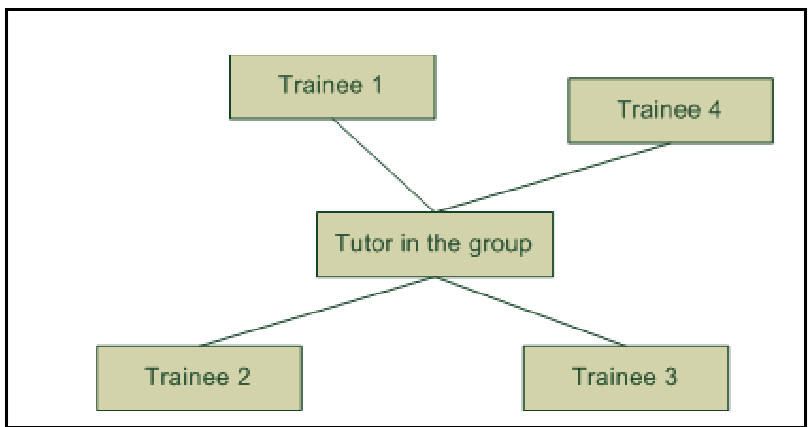
To ensure every student is reached, the system creates a "star" structure. Each tutored group is centered around a tutor who acts as a "driver node," facilitating information flow to all connected trainees.
Methodology: The Weighted Concordance Algorithm
The "engineering" happens through a 5-step matching process. Not all connections are equal; the paper identifies that Language is the strongest predictor of success, followed by Business Branch expertise.
- Weights: Language (10), Business Branch (2), Country (1), Organization (1).
- Concordance (): Calculated by multiplying the number of shared attributes by the category weight.
- Optimization: Trainees are assigned to the tutor with the highest total score, provided the tutor has not hit the "saturation" limit of 20 participants.
The mathematical intuition is simple: . By maximizing this value across the network, we ensure the "impedance" of communication is minimized.
Experimental Results: Efficiency vs. Effort
The results from the railway industry (including companies like OBB and RailCargo Austria) prove that structure beats raw effort.
| Method | Time Period | Avg. Score | Failure Rate (<75%) |
|---|---|---|---|
| No Tutoring | 2009 | 55% | N/A |
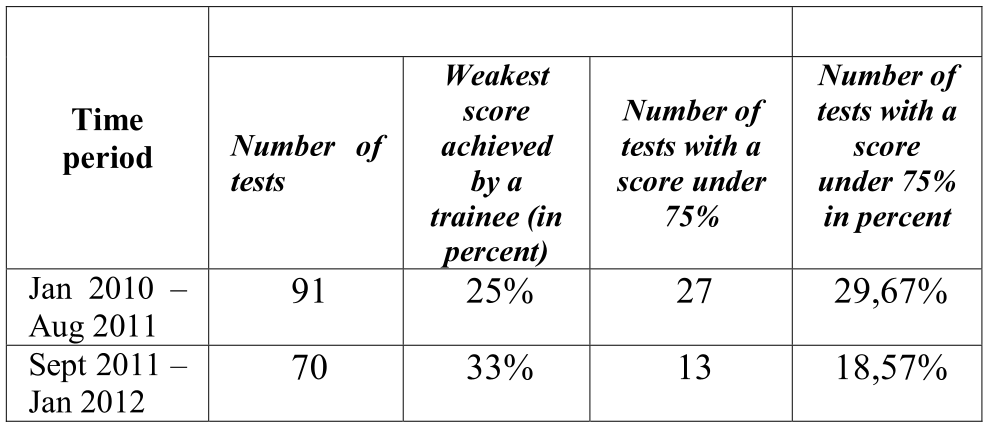
| Random Tutoring | 2010-2011 | 81% | 29.67% |
| Engineered Matching | 2011-2012 | 88% | 18.57% |
The "Efficiency Paradox"
An unexpected finding was that while test scores went up, the number of individual communication attempts (emails, forum posts) went down (from 1.8 to 0.5 per trainee).
Why? Because the matching was so effective that a single forum post by one trainee was relevant to the entire concordant group. The tutor's feedback benefited everyone simultaneously, proving that a well-engineered network is more efficient than a high-traffic, chaotic one.
Critical Insight: The Future of Cognitive Engineering
This work demonstrates that social networks in E-Learning aren't just "organic" social structures; they are technical systems that can be optimized using classical engineering principles.
Limitations: The current model uses a static weighted system based on historical Pearson correlation coefficients. As industrial sectors evolve, these weights (e.g., the importance of geographical location vs. language) may shift.
Takeaway: For L&D professionals and AI-driven education platforms, the message is clear: Stop focusing only on the content, and start engineering the context. By optimizing the "controllability" of the social graph, you can improve outcomes without increasing the tutor's workload.