
Engineering Socially-Aware Systems: Beyond Simple Proximity
Engineering Socially-Aware Systems and Applications
The paper proposes a comprehensive software engineering framework and supporting infrastructure (SocioPlatform) for developing "Socially-Aware Systems." It introduces a methodological process covering requirements to implementation, enabling applications to adapt behavior based on complex human social contexts like relationships, roles, and situations.
TL;DR
Modern pervasive applications need to understand not just where you are, but who you are with and what your relationship is to them. This paper introduces a structured software engineering process and a supporting middleware platform (SocioPlatform) that uses specialized ontologies to model social context. By decoupling social logic from the application code, the authors reduced development effort (LOC) by over 60% and achieved zero-code maintenance for context updates.
The Problem: Social is not just "Another Context"
For years, "context-aware" computing has been synonymous with GPS coordinates and timestamps. However, humans operate in a social milieu. Improving a user's experience requires understanding social roles (e.g., "Supervisor" vs. "Friend") and interaction constraints (e.g., "Do not interrupt during a meeting unless it's family").
The difficulty lies in the fact that social data is:
- Fragmented: Spread across Facebook, LinkedIn, and private calendars.
- Semantic: Requires reasoning (e.g., "Parent" + "Child" = Family relationship).
- Dynamic: Relationships and interaction "contracts" change at runtime (e.g., a new vehicle joining a convoy).
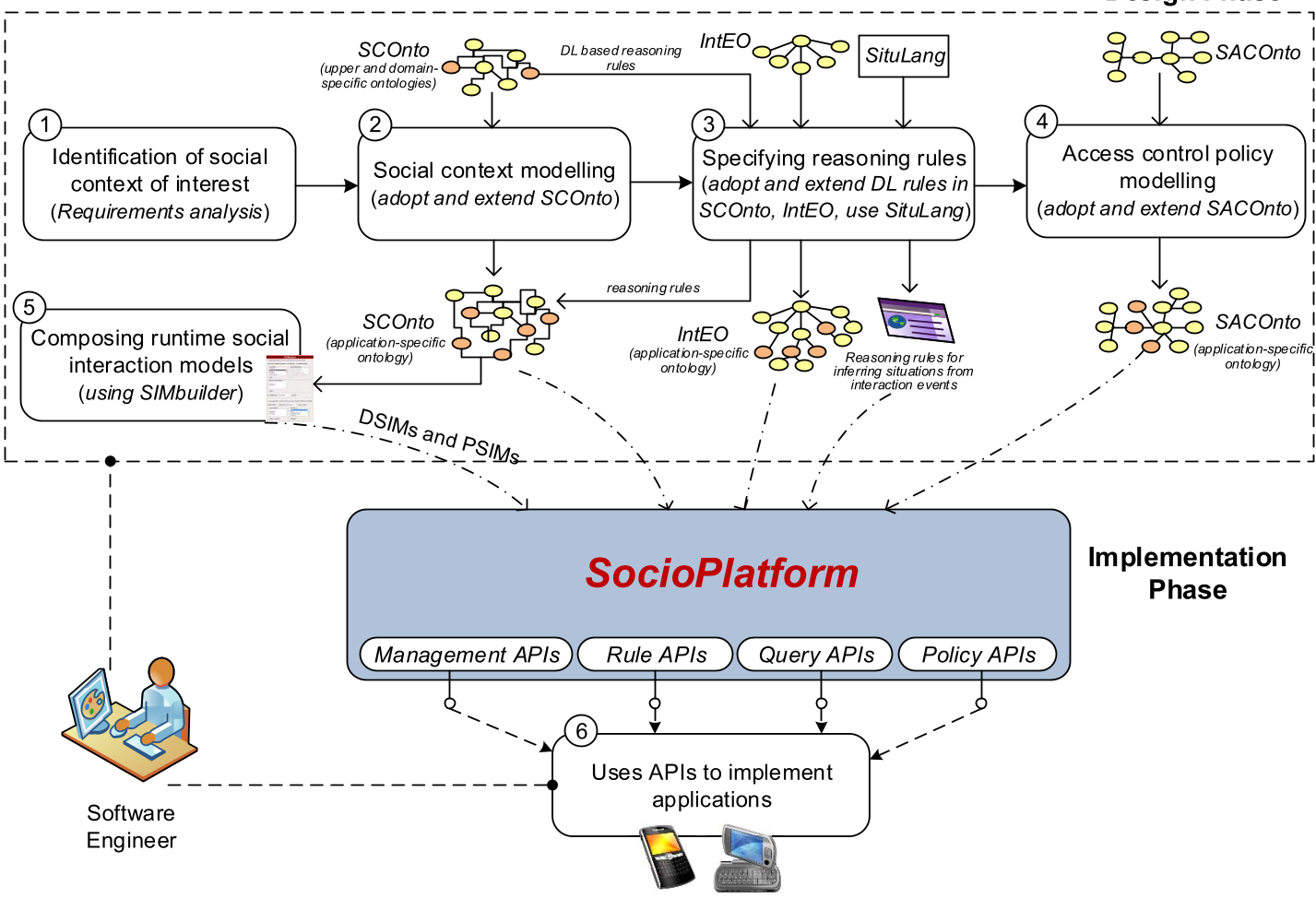
Methodology: Ontologies and Interaction Models
The authors solve these challenges through a two-pronged architectural approach:
1. Data-Centric Social Awareness (SCOnto & IntEO)
They use Upper Ontologies to provide a standard vocabulary for social settings.
- SCOnto: Models connection-oriented relationships (who knows whom).
- IntEO: Models interaction events to infer situations (e.g., if you post about "Food" during "Lunch" time, you are likely "Hungry").
- SACOnto: A privacy-preserving layer that allows users to control information granularity (e.g., "Friends see my location, but my Boss only sees my 'Busy' status").
2. Interaction-Centric Dynamics (DSIM & PSIM)
For collaborative tasks, the paper introduces two specific models:
- DSIM (Domain-centric): Defines the global "rules of the game" for a group (e.g., how a vehicle convoy acts).
- PSIM (Player-centric): Defines an individual's view and coordination across multiple social groups.
Case Study & Evidence
The paper validates the approach through two distinct applications:
- SPCall (Smart Phone Call): An app that filters calls based on the caller's relationship and the callee's current social situation.
- SocioTelematics: A system for autonomous vehicle convoys where drivers form "social" agreements for safety and coordination.
Performance Metrics
The results from a study of eight software engineers are striking:
| Metric | Traditional Approach | This Framework |
|---|---|---|
| Total LOC (SPCall) | 2,374 | 792 |
| LOC to Add New Context | 374 | 0 |
| LOC to Remove Context | 436 | 0 |
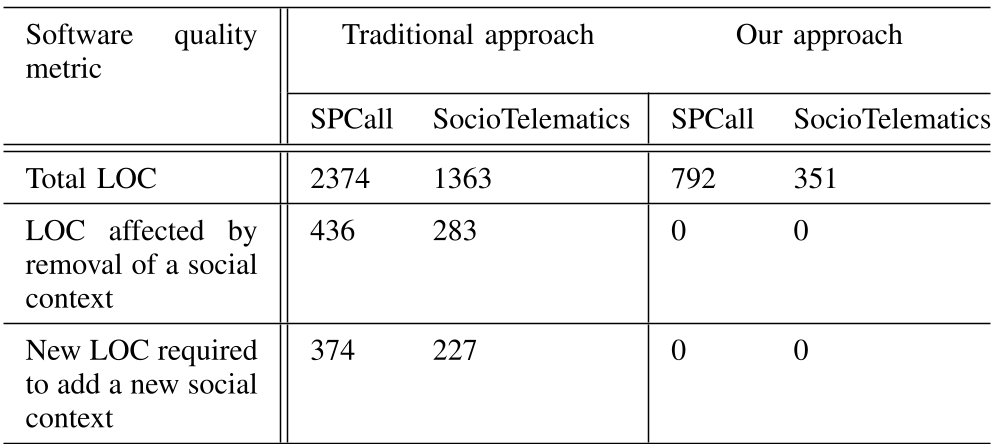
The 0 LOC requirement for modifying contexts proves that the ontology-driven middleware effectively "externalizes" social logic, allowing for highly evolvable systems.
Critical Insight: The "Safe Change" Principle
A standout contribution is the mechanism for Safe Runtime Adaptation. In collaborative systems like the SocioTelematics convoy, changing the "contract" while players are interacting can cause system crashes or logic errors. The authors demonstrate a state-managed adaptation process where entities must be in an IDLE state before a new social model is hot-swapped into the runtime.
Conclusion
This work transitions social-awareness from "ad-hoc" code hacks to a disciplined software engineering field. While the focus on ontologies provides great semantic power, future work must address the usability of these modeling tools and the challenges of testing such highly dynamic, non-deterministic social systems.