
AppCivist-PB: Engineering the Digital Town Hall for Large-Scale Democracy
Engineering Software Assemblies for Participatory Democracy: The Participatory Budgeting Use Case
The paper introduces AppCivist-PB, a service-oriented software platform designed to facilitate Participatory Budgeting (PB) at an urban scale. By leveraging a middleware-based approach to compose both "citizen assemblies" and "software assemblies," the system enables residents to collaboratively brainstorm, develop, and vote on municipal budget allocations through a unified digital environment.
TL;DR
AppCivist-PB is a middleware platform that enables city residents to self-organize into Citizen Assemblies and build custom Software Assemblies. By composing services like collaborative text editing, deliberation, and advanced voting, it allows thousands of citizens to participate in Participatory Budgeting (PB)—the process of deciding how municipal funds are spent—overcoming the scale limitations of traditional face-to-face assemblies.
The "Passive Citizen" Problem
Most modern democracies rely on representative systems, which often relegate citizens to a passive role (voting once every few years). While direct democracy is the ideal, it doesn't scale well; you can't fit a million people into a town hall.
Current "Civic Tech" solutions suffer from fragmentation. Some tools handle voting, others handle discussion, but almost none support the "messy middle" of democracy: the collaborative drafting and versioning of complex project proposals by non-expert citizens. Researchers James Holston, Valérie Issarny, and Cristhian Parra noticed that existing systems lacked a bottom-up approach where citizens could self-assemble based on shared interests rather than top-down government mandates.
Methodology: Composing Democracy
The core innovation of AppCivist-PB is its dual-assembly model, built on Service-Oriented Architecture (SOA).
1. Software Assemblies
Instead of building a "monolith" application, the team treated democratic functions as discrete services.
- Information Access: Map-based proposal tracking.
- Contribution Making: Real-time collaborative editing (via Etherpad integration).
- Decision Making: Configurable voting modules (Range, Ranked, etc.).
2. Citizen Assemblies
This is the "human" side of the architecture. The platform allows for the creation of Campaigns and Working Groups. For example, a group of neighbors in Paris can form an assembly to draft a proposal for a new park, version it through multiple rounds of deliberation, and then "link" their assembly to the city-wide official budget campaign.
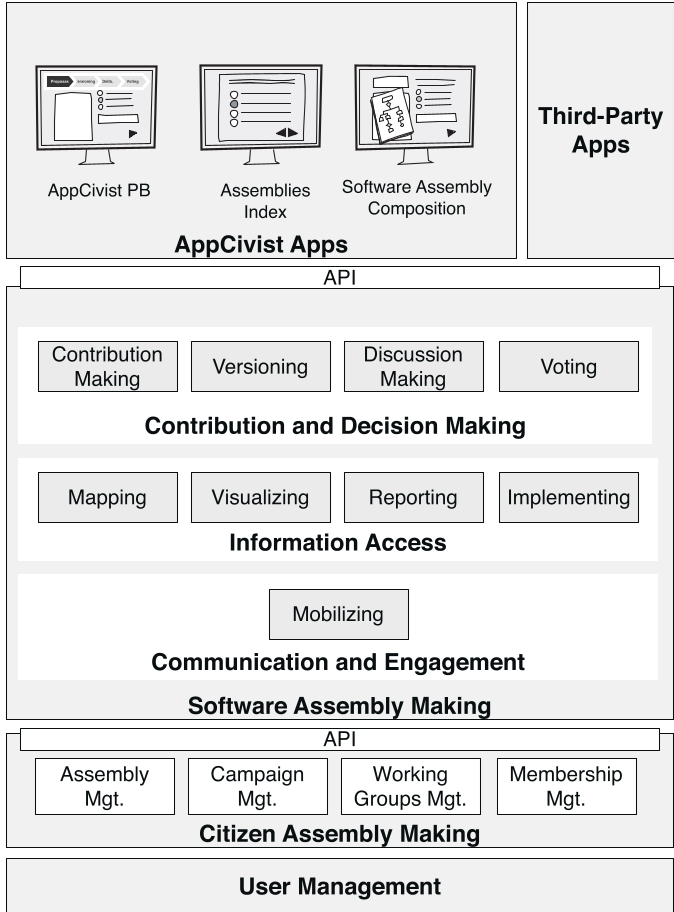 Figure 1: The composition logic of AppCivist-PB, linking high-level citizen assemblies with technical service components.
Experiments and the Paris Use Case
The researchers applied their prototype to the 2015 Paris PB campaign. The scale was massive: over 5,000 proposals were submitted by residents.
The development process highlighted a fascinating tension: Usability vs. Pedagogy.
- The Conflict: Making a platform "too easy" (one-click voting) takes away the educational aspect of democracy.
- The Solution: AppCivist-PB allows for "Fast-Track" configurations for beginners, but keeps complex options (like choosing random juries or specific delibration styles) available to help citizens "learn" how to be active participants.
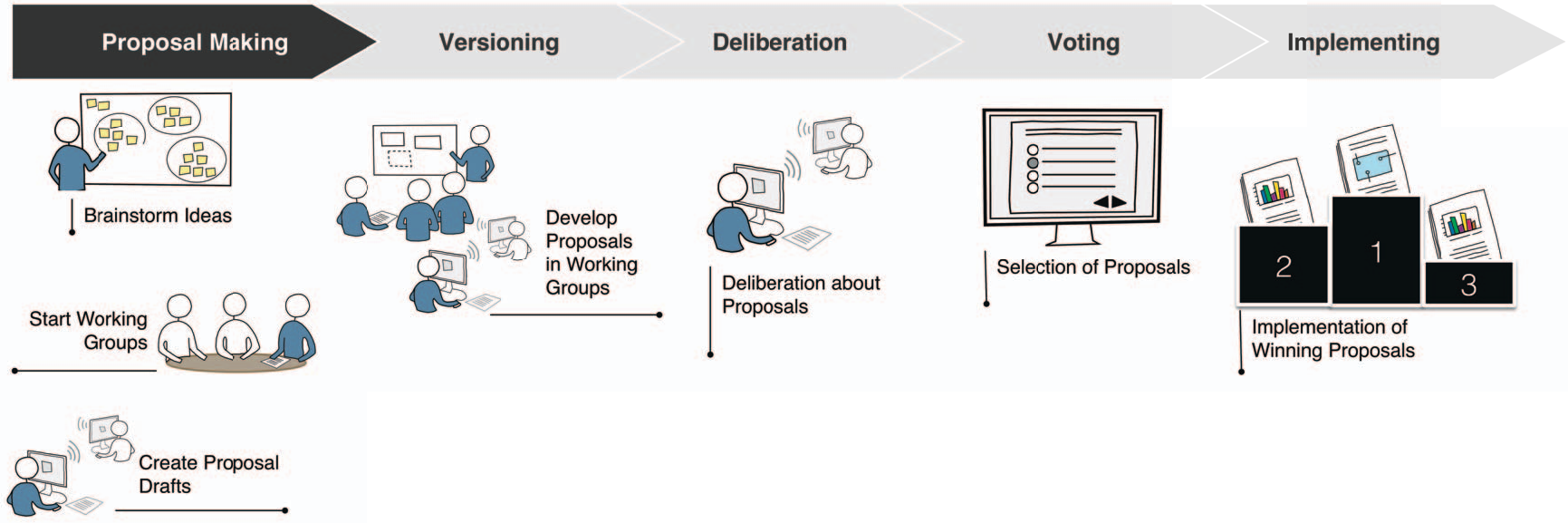 Figure 2: The PB Workflow: from brainstorming and development to technical assessment and final voting.
Critical Insight & Future Outlook
The technical achievement here isn't just a new "app," but a mediator framework. By wrapping third-party tools like Etherpad and Slack, the authors created a "meta-platform."
Limitations: The paper acknowledges that "reverse engineering" third-party APIs is difficult, as many civic tools are closed-source and lack open APIs. This creates a bottleneck for automatic service composition.
The Takeaway: AppCivist-PB proves that ICT can facilitate urban citizenship—a sense of belonging based on shared residency rather than national status. For the future of tech, this suggests that the next generation of social platforms should move away from simple "likes" and toward "structured collaboration" tools that can handle the complexity of governance.
Conclusion
As cities like Paris and Lisbon continue to expand their participatory budgets, the need for robust software assemblies will only grow. AppCivist-PB sets the stage for a world where "Software Engineering for Democracy" is as rigorous and scalable as engineering for e-commerce or social media.