
Beyond the Tweet: Boosting Sentiment Analysis with User Behavior
Enhance a Deep Neural Network Model for Twitter Sentiment Analysis by Incorporating User Behavioral Information
This paper introduces a Sentiment Analysis framework for Twitter that enhances a Convolutional Neural Network (CNN) by integrating textual word embeddings with specific user behavioral features. Evaluated on SemEval-2016 datasets, the model demonstrates that incorporating a user's historical sentiment tendencies and social activity leads to superior classification performance over text-only baselines.
TL;DR
Typical sentiment analysis models act like "blind readers"—they look only at the text of a single tweet. This paper argues that to truly understand a tweet, you must understand the author. By feeding a Convolutional Neural Network (CNN) both the tweet's text and a profile of the user’s past behavior (like their usual mood and social activity), the researchers achieved a significant performance jump, reaching 88.71% accuracy on SemEval benchmarks.
Context: The Limitations of "Text-Only" Analysis
Twitter is a challenging environment for Natural Language Processing (NLP). Tweets are short, riddled with slang, and often lack context. If a user tweets "That's just great," is it sincere or sarcastic? Traditional models (like Naive Bayes or SVM) often fail here because they lack the "big picture."
The authors' core insight is that user behavior is a strong predictor of sentiment. A user who is habitually negative or uses specific linguistic patterns (like high hashtag density) provides a context that makes the sentiment of a single tweet much easier to decode.
Methodology: Fusing Text and Metadata
The architecture proposed is a hybrid CNN designed to extract features from disparate data sources.
1. The Architecture
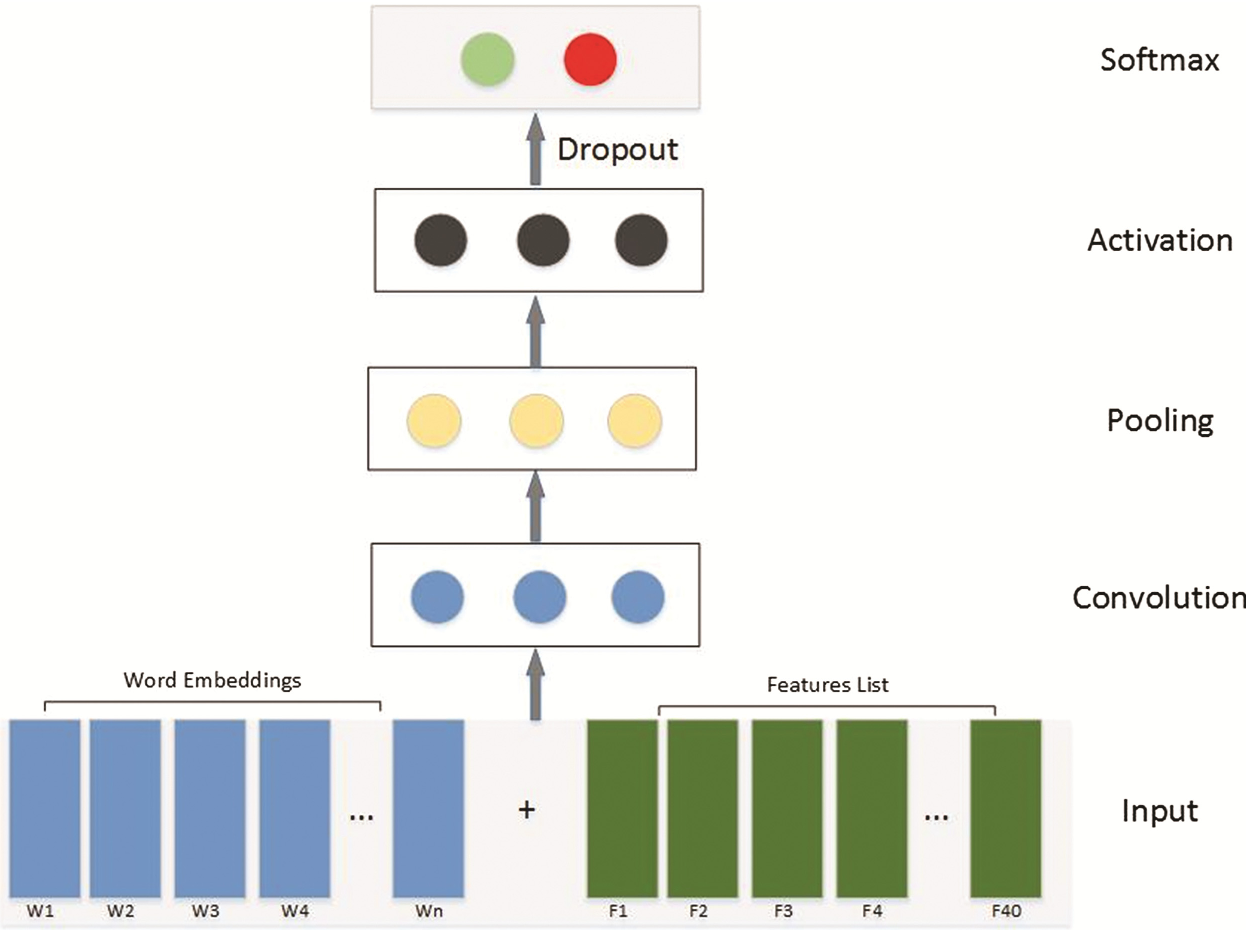
The model utilizes a standard CNN pipeline—Convolution, ReLU activation, Pooling, and Softmax—but with a unique input deck. Instead of just feeding in word vectors, the "Input Layer" is expanded to include a specialized 40-dimensional feature vector.
2. The Feature Set
The researchers extracted 40 distinct behavioral features, categorized into:
- Historical Sentiment: Using the SentiStrength algorithm to scan a user's entire timeline and calculate the probability of them having a positive, negative, or neutral attitude (Features F5-F7).
- Social Status: Counts of followers, friends, and "Verified" status.
- Linguistic Style: Frequency of adjectives, verbs, emoticons, and punctuation (exclamation/question marks).
By concatenating these features with Word2Vec embeddings, the model "knows" both what is being said and the personality of the persona saying it.
Experimental Battleground
The model was tested against Naive Bayes (NB) and Support Vector Machines (SVM) using 10-fold cross-validation on SemEval-2016 datasets.
Key Results
- Peak Performance: The CNN with user features (Set 4) reached 88.71%, consistently beating the baselines.
- Handling Imbalance: Real-world Twitter data is heavily skewed toward positive tweets. Traditional models like SVM often collapse on the minority class (Negative tweets). As seen in the figure below, the CNN maintained much higher precision and recall for negative labels.
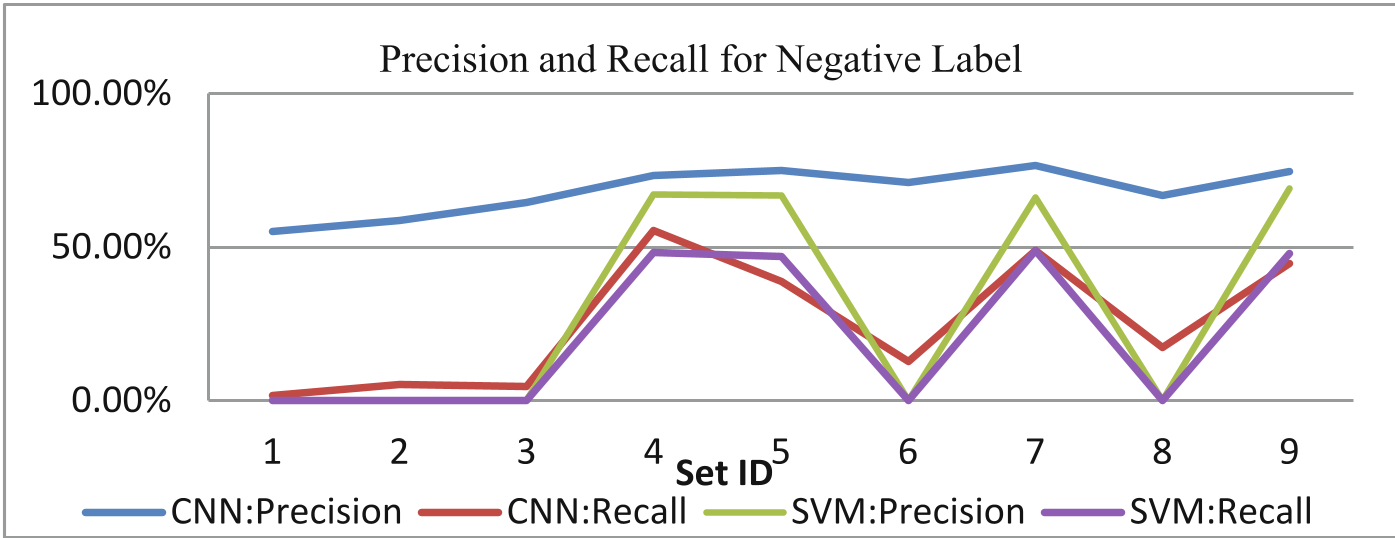
The ablation study showed that Set 4 (Word Embeddings + Historical Sentiment Probabilities) was the most effective combination. This proves that a user's "average mood" is more vital for classification than just their raw count of followers or retweets.
Critical Insight: Why This Matters
The "Deep" in this Deep Learning approach isn't just about the layers in the CNN; it's about the depth of context.
While modern LLMs like GPT-4 can often infer sentiment through sheer scale, this paper highlights a more efficient path for specialized models: Feature Engineering is not dead. By intelligently selecting metadata that correlates with human psychology (user consistency), we can build smaller, faster, and more robust models that don't rely solely on the nuances of short-form text.
Future Outlook
While this work focuses on CNNs, the logical next step is exploring LSTMs or Transformers to capture the temporal evolution of user behavior. Furthermore, applying this to non-binary sentiment (detecting sarcasm or specific emotions like "anger" vs "disgust") remains a promising frontier.