
Beyond Friendship: Enhancing Sentiment Analysis via Social Influence Analytics
Enhance sentiment analysis on social networks with social influence analytics
This paper introduces a novel approach for user-level sentiment analysis on social networks by integrating implicit "Social Influence" relationships. It proposes a Heterogeneous Influence Graph (HIG) model and utilizes a semi-supervised SampleRank algorithm to infer sentiment polarities, outperforming traditional models that rely solely on textual features or simple friendship Homophily.
TL;DR
While many AI models assume you think like your friends (Homophily), this paper proves you actually think like the people who influence you. By moving from simple friendship graphs to a Heterogeneous Influence Graph (HIG), the researchers achieved significant accuracy gains in predicting user sentiment on social media.
The "Friendship" Fallacy
In the world of Social Network Analysis (SNA), the "Homophily" principle—the idea that "birds of a feather flock together"—has been the gold standard. In sentiment analysis, this translates to the assumption that if two people are friends, they likely hold the same opinion.
However, the authors of this paper argue that this is a weak assumption. We all have friends with whom we disagree politically or artistically. The real driver of shared sentiment is Social Influence: the process where one person adapts their behavior or beliefs to another through active interaction.
Methodology: Quantifying the Intangible
The core innovation lies in how the authors turn "influence" into a mathematical feature. They move away from the static follower/friend list and look at Interpersonal Activities:
- LCS Function: Tracks if a user Likes, Comments, or Shares another's post.
- Ratio of Influence (ROI): A normalized score of how much user A interacts with user B's specific topic-related posts.
- Influence Rank (IR): A recursive algorithm (LRA-IR) that identifies "Opinion Leaders"—those who not only have many followers but whose followers are themselves influential.
The Heterogeneous Influence Graph (HIG)
The paper represents the social structure as a complex graph where nodes (Users, Posts) and edges (Friendship, Influence) have different weights.
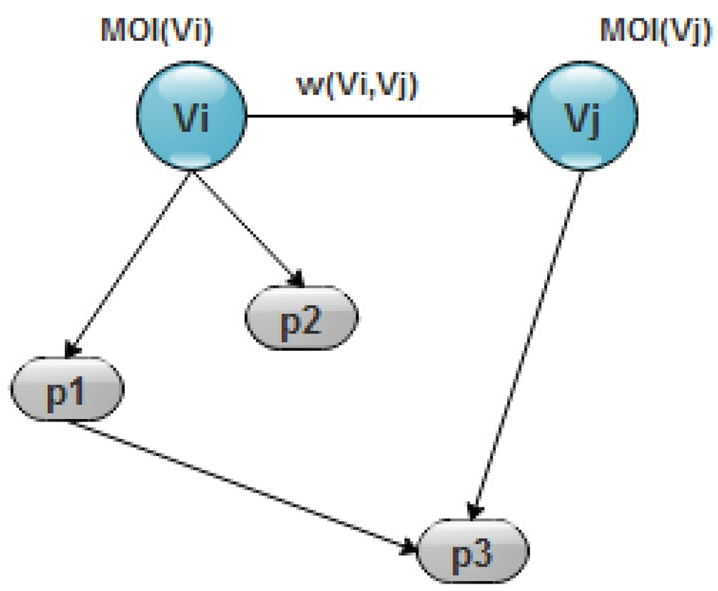 Figure 1: Illustration of a Heterogeneous Influence Graph showing the interplay between users and their topic-specific posts.
The sentiment is then predicted using a Semi-Supervised Learning paradigm. Using the SampleRank algorithm, the model learns parameters that balance two factors:
- User-Post Factor: Does the user's sentiment match their own history of posts?
- User-User Factor: Does the user conform to the sentiment of those who influence them?
Empirical Evidence: Why Influence Matters
The researchers validated their intuition through "Observational Statistics." They found that:
- The probability of an influence relationship is significantly higher if two users share the same sentiment.
- Conversely, users influenced by one another are much more likely to have the same label than random pairs.
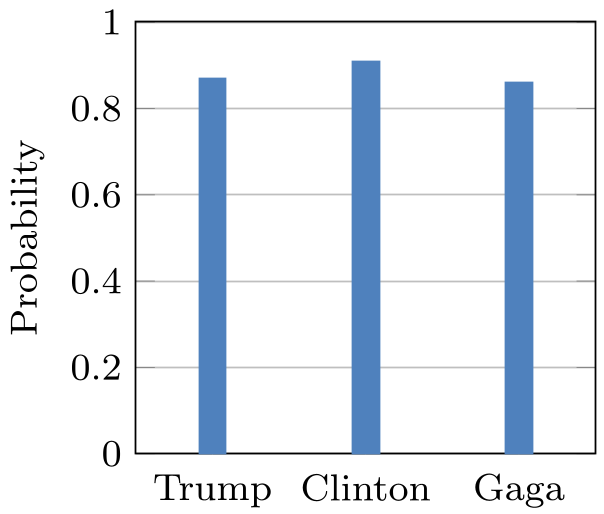 Figure 2: Probability of two users having the same sentiment label, conditioned on having an influence relationship.
Benchmarking Performance
The HIG model was tested against the standard Heterogeneous Graph (HG) baseline across three polarized topics: Trump, Clinton, and Lady Gaga.
The results were conclusive:
- Accuracy Boost: The HIG model consistently outperformed the HG model across all categories.
- F1-Score Mastery: On the "Lady Gaga" dataset, the F1-score jumped from 0.33 to 0.56, highlighting the model's ability to handle the nuances of fan-base interactions.
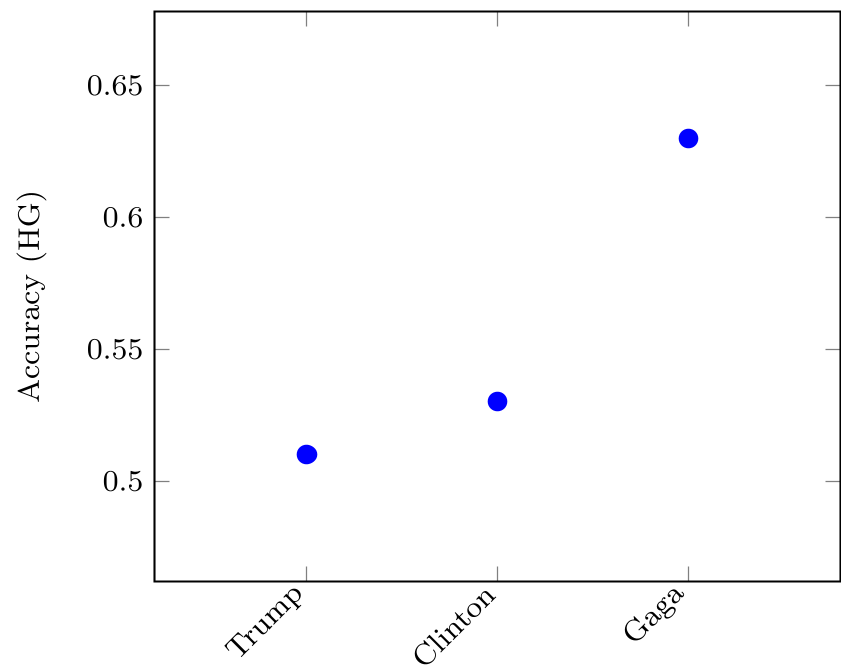 Figure 3: Accuracy comparison between the traditional Homophily model (Tan et al.) and the proposed Influence-driven model (HIG).
Critical Insight & Conclusion
This work shifts the paradigm of social sentiment analysis from "who you know" to "who you listen to." By quantifying explicit interactions (likes/shares), the model captures the dynamic nature of opinion formation.
Limitations: The current model treats posts as independent and focusing on one topic. In reality, a single viral tweet might touch on multiple topics, and professional "Influencers" might shift their tone to maintain engagement rather than reflecting true personal sentiment.
Future Outlook: Integrating Aspect-Based Sentiment Analysis (ABSA) into this influence graph could allow for even more granular predictions—predicting not just if a user is "positive," but specifically what about a topic they support or oppose based on the influencers they follow.