
CARDS: Scaling Trust in Social Networks via Accountability-Based Auditing
Enhanced Audit Strategies for Collaborative and Accountable Data Sharing in Social Networks
This paper introduces an enhanced a posteriori access control model for Decentralized Online Social Networks (DOSNs) called CARDS. It shifts from traditional restrictive encryption to a transparency-based audit system where sharing transactions are logged in a cryptographic "Bichon chain" and verified by a Trust Register Manager (TReMa).
TL;DR
Researchers have proposed a paradigm shift for Decentralized Online Social Networks (DOSNs): moving away from "lock-and-key" encryption toward an accountability-based model. By using a "Bichon chain" to log data shares and an intelligent, distribution-based audit algorithm, they increased delinquency detection rates by over 50%.
Background: The Failure of the "Centralized Trust" Model
Modern social media relies on a central provider to act as the ultimate arbiter of privacy. However, frequent data breaches have proven this trust is misplaced. While Decentralized Online Social Networks (DOSNs) like Diaspora attempt to fix this, they often rely on heavy encryption that makes the user experience slow and key management a nightmare.
The authors of this paper argue that we should treat DOSNs more like human society: allow freedom of movement (sharing) but maintain a transparent "paper trail" (audit log) to punish bad actors after the fact.
The Core Mechanism: The Bichon Chain
To enable accountability without a central database, the authors developed the Bichon Chain.
- What it is: A chained list of records attached to every shared object.
- How it works: Every time a user shares a piece of data, they must append a "Bichon Ring" containing the sharing conditions (trust level, distance from owner, and relationship type) and sign it with their private key.
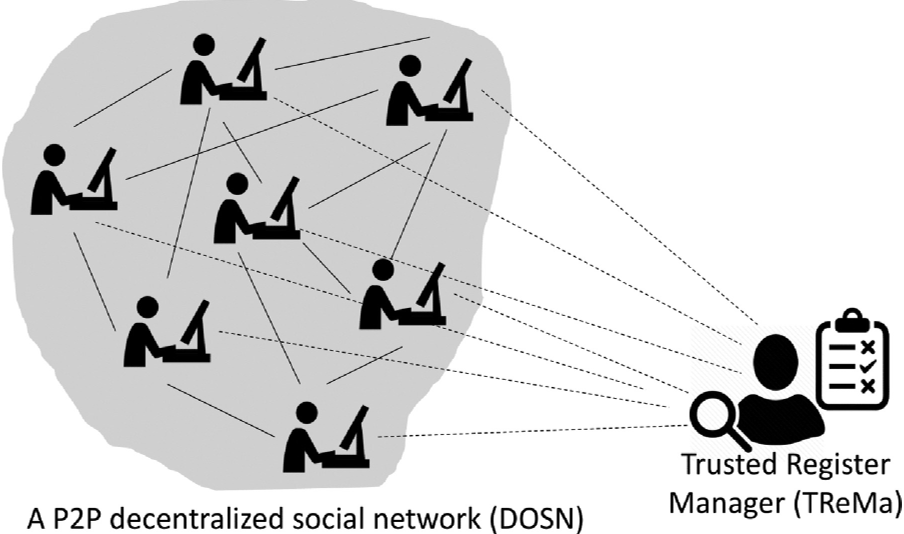 Figure: The CARDS architecture where peers interact and the TReMa (Auditor) maintains the Trust Register.
Methodology: From Random to Intelligent Auditing
The original CARDS model picked nodes to audit at random. This is inefficient—like a police force patrolling random streets instead of high-crime areas. This paper introduces a two-level selection algorithm:
- Level 1 (Delinquency Distribution): The TReMa analyzes the distribution of previously recorded bad behaviors. It focuses 55% of its resources on "outliers"—those who are more than one standard deviation away from the mean delinquency rate.
- Level 2 (Activity Ratios): It then filters these suspicious nodes by their "Activity-to-Friend" ratio. Users who share excessively relative to their social circle size are flagged as higher risk.
The paper employs Subjective Logic to handle uncertainty. Each node has a reputation tuple: —representing Belief, Disbelief, and Uncertainty. If a node hasn't been audited, its uncertainty is 1.0, ensuring that new nodes are eventually cycled into the audit process.
Experimental Results: Proving the Gains
Using the Pokec dataset (a real-world social graph with 30.6M edges), the authors simulated sharing behavior to compare three strategies:
- Random Selection
- Delinquency-Only Selection
- TReMa Enhanced Selection (The Proposed Method)
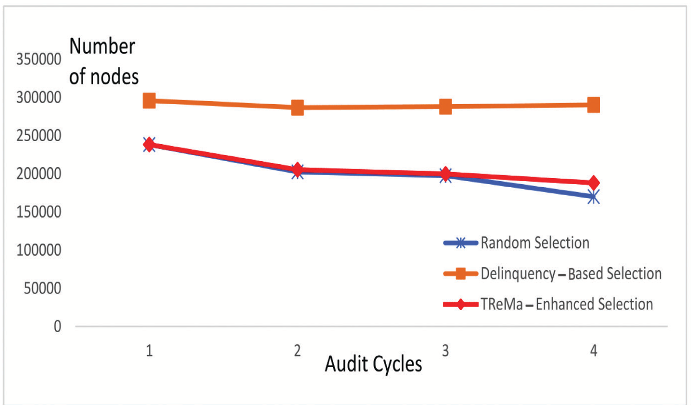 Figure: Comparison of detected delinquencies across different selection techniques.
Key Findings:
- Detection Rate: The TReMa-Enhanced selection outperformed both random and purely delinquency-based models by over 50%.
- Coverage: Unlike the "Delinquency-Only" model, which kept auditing the same known bad actors, the Enhanced model successfully identified new delinquent nodes in every cycle.
The Privacy Trade-off
A major contribution of this article is the honest analysis of the "Privacy Leakage" in audit logs. If the Bichon chain is in plain text, anyone can see the path a photo took across the network.
The authors suggest Camouflage Techniques:
- Distance Hiding: Adding "dummy rings" to the chain so observers cannot tell the actual hop-count.
- Trust Hiding: Using secure two-party comparison protocols so nodes can verify they meet a "MinTrust" requirement without the owner revealing what that threshold actually is.
Critical Insight & Conclusion
This work highlights a critical truth in decentralized security: Preventative measures (encryption) don't scale, but deterrent measures (audits) do.
By treating a social network as a "reputation economy," the CARDS model provides a blueprint for DOSNs that feel as fast as Facebook but offer the sovereignty of a P2P system. The next step for this research, as suggested by the authors, is moving the Bichon chain to a Blockchain to ensure the audit logs themselves are immutable and transparent.