
Transforming Grades into Pixels: An Enhanced CNN Approach to Student Success Prediction
An Enhanced CNN Model on Temporal Educational Data for Program-Level Student Classification
The paper introduces an enhanced Convolutional Neural Network (CNN) framework for program-level student classification, transforming temporal academic records into color images. By integrating specialized loss functions and image augmentation, the model achieves state-of-the-art Accuracy (85%–95%) in forecasting final graduation status.
TL;DR
Educational institutions struggle to proactively identify "at-risk" students due to the sparse and imbalanced nature of academic data. This paper presents a novel solution: converting temporal grade records into color images and applying a CNN-based architecture enhanced by specialized loss functions (MFE) and Data Augmentation. The result is a robust system that achieves 85-95% accuracy in predicting long-term graduation outcomes.
The Challenge: Why Student Data is Hard to Model
Predicting a student's final status at the program level (years in advance) is significantly harder than course-level tasks. The researchers identified three primary "enemies" of accuracy:
- Temporal Dependencies: Grades aren't isolated; they form "knowledge chains" over time.
- Data Imbalance: Fortunately, most students graduate. Unfortunately, this makes "study-stop" (dropout) cases rare, causing models to ignore them.
- Data Shortage: A single department may only have a few hundred historical records, which is traditionally insufficient for "data-hungry" Deep Learning.
Methodology: Seeing Education through a Lens
1. Data-to-Image Transformation
The most striking innovation is the mapping of study results into a color channel. By representing students as a matrix where one axis is "Required Courses" () and the other is "Time/Semesters" (), the authors create a visual signature of academic progress.

2. Handling Imbalance with MFE
Standard Cross-Entropy loss often fails when one class dominates. The authors adapted Mean False Error (MFE) and Mean Squared False Error (MSFE): By calculating error separately for the majority (Graduating) and minority (Study-stop) classes, the loss function forces the CNN to pay equal attention to the "at-risk" students, regardless of their small numbers.
3. Augmentation for Tabular Data
How do you "augment" a grade report? By treating it as an image, the authors used:
- Shear: Simulates shifts in course-taking patterns.
- Zoom: Focuses on specific high-impact semesters.
- Horizontal Flipping: Generates diverse "pathway" variations to help the model learn more generalized features.
Experimental Results: Proving the Concept
The model was tested against traditional baselines like Logistic Regression, Naïve Bayes, and standard Neural Networks (NN) on datasets from the Ho Chi Minh City University of Technology.
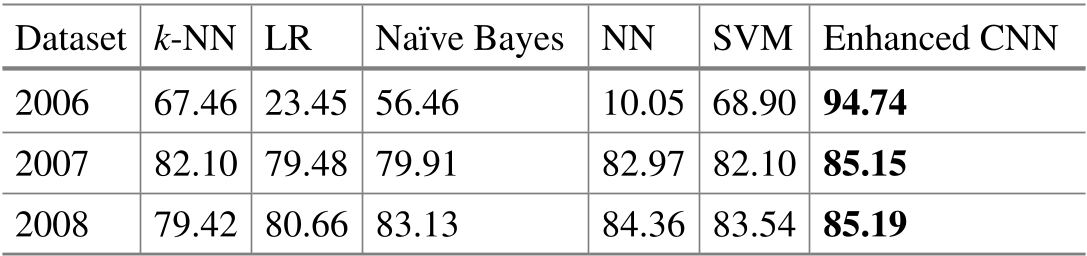
Key Observations:
- Superior Accuracy: The enhanced CNN reached up to 94.74% accuracy, whereas traditional models like k-NN often plateaued in the 60-80% range.
- Augmentation Impact: Using data augmentation consistently boosted performance across all loss functions, proving that "small data" isn't a barrier to deep learning if handled creatively.
- MFE vs. MSE: Using MFE loss improved accuracy significantly in imbalanced scenarios (e.g., in Dataset 2007, jumping from 72.93% to 85.15%).
Critical Insight: Beyond Visuals
The success of this CNN model isn't just about "pretty pictures." It works because convolutions act as local feature extractors. In an educational context, a filter effectively analyzes "clusters" of related subjects taken within a 3-year window. This captures the Inductive Bias that academic success is often determined by the interaction of specific prerequisite subjects over time.
Conclusion & Future Work
This research provides a practical blueprint for educational institutions. By viewing temporal data through the lens of computer vision, we can leverage powerful CNN architectures even with limited datasets. The next step? Moving from binary classification (Grad/Drop) to multi-class classification, predicting specific honors or academic trajectories to provide even more personalized support for students.
Final Takeaway: When your data is too small for Deep Learning, change the way the model "looks" at it.