
eDGP: Breaking the Bias in EEG-Based Emotion Recognition
An enhanced fitness function to recognize unbalanced human emotions data
2020-09-30
Summary
Problem
Method
Results
Takeaways
Abstract
This paper proposes eDGP (enhanced D-score Genetic Programming), a novel framework for binary human emotion recognition (positive vs. negative) using EEG signals. It utilizes an enhanced fitness function, the eD-score, coupled with Fast Fourier Transformation (FFT) for feature extraction, achieving a peak classification accuracy of 87.61% on custom and benchmark datasets.
## TL;DR
Human emotions are messy, and the data we collect from brainwaves (EEG) is even messier—often suffering from severe class imbalance. This paper introduces **eDGP (enhanced D-score Genetic Programming)**, a framework that uses an evolutionary approach and a specialized "distance-based" fitness function to ensure that minority emotions (like negative states) aren't ignored by the AI. Reaching an accuracy of **87.61%**, it sets a new bar for single-channel EEG analysis.
## The Core Challenge: The Imbalance Trap
In affective computing, researchers face a "Goldilocks" problem: positive emotions are often over-represented in experimental settings, while negative emotions are the "minority class." Standard classifiers like Support Vector Machines (SVM) or Multi-layer Perceptrons (MLP) are "lazy"—they achieve high accuracy simply by predicting the majority class every time.
The authors argue that for EEG data to be truly useful in real-world scenarios (like monitoring a student's attention or a driver's stress), the model must be **unbiased**.
## Methodology: Evolution with a Purpose
Instead of using a standard loss function, the authors turned to **Genetic Programming (GP)**. In GP, programs (represented as trees) evolve over generations to find the best mathematical expression for classification.
### The "Secret Sauce": The eD-score
The heart of this paper is the **eD-score**. Unlike standard accuracy, the eD-score:
1. **Uses Tanh Activation**: Controls the "blowing up" of values and centers the data around zero.
2. **Distance Weighting**: It doesn't just check if a prediction is right; it measures *how far* the prediction is from the decision threshold. Farther correct predictions are rewarded more.
3. **Harmonic Mean Logic**: By taking the harmonic mean of majority and minority scores, the fitness function drops to zero if the model fails on *either* class. This forces the "evolution" to prioritize balance.
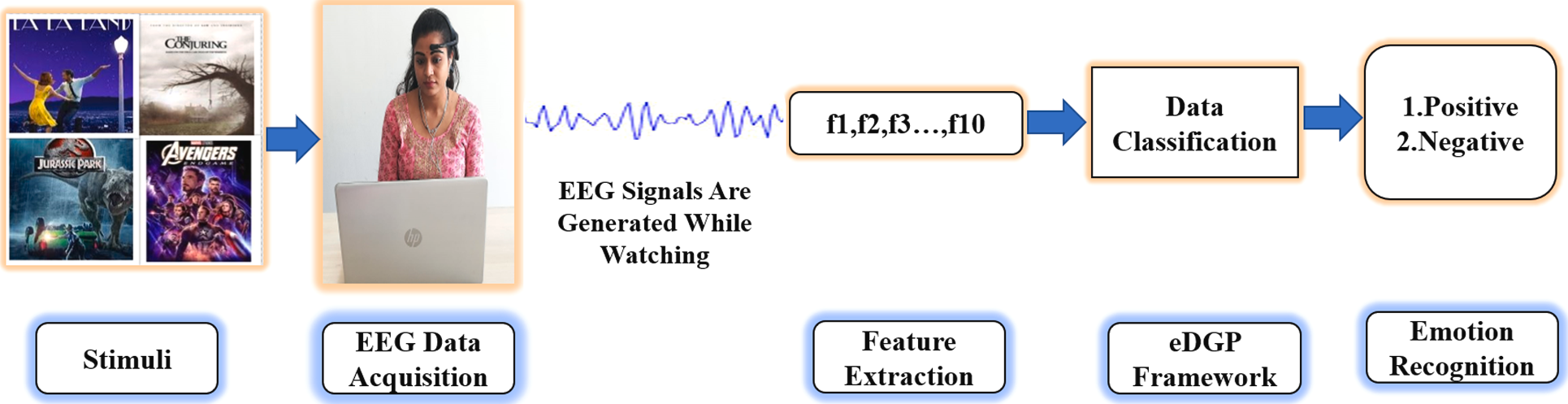
*Fig 1: The EEG-based emotion recognition framework showing the flow from raw signals to the eDGP classifier.*
## Experimental Insights: Who is Most Emotional?
The study didn't just stop at the algorithm; it explored human behavior through the lens of age and gender:
* **The Peak Age**: Participants aged **26–35** showed the highest emotional responsiveness and recognition accuracy (92.08%).
* **Gender Differences**: Females were found to be significantly more emotionally active and overt in responding to visual stimuli compared to males.
* **Attention Link**: The research confirmed a direct correlation—positive emotions are linked to twice the level of attention compared to negative states.
## Results vs. The World
The researchers tested eDGP against established datasets (**DEAP** and **SEED**) and compared it to various baselines.

*Fig 2: Comparative analysis showing eDGP consistently outperforming MLP, KNN, and SVM across different data splits.*
One of the most impressive feats was achieving **87.61% accuracy** using only a **single-channel** NeuroSky MindWave 2 device. Most SOTA methods require 32 or 64 channels, making them impractical for daily use.
## Critical Analysis & Future Outlook
While eDGP is a powerhouse for unbalanced data, it does face the classic Genetic Programming hurdle: **Code Bloating**. As the "trees" evolve, they can become unnecessarily complex. The authors also noted that as we move from binary (positive/negative) to multi-class emotion recognition, the complexity increases significantly.
**The Takeaway**: This work proves that we don't need laboratory-grade, 64-channel helmets to read emotions accurately. With a smarter fitness function that respects data imbalance, portable affective computing is finally becoming a reality.
## Conclusion
eDGP represents a shift from "bigger models" to "smarter evolution." By ensuring that every emotion—no matter how infrequent—carries equal weight in the eyes of the AI, the authors have paved the way for more empathetic and accurate human-computer interfaces.