
Turning Crowd Opinions into Queries: An Enhanced NoSQL Approach for Product Reviews
Enhanced query processing for NoSQL crowdsourcing systems
The paper introduces a specialized NoSQL database system designed for crowdsourcing product reviews, enabling natural language query processing. By integrating POS-tagging, WordNet-based term expansion, and a novel Termset Density ranking metric, the system transforms unstructured crowd opinions into ranked product recommendations. Tested on the IMDb dataset (2M+ reviews), it achieves feasible performance for Big Data scenarios.
TL;DR
This paper presents a NoSQL database prototype that allows users to query millions of product reviews using natural language. By moving away from rigid SQL structures and implementing a custom ranking metric based on term density and semantic expansion (via WordNet), the system identifies products that best match a user's subjective "wishes." It bridges the gap between traditional Information Retrieval and Big Data NoSQL systems.
Motivation: Why Standard Databases Fail at "Wishes"
When a user wants a movie that is "hilarious with great jokes," standard relational databases (RDBMS) fail because they search for structured tags rather than the nuanced sentiment buried in text. While modern search engines exist, they often ignore the "density" of terms—how close related words appear in a review—which is a key indicator of true relevance in crowd-sourced opinions.
The authors' insight is twofold:
- Semantic Context: A query should be expanded to include synonyms and hypernyms.
- Proximity Matters: If "funny" and "movie" appear 50 words apart, it’s less relevant than if they appear in the same sentence.
Methodology: The Architecture of Semantic Search
The system is split into a specific Back-End for indexing and a Front-End Query Engine.
1. Hybrid Storage Strategy
Realizing that a pure relational approach would take over an hour for a single query on 2 million reviews, the authors developed a custom storage layer. While metadata sits in Postgres, the actual Occurrences of words are stored in binary files on the file system, organized by term IDs to allow for massive parallel I/O.
2. The Ranking Metric (PRM)
The "Secret Sauce" is the Product Ranking Metric. It uses a concept called Termset Density:
- Weighting: The whole query is weighted higher than subsets of the query.
- Density: . Essentially, the smaller the window of words containing your query terms, the higher the score.
- Expansion: Using WordNet, the system understands that "hilarious" is related to "funny," assigning a "Semantic Coefficient" to these expanded terms.
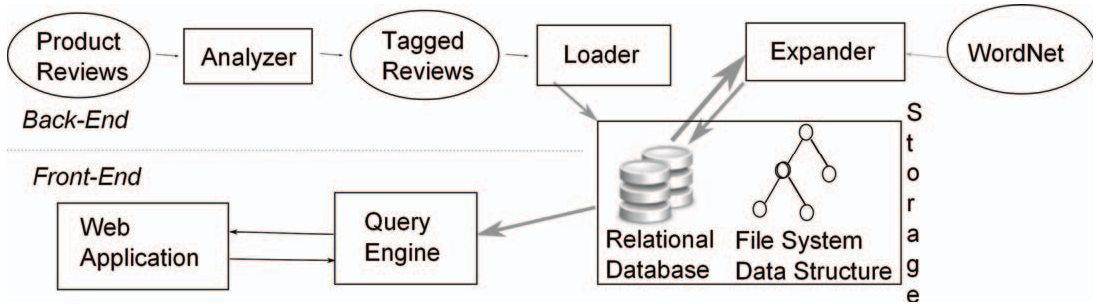 Fig 1: The dual-layer architecture showing the Analyzer (Stanford Parser) and the custom Query Engine.
Experiments and Performance Analysis
The prototype was tested using the IMDb dataset (109,221 movies, 2.2 million reviews).
The Cost of Accuracy: POS-Tagging
One of the most striking findings was the computational cost of Part-of-Speech (POS) tagging. Using the Stanford Parser to identify nouns, verbs, and adjectives took over 2,200 hours for the full dataset. However, the authors argue this is a necessary "one-time" back-end cost to ensure that query expansion (e.g., distinguishing "book" as a noun vs. a verb) remains accurate.
Multi-threaded Gains
By partitioning the occurrence data into 5 sub-trees, the query engine was able to run in parallel.
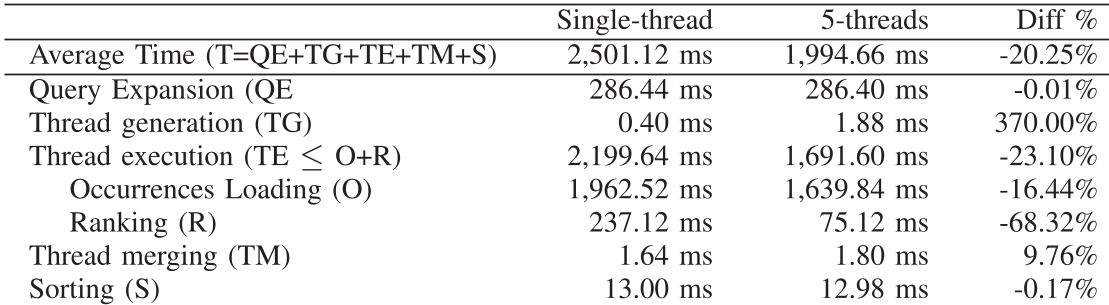 Table 1: Comparing Single-thread vs. 5-thread performance. Note the 68% boost in ranking speed.
The results show that while disk I/O (Occurrences Loading) remains a bottleneck with traditional HDDs, the logic-heavy Ranking phase is highly scalable.
Critical Insight & Future Outlook
The core contribution here isn't just "faster search," but a weighted semantic density model. By treating a query as a set of interacting parts (termsets) rather than just a string of keywords, the system mimics human intuition about what makes a review "relevant."
Limitations:
- I/O Bottleneck: The reliance on traditional file systems limits the loading speed.
- Semantic Complexity: The system currently struggles with negation (e.g., "not a funny movie") and word order.
Future Work: Moving forward, integrating Linked Data and modern SSD storage could solve the remaining latency issues. In a world dominated by LLMs, this work provides a foundational look at how structured NoSQL schemas can still provide a robust, interpretable backbone for natural language interfaces.