
STE3D-CAP-e: Leveling Up CAPTCHA Security via Stereoscopic Depth
Enhanced STE3D-CAP: A Novel 3D CAPTCHA Family
This paper introduces STE3D-CAP-e, an enhanced Stereoscopic 3D CAPTCHA method that leverages human binocular disparity to distinguish foreground text from heavy background clutter. By utilizing red-cyan anaglyph images, the system presents a "text-on-text" challenge that remains highly legible to humans while resisting automated segmentation and 3D reconstruction attacks.
TL;DR
CAPTCHAs are in a constant arms race. As AI gets better at "seeing," developers make CAPTCHAs harder—often to the detriment of human users. STE3D-CAP-e breaks this cycle by using Stereoscopic 3D. By presenting challenges through red-cyan anaglyph images, it creates a "text-on-text" environment that is a nightmare for computer vision but a clear, depth-filled scene for the human eye.
The Segmentation Problem: Where Traditional CAPTCHAs Fail
For years, CAPTCHA security has relied on making characters hard to segment (isolate from the background and each other). Techniques like "crowding" or adding "noise" are common. However, if the noise is too heavy, humans can't read it; if it's too light, AI-powered edge detectors bypass it effortlessly.
The core insight of the authors is that humans possess a unique biological advantage: Stereopsis. By leveraging the way our brain fuses different images from our left and right eyes to perceive depth, we can "filter" visual clutter in 3D space—something that traditional 2D image processing struggles to emulate.
Methodology: Engineering a 3D Barrier
The authors didn't just move 2D text into a 3D engine; they redesigned the underlying AI problem.
1. The "Text-on-Text" Clutter
Unlike standard CAPTCHAs that use random lines or dots, STE3D-CAP-e uses other characters as clutter. This creates a massive ambiguity for machine vision: which "E" is part of the solution and which is part of the background?
2. Strategic 3D Transformations
Characters are rotated in 3D space (Yaw, Pitch, and Roll) and translated along the Z-axis (depth). Crucially, the authors apply scaling compensation: characters further back are scaled up so that in the final 2D anaglyph, all characters appear the same size. This prevents bots from simply using "size" as a proxy for "foreground."
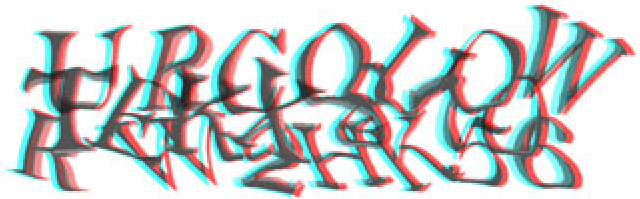 (a) Solid object version vs (b) Wireframe version. The foreground characters occupy a distinct depth plane.
3. Thwarting 3D Reconstruction
An attacker might try to use "Stereo Correspondence" to reconstruct the 3D scene and isolate the foreground. To counter this, STE3D-CAP-e uses:
- Translucency: Foreground and background colors blend, confusing pixel-matching algorithms.
- Texture-less Rendering: Most 3D reconstruction algorithms require surface texture to find "matching points." By using flat colors, the authors create ambiguity for the bot.
Performance & Usability
Security is worthless if users hate it. The authors conducted a pilot study to test two versions: Solid and Wireframe.
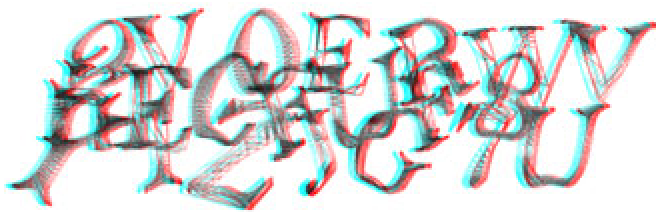 Sample of foreground characters 'TEKX' and 'ECFU' appearing to float in front of background noise when viewed with 3D glasses.
- Accuracy: Humans achieved an impressive 86.71% overall accuracy.
- Speed: Average solve time was a mere 6.5 seconds, well within the limits of a positive user experience.
- Wireframe Advantage: Interestingly, the wireframe version performed slightly better (88.29%), likely because it reduces the total screen "mass," making it easier for the human brain to isolate specific character outlines.
Critical Insight: The "Stereo-Blind" Limitation
While STE3D-CAP-e is a brilliant application of computer vision principles to security, it has a notable "hardware" requirement. Users need red-cyan glasses, and those who are stereo-blind (cannot perceive depth due to visual impairments) or color-blind (specifically regarding red/cyan filters) will find this CAPTCHA impossible.
However, as autostereoscopic displays (like those used in the Nintendo 3DS or modern "3D tablets") become more common, the need for glasses will vanish, potentially making this one of the most secure text-based CAPTCHA formats available.
Conclusion
STE3D-CAP-e succeeds by moving the "hard AI problem" from the realm of character recognition to the realm of 3D scene decomposition. By forcing an attacker to solve the complex problem of depth perception in a translucent, texture-less environment, it provides a high-security threshold while keeping the task simple and fast for most humans.