
Enhanced VPSNs: Achieving Technical "Invisibility" in a Centralized World
Enhanced Virtual Private Social Networks: Implementing user content confidentiality
This paper introduces an enhanced Virtual Private Social Network (VPSN) designed to provide user-generated content confidentiality on centralized platforms like Twitter. The core method utilizes symmetric encryption via a unique "Hash Chain XOR" (HCX) algorithm, leveraging out-of-band session keys and innocuous social media posts as data encryption seeds.
TL;DR
The modern social media dilemma is a choice between the convenience of centralized platforms (Facebook, Twitter) and the privacy of decentralized alternatives. This paper proposes a middle ground: an Enhanced Virtual Private Social Network (VPSN). By splitting content into innocuous OSN posts and encrypted Cloud-stored data, users can achieve near-total confidentiality without leaving their social circles.
The Problem: The Illusion of "Delete" and Data Exploitation
In a centralized OSN, you don't own your data; you lend it. The authors highlight two critical risks:
- Legacy: Deleted posts often persist in backups or third-party developer databases.
- Exploration: OSNs claim rights to use your content for marketing and AI training.
While Decentralized OSNs (DOSNs) solve this, they lack the massive user base required for a social network to be "social." Previous VPSN attempts tried to fix this but often used steganography—hiding data inside images or text. The problem? Steganography is often detectable via statistical analysis, creating a "red flag" for the platform.
Methodology: The HCX Algorithm & Multi-Channel Stealth
The authors move away from hiding data in the post to using the post as a decryption trigger.
1. The Multi-Channel Architecture
The system splits the communication into three channels:
- The OSN (Twitter): Broadcasts an innocuous, natural language key (), such as "The weather is awful today."
- The Cloud (Dropbox): Stores the actual encrypted content (Ciphertext ).
- Out-of-Band: A one-time secret session key () shared privately between users.
2. The Hash Chain XOR (HCX) Implementation
Standard XOR ciphers require a key as long as the message. To solve this, the authors developed HCX. It generates a hash chain () where each link is derived from a symmetric key , where .
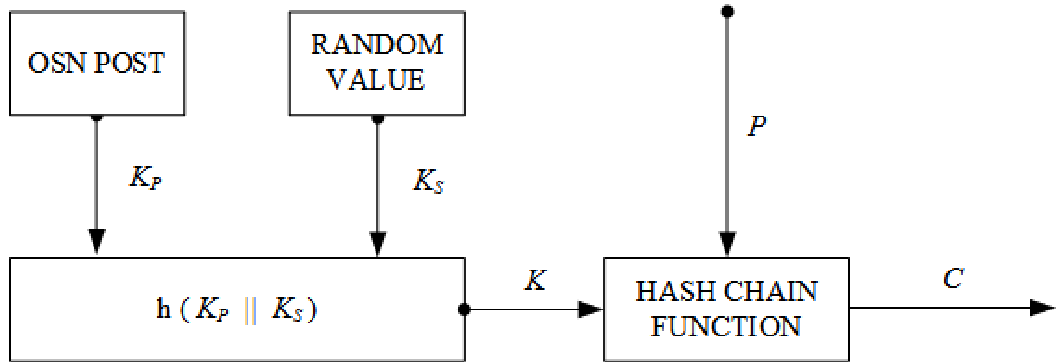
This ensures that even if one link is compromised, the rest of the chain remains secure without the original . The final ciphertext is simply .
Performance & Practicality
The researchers tested this using Python and SHA-3 (256-bit). They found that the primary bottleneck isn't the cryptography, but the Cloud propagation time.
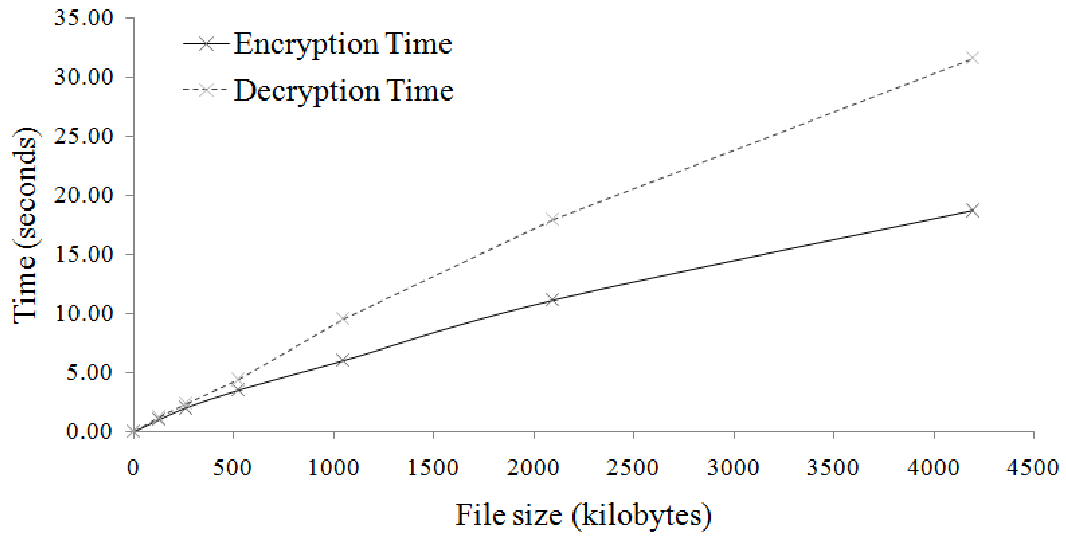
- Encryption/Decryption: Negligible (sub-second for most text/small files).
- Invisibility: To an observer or the OSN algorithm, the user just posted a mundane tweet about the weather. There is no suspicious metadata or "dummy data" to trigger censorship or account flagging.
Critical Analysis: Is it Truly Secure?
The "Invisibility" goal is well-met. However, the system relies on two major assumptions:
- Non-Collusion: It assumes Twitter and Dropbox won't share data to de-anonymize the user. In the age of massive corporate mergers and government subpoenas, this is a calculated risk.
- Key Management: The "out-of-band" sharing of remains the classic "last mile" problem of cryptography.
Takeaway for Future Research
This paper shifts the focus of VPSNs from hiding messages to distributing them across unrelated services. For developers, the takeaway is clear: the future of privacy on the "Public Web" isn't better encryption alone, but smarter architecture that leverages existing infrastructure in unintended, private ways.
Future Outlook
The authors suggest that the "Optimum VPSN" will eventually combine Anonymity (hiding who), Confidentiality (hiding what), and Integrity (preventing changes) into a single, seamless user experience that works across multiple platforms simultaneously.