
AENN-JAYA: Enhancing Brain-Inspired Networks for High-Precision Wind Power Forecasting
Enhancement of Artificial Emotional Neural Network Using JAYA Algorithm and the Investigation of Expanded Feature Selected for Wind Power Forecasting
This paper introduces an enhanced Artificial Emotional Neural Network (AENN) based on Brain Emotional Learning (BEL), utilizing the JAYA optimization algorithm to refine weight and bias parameters. The study evaluates two variants, AENN-Max-JAYA and AENN-Mean-JAYA, for wind power forecasting, achieving state-of-the-art performance in prediction accuracy.
Executive Summary
TL;DR: Researchers have successfully upgraded the Artificial Emotional Neural Network (AENN)—a machine learning model inspired by the human limbic system—by integrating the JAYA optimization algorithm. By refining how the model "perceives" input through expanded features (Max vs. Mean), the proposed AENN-Max-JAYA model significantly reduces error rates in wind power forecasting, outperforming traditional backpropagation and Genetic Algorithm-based counterparts.
Context: This work represents a significant step in the "Bio-inspired AI" ecosystem. It moves away from standard "black box" deep learning toward a structured, modular approach that mimics emotional learning in the mammalian brain, specifically for time-series forecasting.
Motivation: Why Emotional Learning for Wind Power?
Wind power is notoriously chaotic. Traditional Artificial Neural Networks (ANNs) often struggle with the sharp fluctuations and non-linear patterns of wind speed. The authors identified two critical gaps in existing AENN research:
- Inefficient Training: Genetic Algorithms (GA) are computationally heavy and often get stuck in local optima, limiting the model's generalization capabilities.
- Feature Representation: The "Thalamus" module in AENNs generates an "expanded feature." Whether this should be the maximum or average of the stimulus was a point of contention in previous SOTA works like WTAENN.
Methodology: The Architecture of Emotion
The AENN mimics the interaction between the Amygdala (AMYG) and the Orbitofrontal Cortex (OFC).
1. The Limbic Mechanism
- Thalamus: Functions as a fast-response sensory relay, producing an "imprecise" expanded feature.
- Amygdala (AMYG): Learns emotional associations and produces a fast reaction.
- Orbitofrontal Cortex (OFC): Acts as a "moderator," evaluating the AMYG's response to prevent inappropriate outputs based on the context.
2. Enter JAYA Optimization
The core innovation is using the JAYA algorithm to tune the (AMYG) and (OFC) weights. Unlike GA, which requires complex selection and crossover operations, JAYA follows a simple logic: This formula pushes every solution toward the current best while actively repelling it from the current worst, ensuring faster and more robust convergence.
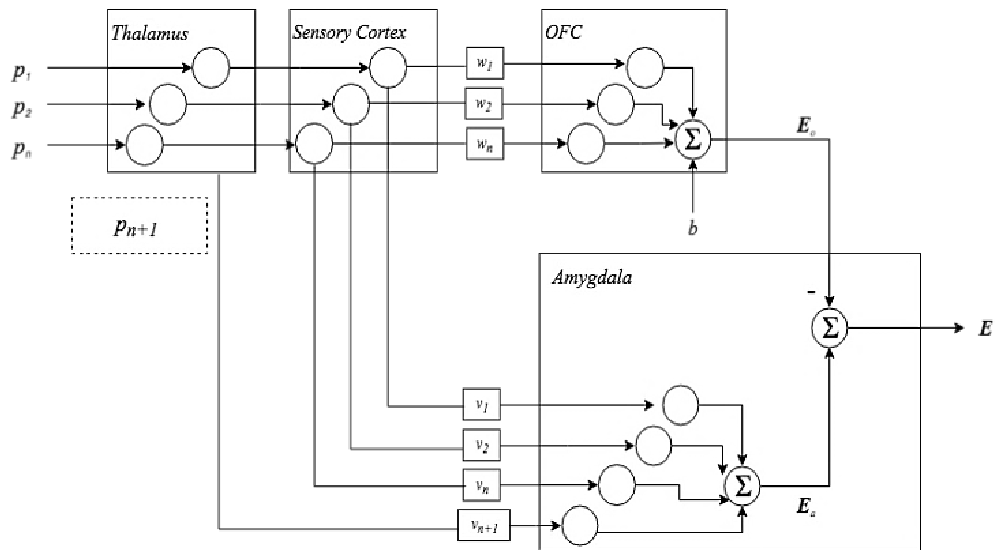 Figure 1: The AENN model inspired by the interaction between the Amygdala and the Orbitofrontal Cortex.
Experiments: Proving the Superiority
The authors tested their models using the Australia wind power dataset (8712 samples). They compared AENN-JAYA against:
- ANNs-LM: Standard Feedforward Networks with Levenberg-Marquardt training.
- WTAENN-GA: Winner-Take-All Emotional Networks trained via GA.
- AENN-Mean-GA: Previous standard for emotional forecasting.
Key Results
- Lower Error: AENN-Max-JAYA achieved an RMSE of 0.5276, the lowest among all tested models.
- Stability: The standard deviation (SD) of results across 30 trials was only 0.0171, indicating that JAYA is much more stable than GA-based methods.
- Convergence: As shown in the training plots, JAYA-based models converged steadily, avoiding the plateaus common in evolution-based training.
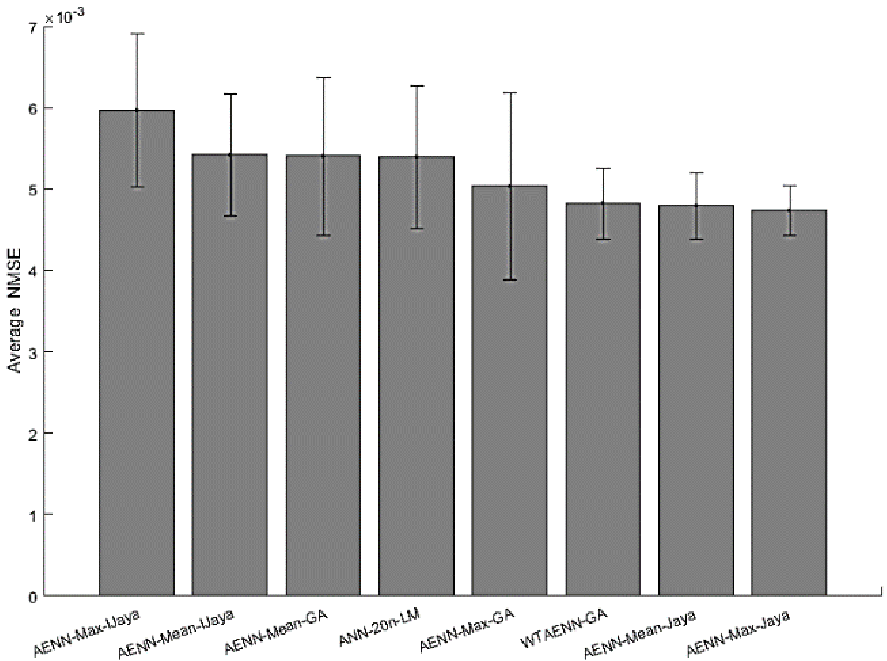 Figure 2: Statistical comparison of RMSE across different models, highlighting the superior performance of AENN-Max-JAYA.
Critical Analysis & Conclusion
The study concludes that AENN-Max-JAYA serves as a powerful tool for chaotic forecasting. The "Max" selection strategy for expanded features proved slightly superior to the "Mean" strategy, likely because max-pooling captures the peak intensities of wind gusts which are critical for power estimation.
Takeaway: By combining bio-inspired modularity (AENN) with efficient parameter-less optimization (JAYA), we can build forecasting tools that are more accurate and theoretically grounded in cognitive science.
Limitations: While JAYA outperformed GA, the paper does not extensively discuss the computational time per iteration compared to standard Gradient Descent. Future work should investigate applying this limbic system architecture to higher-dimensional multi-modal sensor fusion tasks.