
Enhancing CNNs: Why Preprocessing is the Secret Sauce for Emotion Recognition
Enhancing CNN with Preprocessing Stage in Automatic Emotion Recognition
This paper presents an enhanced Convolutional Neural Network (CNN) framework specifically optimized for facial emotion recognition by integrating a robust multi-stage preprocessing pipeline. The authors demonstrate that combining face detection, ROI cropping, and data augmentation allows a standard CNN to achieve a state-of-the-art accuracy of 97.06% on benchmark datasets like CK+, JAFFE, and MUG.
TL;DR
While many researchers focus on building deeper neural networks, this paper proves that for Facial Emotion Recognition (FER), how you treat the data before it enters the model is what truly matters. By combining precise face detection, ROI cropping, and normalization, the authors achieved an impressive 97.06% accuracy using a relatively lightweight CNN on standard datasets like CK+ and JAFFE.
The Problem: Noise and Data Starvation
Deep learning is famously data-hungry. In fields like emotion recognition, datasets are often small and "noisy." Raw images contain distracting backgrounds, varying lighting, and head poses that don't contribute to the underlying emotional signal.
The authors identify two fatal flaws in naive CNN applications for FER:
- Background Interference: Including non-face pixels dilutes the signal-to-noise ratio.
- Contrast Volatility: Low-contrast images trap information, making it difficult for filters to detect subtle muscle movements (Action Units).
Methodology: The Power of the Pipeline
The authors propose a multi-stage preprocessing architecture designed to "purify" the input for the CNN.
1. The Preprocessing Ensemble
- Face Detection (Haar Cascades): Isolating the face to ensure the CNN only sees the relevant "Region of Interest" (ROI).
- Normalization Trio: They compared Global Contrast Normalization (GCN), Local Normalization, and Histogram Equalization. GCN effectively standardizes intensities, preventing specific lighting conditions from biasing the model.
- Noise Injection: By adding Salt & Pepper and Speckle noise, they performed a "stress test" on the model, facilitating better generalization as a form of augmentation.
2. CNN Architecture
The model employs a standard but effective structure:
- Convolutional Layers: Using 5x5 kernels to capture spatial features like corners of the mouth or eyebrows.
- Down-sampling: Max-pooling layers to maintain translation invariance.
- Final Classification: A dense layer outputting 6 nodes (Anger, Happy, Disgust, Fear, Sad, and Surprise).
 Visual representation of how various normalization techniques (GCN, Local) alter the input image before processing.
Experiments and Breakthroughs
The results were clear: Segmentation is king.
- ROI Impact: Simply cropping the face (Step B) increased performance from 61.81% (raw) to 86.08%.
- Resolution Sweet Spot: Interestingly, the model performed better at 32x32 and 64x64 resolutions than at 128x128. This suggests that for simpler CNN architectures, excessive resolution introduces more complexity than the model can effectively resolve.
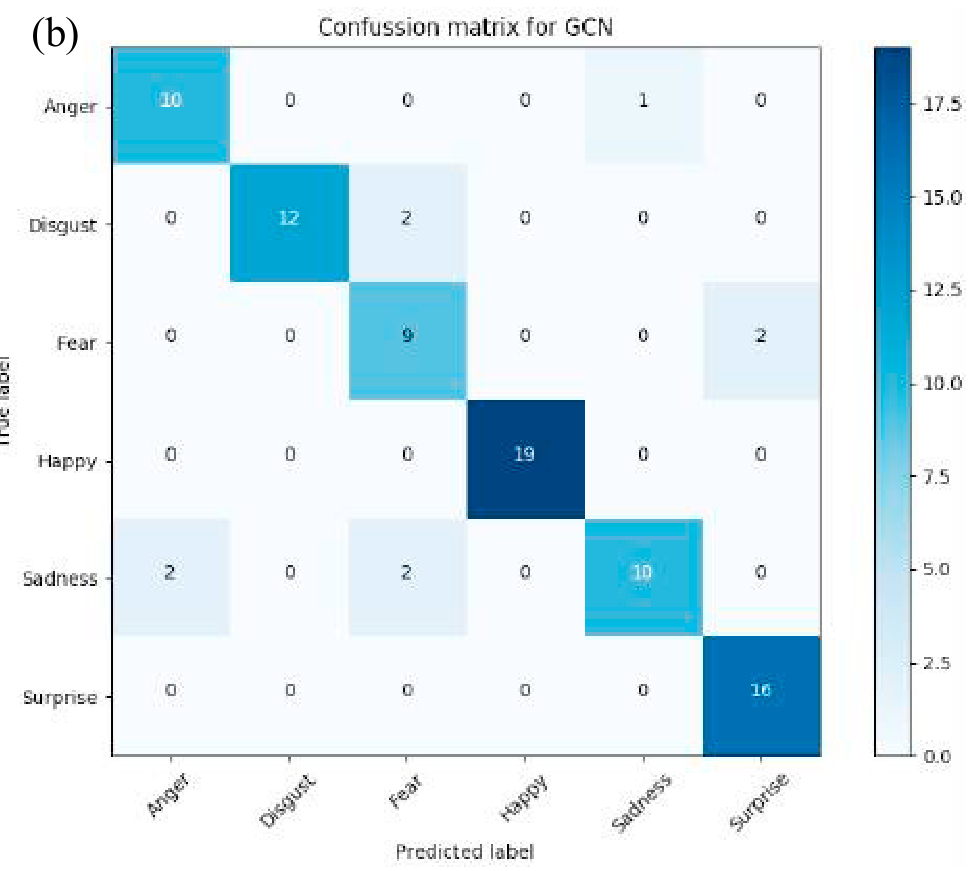
- Emotion Specificity: The model achieved 100% accuracy for Happy and Surprise. However, Sadness remained the most difficult emotion to classify, often being confused with Anger or Fear due to similar visual intensities.
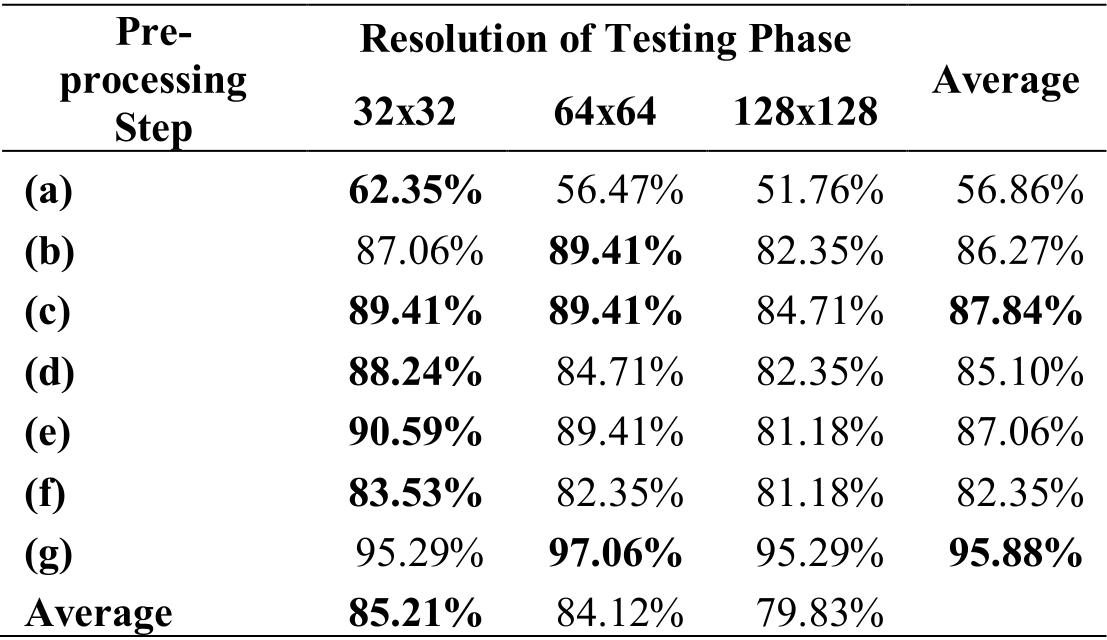 Performance breakdown across different resolutions and preprocessing stages.
Critical Analysis & Conclusion
The core takeaway is that Environment Isolation (Cropping) and Feature Standardization (GCN) are not just "optional extras"—they are fundamental to achieving SOTA results in specialized CV tasks.
Limitations
- Dataset Bias: The study uses "posed" datasets (JAFFE, CK+, MUG) where subjects are instructed to express emotions. Performance might drop in "in-the-wild" scenarios where expressions are spontaneous and micro-scale.
- Complexity vs. Resolution: The failure of the 128x128 resolution indicates the model's capacity was too small for high-dimensional inputs.
Future Outlook
The authors suggest that future work should focus on image synthesis (e.g., using GANs) to generate artificial training samples, further solving the "data starvation" problem that plagues emotion recognition research. This would allow for even deeper architectures to be trained without the risk of extreme overfitting.