
Beyond Homogeneity: Accelerating Cultural Learning with Heterogeneous Social Fabrics
Enhancing Cultural Learning under Environmental Variability Using Layered Heterogeneous Sociometry-Based Networks
This paper introduces a layered heterogeneous social network component into the Cultural Algorithms (CA) framework to solve optimization problems in dynamic environments. By integrating diverse topologies like ring, tree, and hybrid structures, the method—referred to as Heter-SFI—enables "knowledge swarming" where different knowledge sources efficiently coordinate agent behavior to track moving optima.
TL;DR
Optimization in dynamic environments requires more than just fast computation—it requires a "social" structure that can learn and adapt. This paper presents a significant upgrade to Cultural Algorithms (CA) by introducing a layered, heterogeneous social network. By leveraging diverse connectivity patterns (trees, rings, and hybrid meshes), the system—Heter-SFI—tracks moving optima up to 3x faster than traditional methods.
The Evolution of Social Engineering in AI
Most evolutionary algorithms simulate survival of the fittest, but Cultural Algorithms simulate the evolution of civilization. They maintain a Population Space (individuals) and a Belief Space (shared knowledge). However, the "social fabric"—how individuals talk to each other—has traditionally been simplistic and uniform.
The authors argue that a single, homogeneous network topology (like a simple ring or a fully connected graph) is insufficient for complex, shifting landscapes. Just as human societies use different organizational structures for different tasks, AI optimization needs Neighborhood Heterogeneity to handle "environmental variability."
Methodology: Weaving the Social Fabric
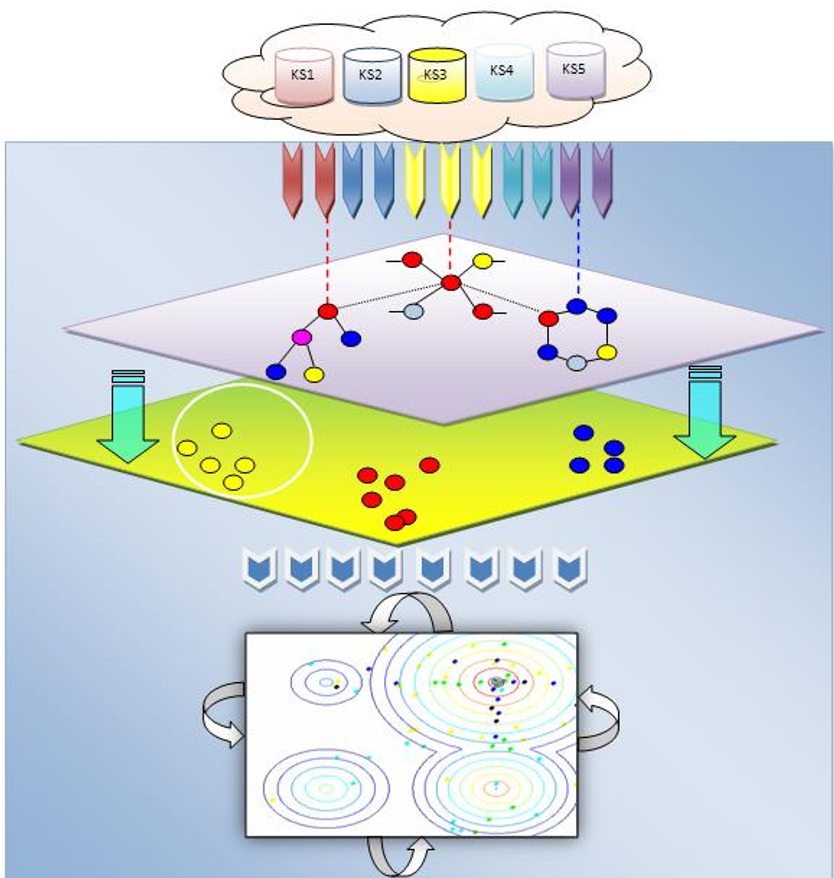
The core innovation is the Layered Heterogeneous Social Fabric. Instead of forcing all agents into one communication style, the authors layer multiple topologies:
- lbest (Ring): Encourages local exploitation.
- gbest: Facilitates global information broadcast.
- Tree & Hybrid Tree: Organizes agents into hierarchies and clusters for specialized searching.
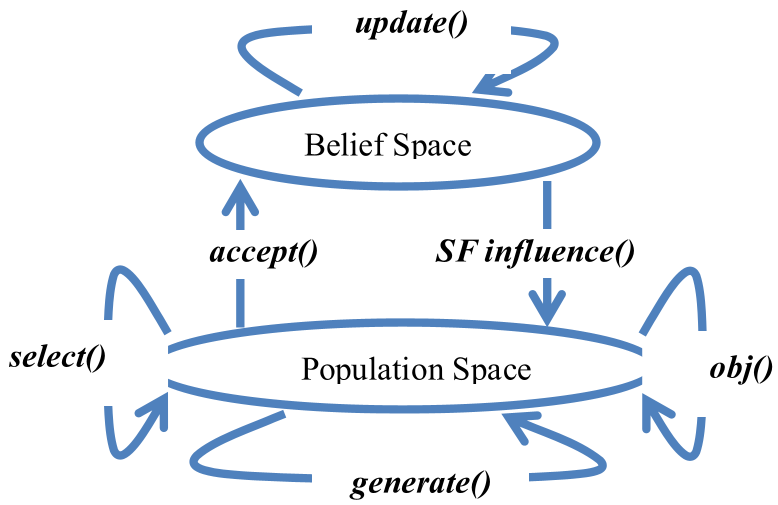
The paper introduces an Influence Function that acts as a mediator. At each step, a conflict resolution process (like "Most Frequently Used" or "Weighted Majority Rule") decides which knowledge source—History, Situational, or Topographical—will guide an individual node through the social network.
The Topologies at Play
The "weaving" process connects nodes across different layers, allowing flow in one network (e.g., a tree) to promote discovery in another (e.g., a ring).
Experiments: Conquering the "Field of Cones"
The system was tested on the DF1 generator, which produces a landscape of resource cones that move or change height over time. In this "moving target" scenario, the goal is for the population to swarm to the highest peak as quickly as possible after a shift.
Key Insights:
- Knowledge Swarming: By the time the system reaches the second or third cycle of a recurring change, the History Knowledge source takes over. It "remembers" where the peak was before, and the heterogeneous network broadcasts this memory to the agents instantly.
- Tighter Formations: As situational knowledge improves, the "bounding boxes" (the search area of the agents) become more focused and overlap more frequently, indicating high confidence in the solution.

As shown in the data, the Heter-SFI approach required only 4 generations to adapt to a shift, dwarfing the performance of the non-networked MVT (12 generations) and the homogeneous Homo-SFI (9 generations).
Critical Insight & Conclusion
The true value of this work lies in the Synergism. The authors proved that when a social network is "trained" on a recurring pattern, its internal structures emerge as a map of the problem itself. The "Heterogeneous" aspect isn't just about complexity—it's about providing the right search resolution at the right time.
Limitations: While the results are impressive, the computational overhead of maintaining multiple layered networks and performing node-level conflict resolution may scale poorly for extremely large agent populations (e.g., millions of nodes).
Future Outlook: We can expect this "Social Fabric" approach to transition from abstract optimization to real-world applications like Autonomous Swarm Robotics or Dynamic Logistical Routing, where the network structure must adapt to physical environmental barriers in real-time.