
Beyond the Linear Undo: Navigating the Multiverse of Data Exploration
Enhancing data exploration with a branching history of user operations
The paper introduces a branching history system for Exploratory Data Analysis (EDA) that allows users to capture, visualize, and navigate alternative exploration scenarios. It leverages an AI-based "context" formalism to maintain multiple inconsistent database states, enabling "Time Travel" navigation and selective undo/redo across different branches of exploration.
TL;DR
The paper introduces a revolutionary approach to Exploratory Data Analysis (EDA) by treating user history not as a linear tape to be rewound, but as a branching multiverse of scenarios. By integrating AI "contexts" into the database layer, the system—part of the Visage environment—allows analysts to visualize alternative "what-if" paths, selectively redo complex events across branches, and perform analytical comparisons between mutually exclusive data states.
The "Electronic White-out" Trap: Problem & Motivation
Most software treats the Undo button as "electronic white-out"—a tool to fix mistakes. However, in data exploration, backtracking isn't just about fixing errors; it’s about investigating alternatives.
The Pain Points:
- Memory Dependency: To compare "Scenario A" with "Scenario B," users must either remember the first state or manually duplicate the entire application.
- Linear Constraints: Standard undo lists force users to find conceptual branch points in a flat sequence of events, which is cognitively taxing.
- State Isolation: There is no way to write a formula like
Scenario_B.Profit - Scenario_A.Profitbecause the system can only exist in one state at a time.
The authors' insight was to treat the exploration process itself as a dataset, modeling history as a tree where every decision can spawn a new timeline.
Methodology: The Architecture of Time Travel
The core of the system is the Branching Time Model, implemented via Contexts.
1. The Context Formalism
Instead of a single database state, the system uses a pair: <scenario, time>.
- Lifting Rules: A state is reconstructed by starting from the root and replaying all updates along the path to the current node.
- holdsIn Operator: This allows the system to query values from other contexts. For example, calculating the difference in profitability between a 4% interest rate scenario and a 5% scenario is done by explicitly referencing both contexts in a single formula.
2. The Time Travel Interface
The UI consists of a tree visualization where the X-axis represents time.
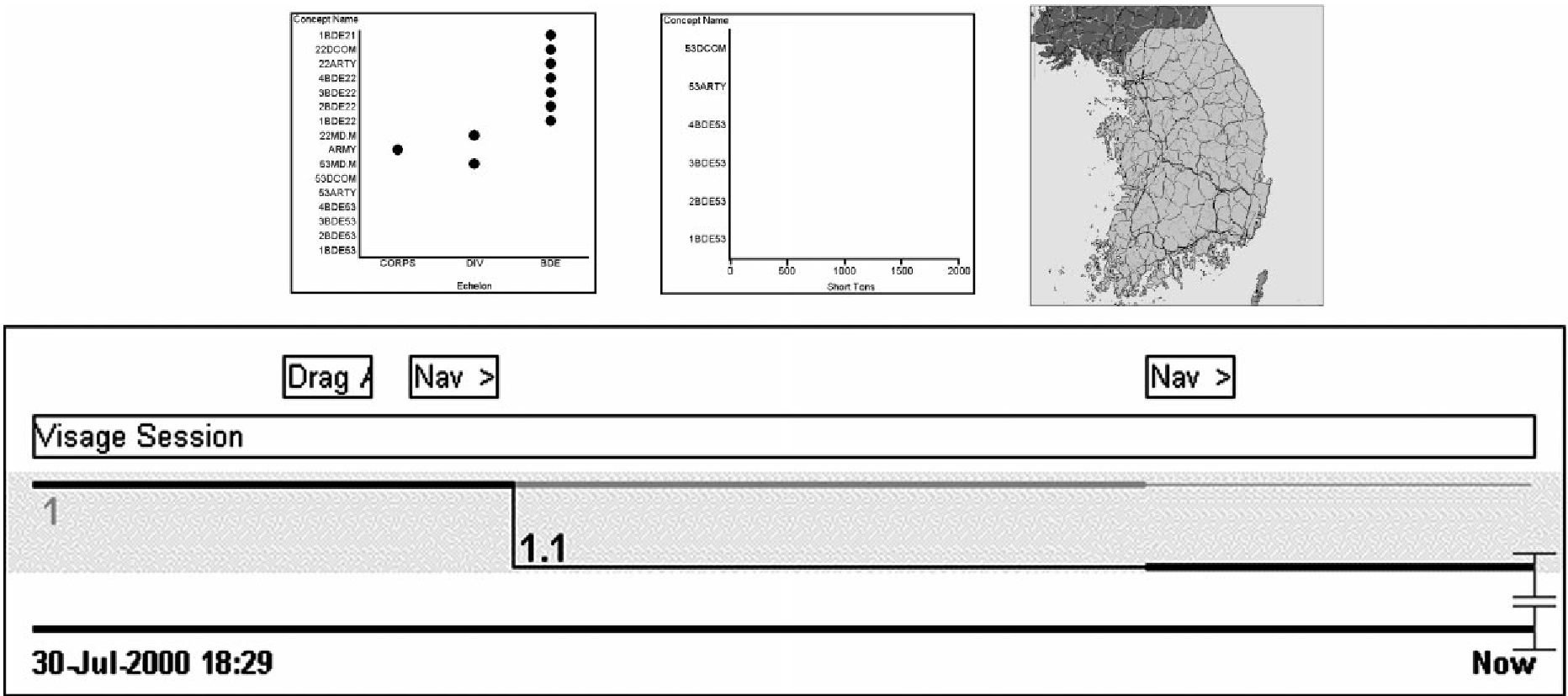 Users can drag an I-beam slider to "slide" through time, watching the visualizations animate through past states.
3. Inferring Intention
When a user drags an event (like "Brushing units with high supply") from one branch to another, the system doesn't just replay low-level IDs. It uses heuristics to infer intent. If a user drew a bounding box in a bar chart, the system assumes the intent was to "select items within this numerical range" rather than "select these specific 5 items," making selective redo much more powerful.
Experiments & Results: Comparing Worlds
The system makes comparing scenarios trivial. By creating two "Frames" (windows) and assigning each a different context, the user can see side-by-side visualizations of different futures.
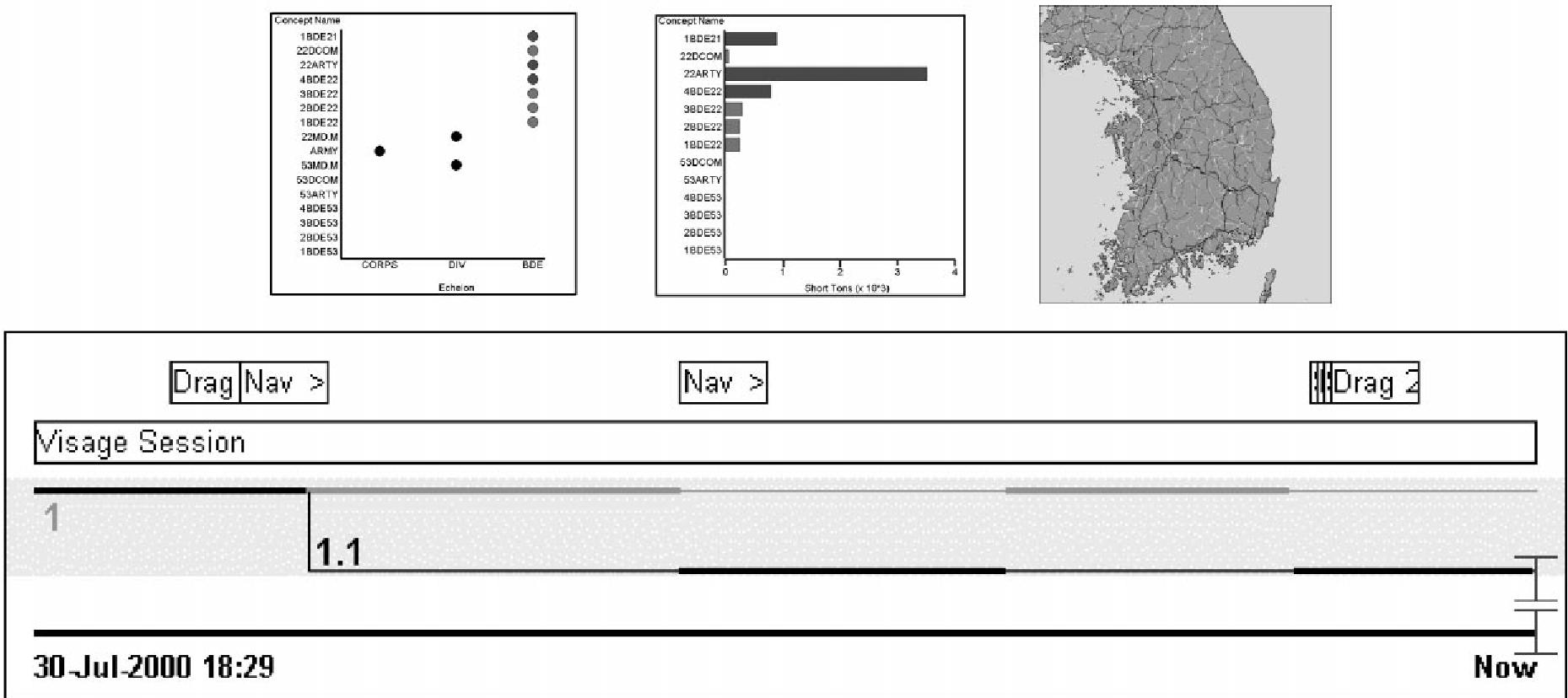 In this example, the user successfully replayed a complex analysis (originally done on one army division) onto a different division by simply dragging the "event" across the tree.
Key Technical Achievement:
- Automatic State Capture: Because the context layer sits on the database, developers don't need to write manual
undo()methods for new features. The database handles the versioning of every attribute automatically. - Efficiency: Querying history is linear relative to the number of updates, which remains snappy for thousands of interactions.
Critical Analysis & Conclusion
The Takeaway
This paper is a masterclass in applying formal AI concepts (Contexts and Situation Calculus) to solve practical HCI problems. It elevates the "History" panel from a utility to a central part of the analytical logic.
Limitations & Future Work
- Cognitive Overload: Navigating a complex tree of hundreds of branches could become as confusing as the linear history it seeks to replace.
- Temporal Domains: The authors acknowledge that if the data itself also has a time dimension (e.g., a budget for the year 2027), managing "User Time" vs. "Domain Time" requires a dual-slider approach that might be too complex for average users.
Future Outlook: As we move toward AI-augmented interfaces, the ability for an agent to "look back" through a branching history to understand a user's intent or "branch out" to simulate multiple outcomes will be foundational. This work provided the early blueprint for that future.