
Social Query: Transforming Facebook Statuses into Actionable Knowledge
Enhancing the Status Message Question Asking Process on Facebook
This paper introduces Social Query, a mobile application designed to improve Status Message Question Asking (SMQA) on Facebook. It integrates Question Rephrasing, Expert Search Filtering, and Expertise Finding to increase the response rate and quality for users seeking help within their social network.
TL;DR
Social Query is a mobile app that optimizes the "Status Message Question Asking" (SMQA) process on Facebook. By combining automated rephrasing tips, demographic filters, and expertise ranking algorithms, it helps users target the right friends with the right words, significantly increasing the odds of receiving high-quality answers.
The Problem: The "Shouting into the Void" Dilemma
While Social Networks (SNs) are vast repositories of knowledge, asking a question via a status update is often hit-or-miss. Two major hurdles exist:
- Algorithmic Friction: Facebook’s news feed algorithm doesn't guarantee your resident "tech expert" friend will ever see your plea for PC building advice.
- Human Friction: Users often phrase questions poorly—too long, too vague, or lacking context.
The authors argue that "broadcasting" is inferior to "directing." However, directing requires knowing who to ask, which is a complex cognitive task for the user.
Methodology: The Three Pillars of Social Search
The Social Query app introduces a structured workflow called the Question Analyzer, which moves the user through three critical stages:
1. Rephrasing & Filtering
The system analyzes the text to suggest improvements (e.g., "be more specific," "limit to one sentence"). Simultaneously, it allows users to apply filters like Gender, Age, Profession, or Location to ensure the expertise search is contextually relevant.
2. Expertise Finding (EF) Engine
The app implements three distinct Information Retrieval (IR) models to identify experts among a user's friends:
- Vector Space Model (VSM): Uses TF-IDF and Cosine Similarity to match question text with friends' profile content.
- Voting Model: Treats expertise as a popularity/retrieval problem where profile documents count as "votes."
- PageRank: Evaluates the authority of a user within the social graph based on past interactions.
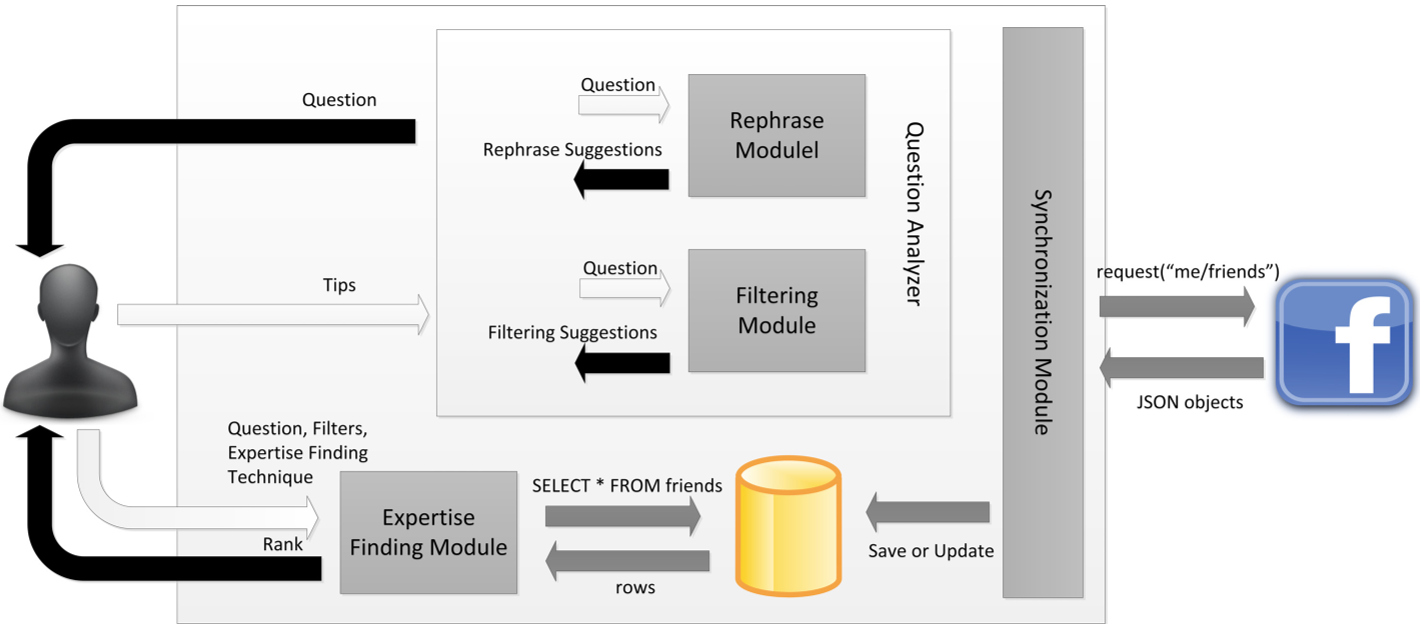 Figure 1: The system architecture highlighting the Synchronization, Expertise Finding, and Filtering modules.
3. Directed Tagging
Instead of a general post, the app helps the user "tag" the identified experts directly in the post, ensuring the Facebook notification system forces visibility to the most capable responders.
 Figure 2: The mobile interface guiding the user from phrasing to expert selection.
Experimental Results & User Perception
The authors validated the concept through a study with 250 Facebook users.
- Utility: The Expertise Finding Engine and Filtering Engine were the highest-rated features, considered "Useful" or better by the vast majority of participants.
- Expertise vs. Social Ties: Interestingly, users valued "Truth" and "Accuracy" far more than "Personalization" or "Friendship Bond." This suggests that users view SMQA as a functional tool rather than just a social interaction.
- Demographic Filtering: While Age and Profession filters were highly accepted, the Gender Filter proved controversial, showing a significant divide in perception between male and female respondents.
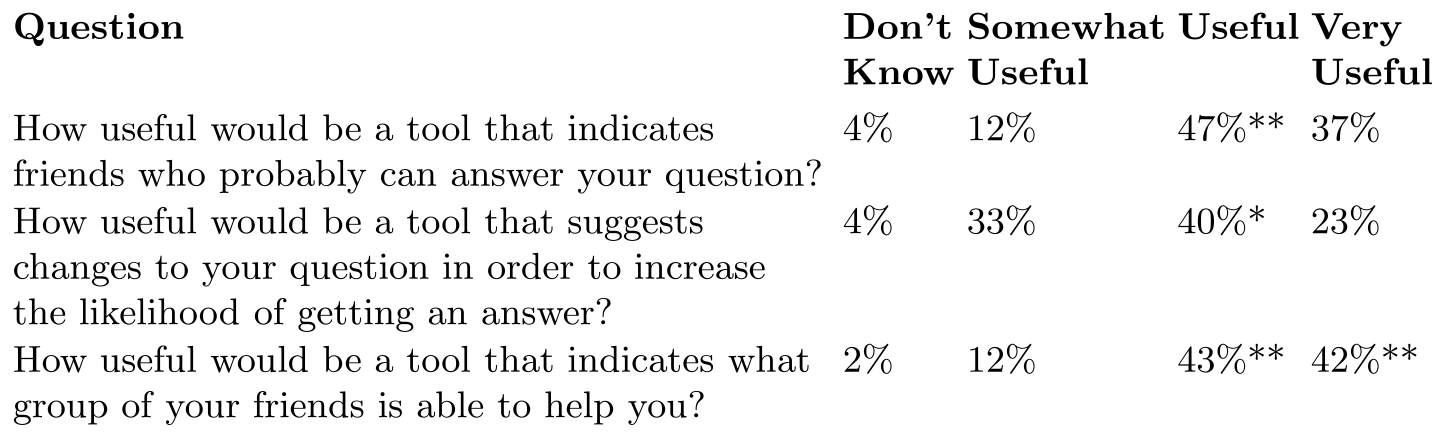 Table 1: User feedback on the perceived utility of Social Query’s core features.
Critical Insight: The Value of "Local" Expertise
Most prior research on expertise finding (EFS) focuses on finding global experts (e.g., the top programmers on Twitter). This paper highlights the value of Local Context. An "average" expert within your circle of friends is more likely to help you than a "top-tier" global expert who doesn't know you. Social Query bridges this gap by quantifying the "social capital" already present in a user's friend list.
Conclusion
Social Query provides a blueprint for making social networks smarter. While the current implementation relies on classical IR models, the framework is perfectly positioned for future integration with LLMs for more nuanced semantic matching. The work proves that users are willing to undergo a more "guided" process if it guarantees a higher probability of solving their problems.
Future Work: The authors aim to incorporate user reputation (social credit) and extend the search to "friends-of-friends," effectively expanding the searchable knowledge base while maintaining the trust of social proximity.