
Social Information Retrieval: Beyond Keywords to the Wisdom of Crowds
Enhancing information retrieval performance by using social analysis
The paper introduces a Social Information Retrieval (SIR) model that enhances search performance by integrating social signals. It combines a personalized query expansion mechanism with a novel "Social Score" metric that evaluates user reliability and content feedback, achieving a significant improvement in precision and recall on social media datasets.
TL;DR
This research moves Information Retrieval (IR) from a static "content-matching" paradigm to a dynamic social process. By introducing a Social Score that evaluates user reliability (objectivity and activity volume), the authors demonstrate that search results can be significantly refined. Tested on a massive social media dataset (93,000+ items), the method boosts precision by 10% through a clever combination of K-means clustering for query expansion and user-weighting metrics.
Background: The Limits of Traditional IR
Traditional search engines are inherently "lonely"—they look at the text of a document and the text of your query and try to find a bridge between them. However, in the era of Web 2.0, documents are no longer static. They are alive with comments, tweets, and interactions. The authors identify two major gaps in prior work:
- Vocabulary Mismatch: Users and authors often use different words for the same concept.
- Feedback Noise: A "like" or a "comment" doesn't mean the same thing from everyone. A user who hates everything (a "pessimistic" user) should have their negative feedback weighted differently than a balanced reviewer.
Methodology: The Social Scoring Engine
The proposed model operates in a sophisticated 8-step pipeline, but its heart lies in the Social Score Computation.
1. Query Expansion via Clustering
To solve the vocabulary gap, the system doesn't search the entire database. Instead, it uses K-means clustering to group similar documents. When a user submits a query, the system identifies the nearest cluster and pulls "decisive terms" from that cluster to expand the query, providing immediate context that the user might have missed.
2. The Weight of Reliability
The most innovative part of the paper is how it handles the "Wisdom of the Crowds." Instead of treating all user feedback equally, it calculates a weight based on:
- Objectivity (): Does the user provide both positive and negative feedback? If a user has given both types of opinions, they are considered more reliable/objective.
- Activity Volume (): How many subjects has the user annotated?
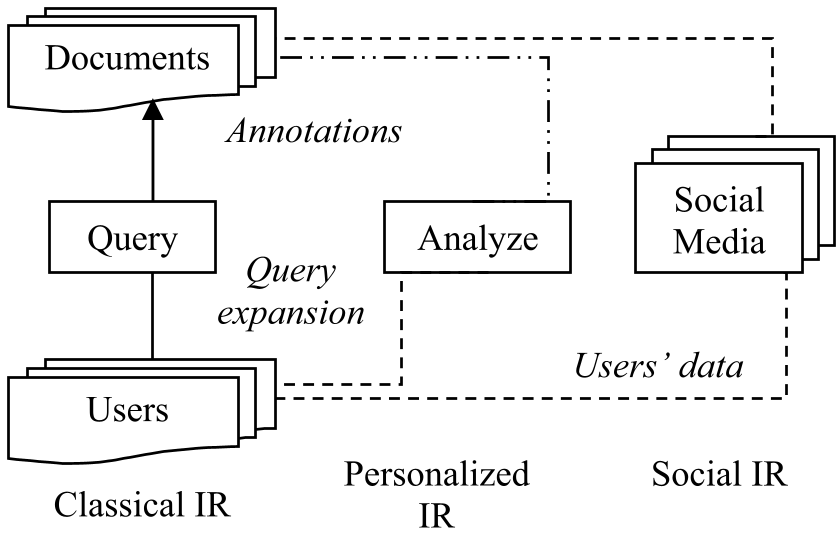 The model integrates social signals as a second source of truth to refine the IR process.
3. Document Weighting
The final document score is not just its similarity to the query, but the sum of the weights of the users who interacted with it, multiplied by the sentiment of their interaction ( for positive, for negative).
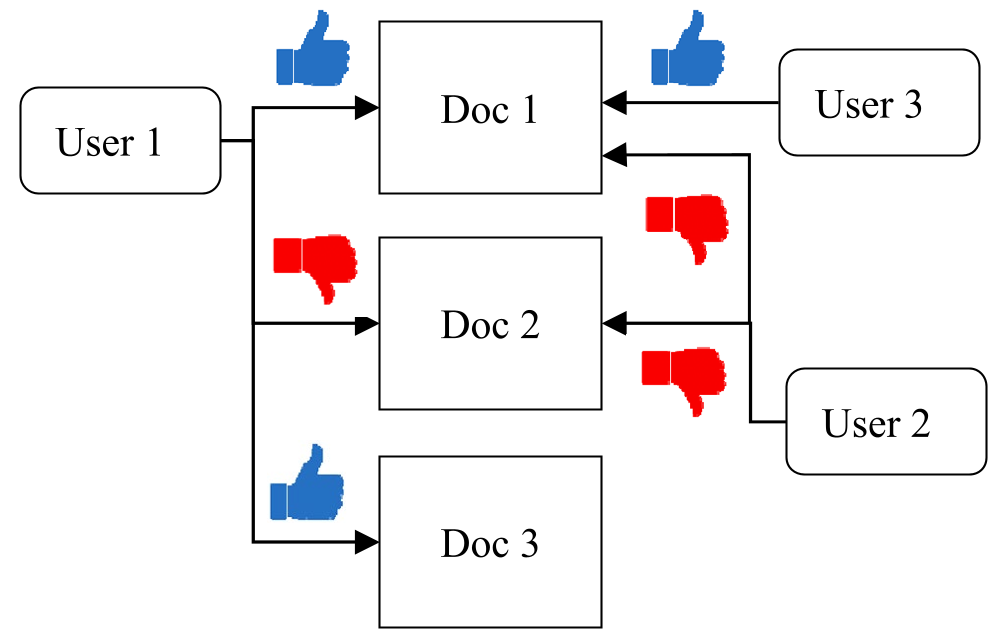 Formulaic representation of how user reliability weights are translated into document rankings.
Experimental Validation
The authors tested their model on a diverse dataset covering topics like Economy, Microsoft, Obama, and Palestine.
Significant Performance Gains
The results prove that adding social data layers progressively improves search quality:
- Standard IR: Recall 83.5% | Precision 85.0%
- Query Expansion: Recall 92.8% | Precision 91.2%
- Full Model (+User Analysis): Recall 93.5% | Precision 91.3%
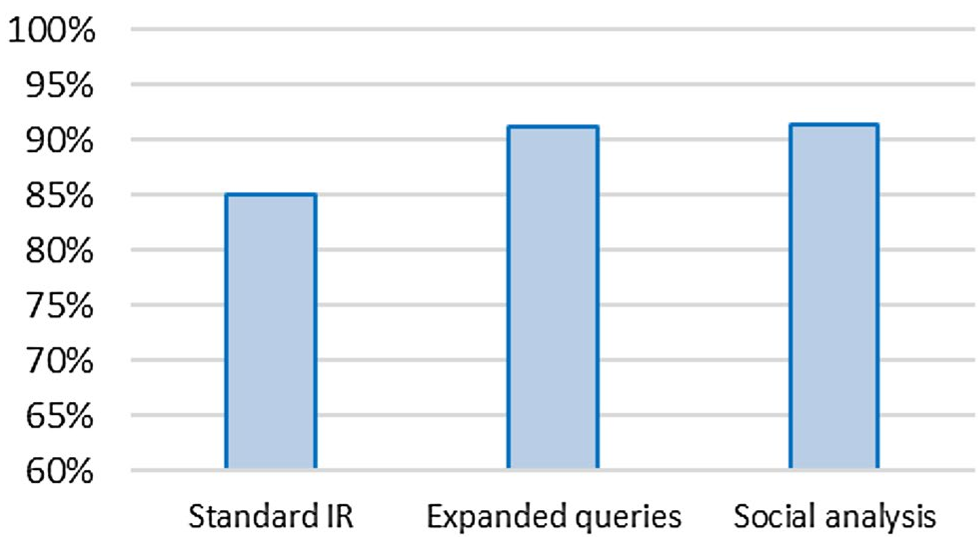 The precision-recall curve illustrates the clear advantage of integrating document and user analysis over traditional baselines.
Critical Insight: The Reliability Gap
The paper honestly addresses a key limitation: Data Sparsity. The social score depends heavily on the volume of existing feedback. If an author has very little history, the system's "knowledge base" is reduced, making it harder to assign a reliable weight. This suggests that for new platforms with low user engagement, the model might initially revert to standard query expansion performance.
Conclusion & Future Horizons
By quantifying "user reliability," this work provides a framework for making sense of the messy, heterogeneous world of social media data. It proves that the identity and behavior patterns of the querier and the annotator are just as important as the content itself.
Future extensions of this work could involve Time-Sensitivity—recognizing that social opinions change over time—and exploring how external knowledge bases like DBpedia can further enrich the initial query expansion phase.