
Socializing the Streets: Lessons from a Decade of Hybrid Urban Interaction
Enhancing interactive public displays with social networking services
The paper explores "UBI-hotspots," an interconnected network of large-scale interactive public displays in Oulu, Finland, integrated with Social Networking Services (SNSs). By leveraging APIs from platforms like Facebook and Flickr, the study demonstrates how personalized and socially-driven applications can overcome "display blindness" and foster community engagement in urban environments.
TL;DR
Researchers from the University of Oulu deployed a network of "UBI-hotspots"—57-inch interactive displays—across a city center to study how social networking services can revive public interest in digital signage. The study proves that public interaction is inherently social, and services that allow for group play and bridge physical activities to online profiles (like Facebook) are the only ones that achieve sustained engagement.
The Problem: The Invisible Screen
Despite the proliferation of digital billboards, we have become experts at ignoring them—a phenomenon the authors call Display Blindness. Most public displays provide static or irrelevant information, offering no "perceived utility." The research team hypothesized that by injecting Social Capital into these screens via Social Networking Services (SNSs), they could transform "cold" outdoor hardware into "warm" community touchpoints.
Methodology: The UBI-Hotspot Ecosystem
The researchers didn't just build a screen; they built a testbed. Each UBI-hotspot was equipped with:
- 57" Full HD Touchscreens for direct interaction.
- Bluetooth and NFC for "pairing" the display with a user's personal identity.
- Embedded Cameras for social content creation.
- SNS Integration: Using APIs from Flickr (for photos) and Facebook (for identity and sharing).
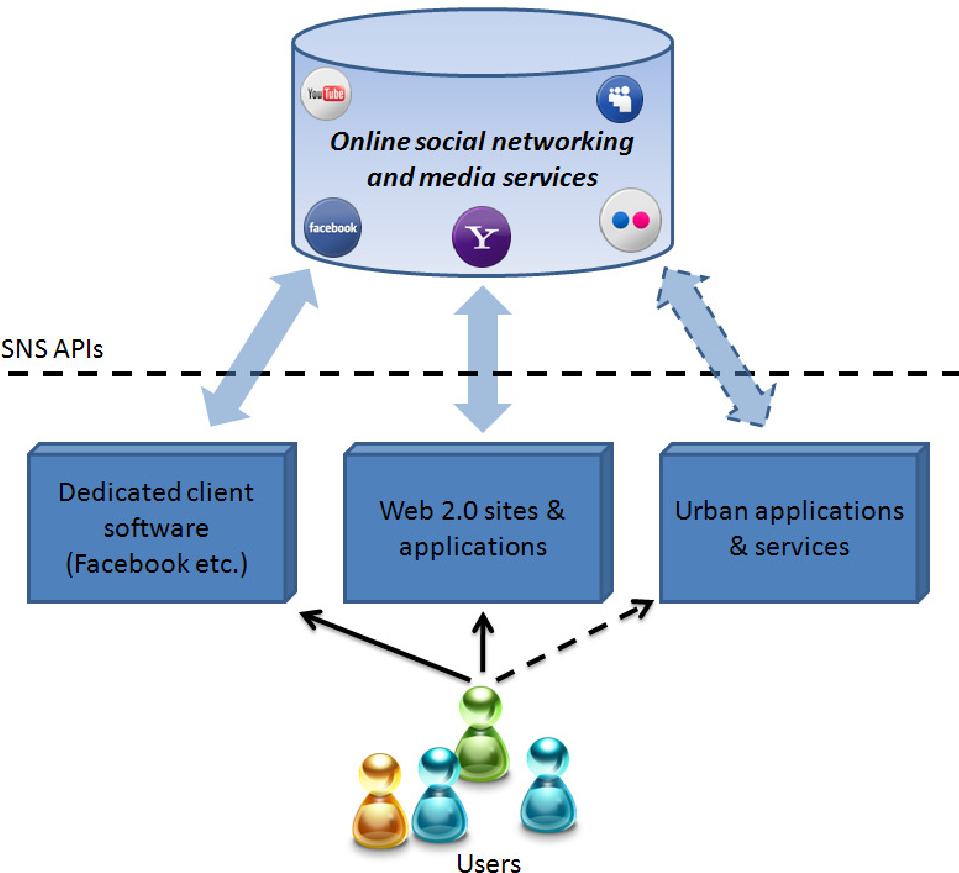 Figure 1: Conceptual model of leveraging SNS APIs to power public display services.
The crown jewel of their service suite was UBI-postcard. Unlike a standard photo gallery, this service encouraged users to strike a pose, add a digital frame, and send the result to friends. It successfully gamified the presence of a public camera.
Quantitative Success: What Actually Worked?
The data from the 10-month longitudinal study revealed a clear winner. While video services (UBI-videos) struggled due to the high effort required to consume long-form content in public, the UBI-postcard thrived.
 Figure 2: Performance metrics across different SNS-based services. Note the dominance of UBI-postcard in "meaningful sessions."
Key Insights from the Data:
- The "Group Effect": Users reported a strong preference (3.78/5) for using the hotspots with others. Public displays are not "personal computers"; they are "stage backgrounds" for collective experiences.
- Instant Gratification: Services that required significant "work" (like uploading video via Bluetooth) failed. Users want low-friction interaction.
- Identity Pairing: Integrating Facebook profile pictures directly onto the display UI provided a "personalization" that made users feel the technology belonged in their urban environment.
Critical Analysis: The Challenge of Persistence
While the study was a success, it highlighted a major hurdle: Novelty Wear-off. As shown in the monthly logs, total launches decreased over time. To combat this, the authors suggest that content must be dynamic and "situated"—the display must adapt to the specific social context of the people standing in front of it at that exact moment.
Conclusion and Future Outlook
This work serves as a foundational blueprint for Urban Computing. It tells us that the future of the "Smart City" isn't just about efficiency or sensors; it's about the "Social Surroundings." For technologists, the takeaway is clear: If you are building for the public, don't build a kiosk—build a catalyst for social interaction.
Limitations to Consider: The study noted that while youth adopted the tech eagerly, elderly users required "guided walkthroughs." Bridging the digital divide remains a significant barrier for ubiquitous urban interfaces.