
Beyond Distance: Enhancing Virtual World Realism through Social Proximity
Enhancing Navigation in Virtual Worlds through Social Networks Analysis
The paper introduces a Social Network Analysis (SNA) approach to enhance realism in Virtual Worlds (VWs) by dynamically adjusting avatar rendering quality. By calculating social proximity across multiple platforms, the system prioritizes high-fidelity rendering for known acquaintances in crowded virtual scenes, mimicking human cognitive mechanisms.
TL;DR
In the quest for "Realism" in Virtual Worlds (VWs), we often focus on ray-tracing and haptics. This paper argues that realism is actually a perceptual and social problem. The authors propose a system that uses Social Network Analysis (SNA) to render friends in high detail while leaving strangers as "background noise," effectively transposing human cognitive focusing mechanisms into digital spaces.
Background: The "Clonal Crowd" Problem
If you've ever spent time in a crowded virtual space like Second Life or Solipsis, you’ve faced the ambiguity problem. Because the number of available base avatars is limited, everyone looks similar. To find a friend, you have to read floating text labels—a process that is neither natural nor immersive.
Current rendering engines use a simple Distance-Based Level of Detail (LoD): if an object is physically close to your camera, draw it with high polygon counts. If it's far, simplify it. This paper argues this is fundamentally flawed because humans don't prioritize by distance alone; we prioritize by relevance.
Methodology: Socially-Aware Rendering
The authors shift the paradigm from Physical Distance to Social Proximity.
1. The Multi-Source Social Graph
The system doesn't just look at who you talk to in the virtual world. It aggregates interactions from external platforms (Facebook, Twitter, etc.) into a unified directed graph .
2. Computing Proximity
The core of the method is a proximity formula that weights interactions across different social networks:
 This ensures that a "Best Friend" on Facebook is rendered with high fidelity in the VW, even if you’ve never met their avatar before.
3. Social Display Definition (SDD)
Instead of a binary "Show/Hide," the authors propose three zones of detail based on proximity thresholds:
- Z1 (Proximity > 0.75): Very High Definition (VHD).
- Z2 (Proximity 0.4 - 0.75): High Definition (HD).
- Z3 (Proximity < 0.4): Medium/Low Definition.
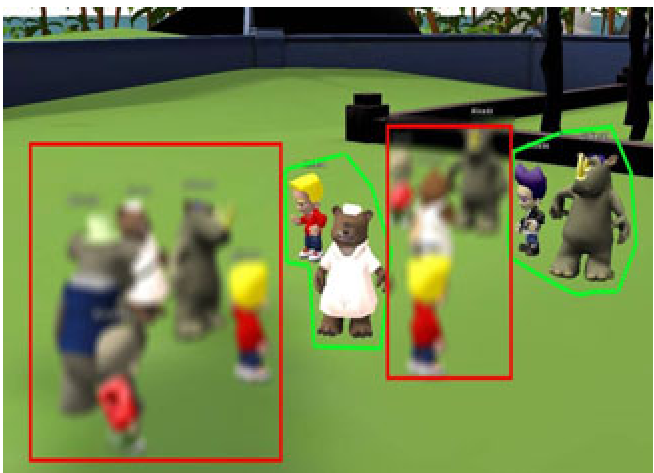 In the figure above, acquaintances are rendered with distinct features (rectangles), while strangers remain blurred silhouettes (circles).
Experiments and Infrastructure
The authors integrated this logic into Solipsis, a decentralized P2P virtual world. They tested the system on a network of HP EliteBooks, simulating crowded scenes with 20 concurrent avatars.
Key Observation: The experiment focused on whether this additional "Social Layer" would bog down the system. The results indicated that while it doesn't yet provide a massive "optimization" (due to existing implementation overheads), it does not worsen the performance. The real value is the Cognitive Load reduction for the user.
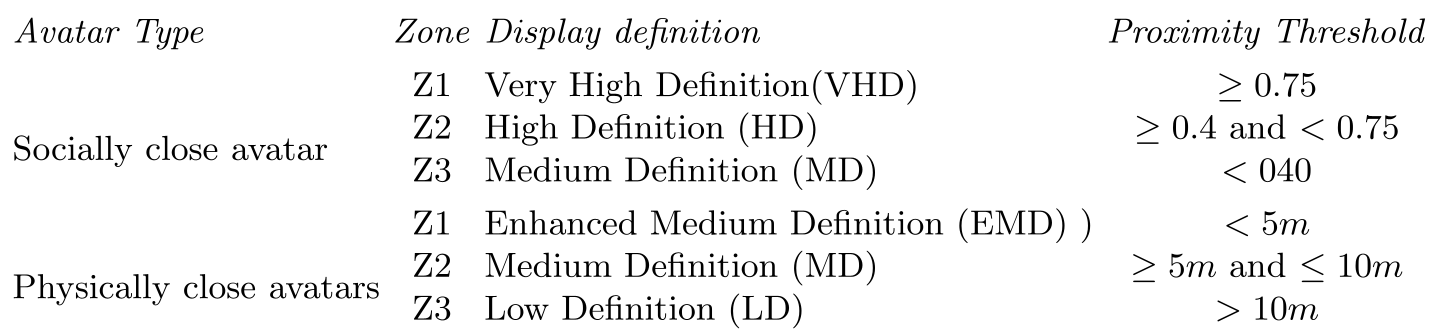 The threshold table mapping social proximity to specific display definitions.
Critical Insight: The "Open" Metaverse
The most profound takeaway from this paper is the concept of Open Virtual Worlds. Most modern VWs are "walled gardens"—what happens in the game stays in the game. This paper suggests that the Metaverse should be an extension of our existing social existence. By reaching out to the "Wormholes of communication" (external APIs), the VW becomes a smarter, more personalized environment.
Limitations & Future Work
The authors acknowledge a few hurdles:
- System Overhead: Currently, the logic for checking social proximity adds a layer of computation that balances out the savings from rendering fewer polygons.
- Privacy: Injecting external social data into a VW raises questions about how much "closeness" information should be shared between clients.
- User Testing: The current study is technical; the next step is a qualitative study to see if users actually feel more immersed.
Conclusion
By moving away from "Distance = Detail" and toward "Social = Detail," this research provides a blueprint for managing the chaos of future crowded metaverses. It’s a step toward a digital world that doesn't just look like the real world, but feels like it by respecting our natural cognitive biases.