
LBSN-Enhanced MONs: Bridge the Gap in Opportunistic Networking with Social Intelligence
10236_Enhancing opportunistic networking using location based social networks.
The paper proposes a novel architectural framework that enhances Mobile Opportunistic Networks (MONs) by integrating Location-Based Social Networks (LBSNs) with Software-Defined Networking (SDN). By leveraging machine learning to analyze social "check-ins" and movement patterns, the system aims to pre-calculate movement probabilities to optimize data routing in intermittently connected environments.
TL;DR
Mobile Opportunistic Networks (MONs) have long struggled with the "fragmentation" problem—where nodes move in and out of range, making stable routing nearly impossible. This paper proposes a paradigm shift: instead of guessing where a node might go, why not utilize the social check-ins from Location-Based Social Networks (LBSNs)? By integrating LBSN data into an SDN-based controller, the authors create a predictive routing engine powered by machine learning.
The "Blind Routing" Problem
Traditional routing protocols in Delay Tolerant Networks (DTNs) often rely on "flooding" (sending data to everyone) or "probabilistic" methods based on past encounters. However, past behavior is not always a perfect indicator of future movement.
The core pain point is the Information Gap:
- Prior Work Limitation: Existing methods use internal network metrics (e.g., historical contact frequency) but ignore external social intent (e.g., a user checking into a café via Foursquare or Facebook).
- The Insight: Human mobility is highly social. If we know a user just checked into a location, we can predict their future presence and use them as a "data mule" for that specific geographical area.
Methodology: The Social-Aware SDN Architecture
The authors propose a multi-layered architecture where the network is managed by a centralized Network Controller—an approach derived from Software-Defined Networking (SDN).
1. Social Network Entity (SN System)
This is the "brain" of the operation. It consists of four critical sub-components:
- SN Connectivity: Manages API keys and crawls data from social platforms.
- Data Determination: Maps Radio Access Technology (RAT) range to social media users within that specific boundary.
- MLE Training: The Machine-Learning Engine that digests social data to create context-aware mobility profiles.
- Intelligent Routing: The final decision-making layer that selects the best route based on the probability of a node reaching its destination.
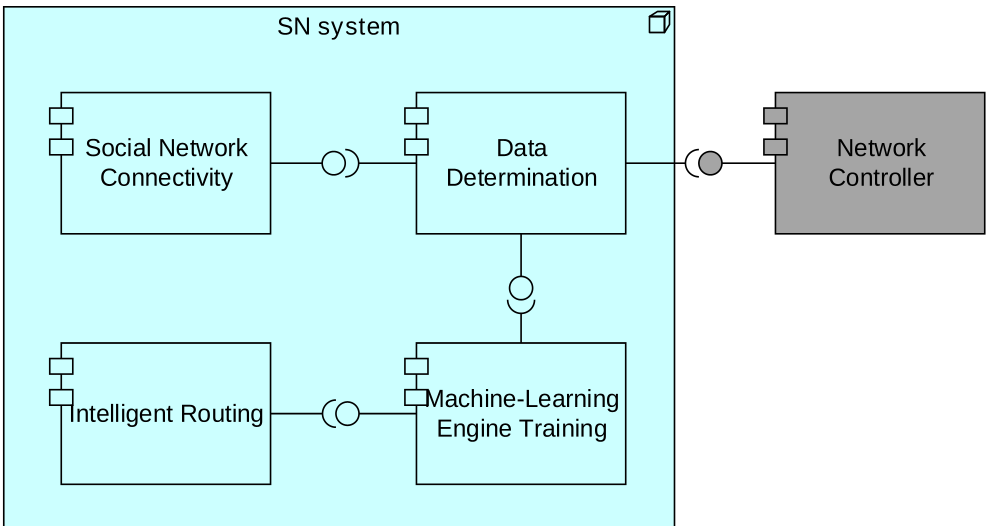 Figure 1: The high-level deployment architecture showing the interaction between the SDN Controller and the Social Network components.
2. The Machine Learning Engine (MLE)
The paper emphasizes the move from raw data to "Inferred Knowledge." By combining RAT context (physical signal strength/range) with SN context (social check-ins), the system trains an MLE that identifies the most reliable "next-hop" candidates.
From Business Logic to Application Functions
One of the paper's strengths is its rigorous mapping using the ArchiMate® framework. It bridges the gap between high-level business needs (efficient data delivery) and low-level application functions (API key retrieval, database storage).
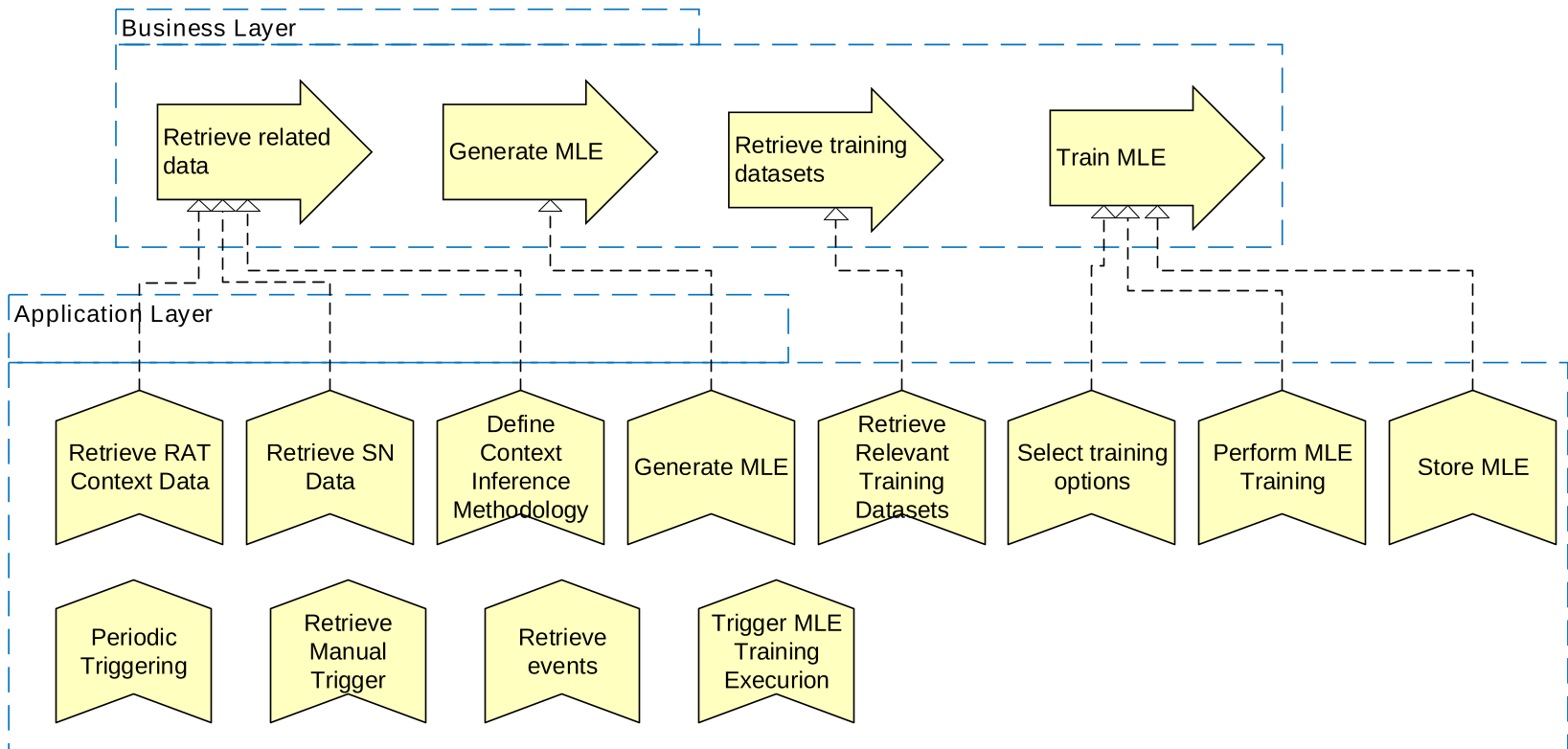 Figure 2: The detailed mapping of the Machine-Learning Engine Training service from business processes to specific application functions.
Critical Insight & Future Outlook
This work sits at the intersection of Social Computing and Mobile Networking. While many papers focus on the physics of the wireless signal, Lambrinos and Kosmides argue that the intent of the human carrier is just as important.
Takeaways
- Predictive Power: Check-in data provides a "future-looking" metric that historical mobility data lacks.
- SDN as an Enabler: Centralizing the routing decision in an SDN controller allows for the heavy lifting of Machine Learning to be done off-device, saving battery for the mobile nodes.
Limitations
As an architectural proposal (published in 2016), the paper focuses more on the specification and design than on large-scale quantitative field tests. The effectiveness of this system depends heavily on the density of LBSN check-ins and the privacy policies of social platforms, which have become significantly more restrictive in recent years.
Conclusion
By treating mobile users not just as signal repeaters, but as social entities with predictable destinations, this architecture provides a blueprint for more resilient IoT and 5G environments where connectivity is an exception, not a rule.