
Group Context: Balancing Social Collaboration and Individual Privacy
Enhancing privacy in social applications with the notion of group context
The paper introduces the concept of "Group Context" for social applications, a mechanism that separates individual context data from information shared within a group. It proposes a negotiation-based process to establish common situational knowledge while preserving user privacy through obfuscation and policy-driven filtering.
TL;DR
In the era of pervasive social computing, sharing your "context" (where you are, what you're doing) is essential for collaboration but a nightmare for privacy. This paper proposes a negotiated Group Context framework. Instead of exposing raw personal data, users negotiate what details to share, allowing groups to function—such as finding a common meeting spot—while keeping individual data safely obfuscated.
Background: The Context Gap
Traditional context-aware systems are "self-centered." They know your location and your activity. However, social interactions like a group of travelers in a new city require a shared reality. Prior work often ignored the privacy implications of merging these personal "bubbles" into a group view. The authors of this paper argue that a group context should be a distinct entity, resulting from a consensus rather than a simple data dump.
Problem: The Privacy Dilemma in Social Apps
When you join a "European Capital Visitors" group, you want to see who is nearby, but you might not want every stranger in the group to have your exact GPS coordinates. Existing systems lack:
- Clear boundaries between personal and shared information.
- Negotiation mechanisms to decide how much detail (Level of Detail - LoD) is actually necessary for a specific task.
- Policy enforcement that bridges the gap between individual privacy and group functionality.
Methodology: The Core of Group Negotiation
The researchers propose a two-phase process to establish trust and functionality:
1. Modeling with Abstraction
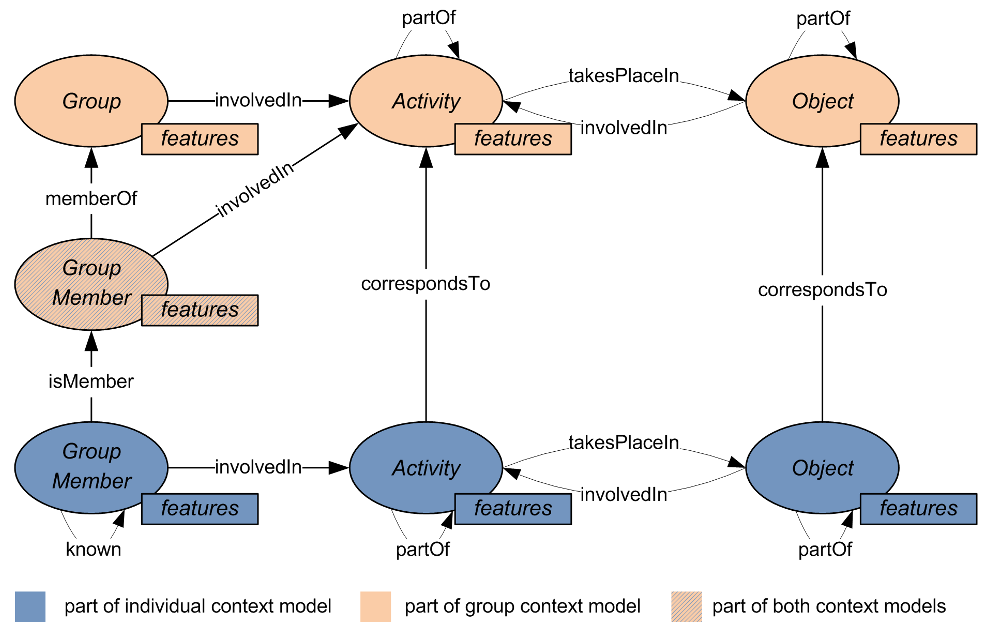
Individual context is modeled using persons, objects, and activities. To protect privacy, the authors use ontological hierarchies. For instance, an activity can be shared at different levels:
- Detailed: "Sightseeing at the Louvre"
- Abstract: "Leisure Activity"
2. The Negotiation Process
Before any context data is sent, the group founder distributes a Policy Proposal. This proposal defines:
- Which context features are needed (e.g., location, device type).
- The maximum level of detail allowed.
- Visibility (Internal to group vs. External to public).
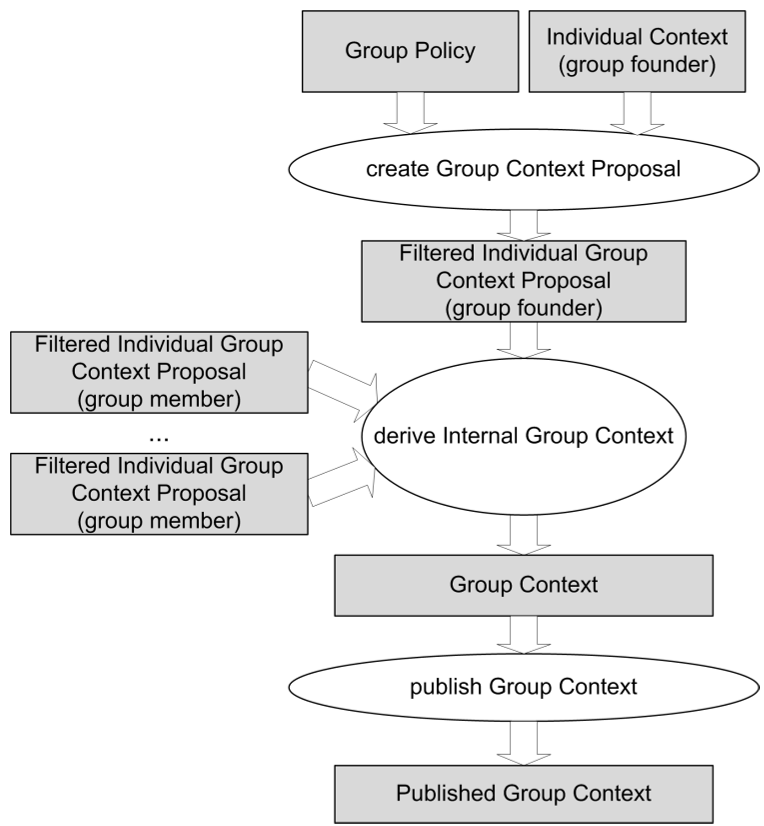
Only after all members agree on these "terms of service" does the system filter and obfuscate their individual data to create the Group Context.
Experiments & Results: Prototype Feasibility
To prove this isn't just theory, the team built a prototype for Android using the Mobilis framework and XMPP.
Key Implementation Details:
- Ontologies: Used OWL DL to describe policies and hierarchies.
- Filtering: A context service component acts as a "Trust Anchor," processing a user's raw data and only releasing the "filtered" version to the group.
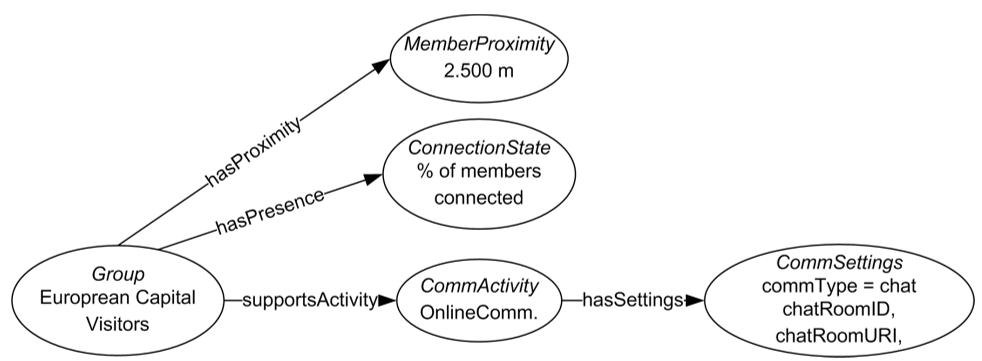
- Outcome: In a test scenario for "Online Communication," the system successfully derived a
MemberProximityvalue. This allowed members to see how far apart they were without the app ever knowing or sharing their actual coordinates.
Critical Insight & Conclusion
Takeaway
The genius of this work lies in the decoupling of data from functionality. By negotiating a "Lowest Common Denominator" (e.g., all members agreeing to chat because one member has a low-bandwidth device), the group preserves both its technical and social integrity.
Limitations
The current approach relies heavily on a "Group Founder" or coordinator to manage negotiations. In highly dynamic, hierarchy-free groups, the overhead of constant re-negotiation (as members join or leave) could become a bottleneck for mobile device battery and user patience.
Future Outlook
This paper sets the stage for "Privacy-by-Negotiation." As AI and pervasive sensing become more intrusive, the ability for our devices to automatically negotiate our "social presence" without leaking our "private essence" will be a cornerstone of secure social networking.