
Beyond Accuracy: Solving the "Weak Class" Problem in Biological Data Mining
Enhancing Recognition of a Weak Class – Comparative Study Based on Biological Population Data Mining
The paper investigates strategies to improve the "weak class" recognition in binary classification within biological population datasets (animal breeding). It evaluates Boosting, non-symmetric misclassification costs, and metalearning (ensembling), finding that a combination of boosting with cost-sensitive learning yields the best balance between sensitivity and specificity.
TL;DR
In biological population studies, classification models often fail to recognize critical minority indicators—a phenomenon known as the "Weak Class" problem. This study discovers that standard metalearning (ensembling) often worsens this bias. Instead, the authors demonstrate that fine-tuned Boosting (5 iterations) combined with non-symmetric misclassification costs provides the most robust path to balancing sensitivity and specificity.
The "Weak Class" Dilemma in Life Sciences
Predicting traits in animal breeding (like horse height) isn't just about general accuracy; it's about identifying specific biological markers. Even with balanced datasets (e.g., 2521 vs 2333 samples), typical models like Logistic Regression or Decision Trees exhibit an inherent bias. They achieve high overall accuracy by "playing it safe" on the majority pattern while effectively ignoring the minority or "weak" class.
The motivation here is clear: in breeding, failing to identify a high-value offspring (a "1") is more costly than mislabeling a standard one. Conventional metrics like Accuracy mask this failure; we need Sensitivity.
Methodology: Tuning the Learning Bias
The researchers compared four distinct strategies to rescue the weak class:
- Iterative Boosting: Using sequences of models to focus on earlier errors.
- Cost-Sensitive Learning: Explicitly penalizing the model more for missing a "1" than for misclassifying a "0".
- Hybrid Approach: Combining Boosting with Non-Symmetric Costs.
- Metalearning: Voting across different architectures (NN, CHAID, etc.).
The Architecture of Comparison
The study utilized a variety of classical and modern statistical learners to establish a baseline.
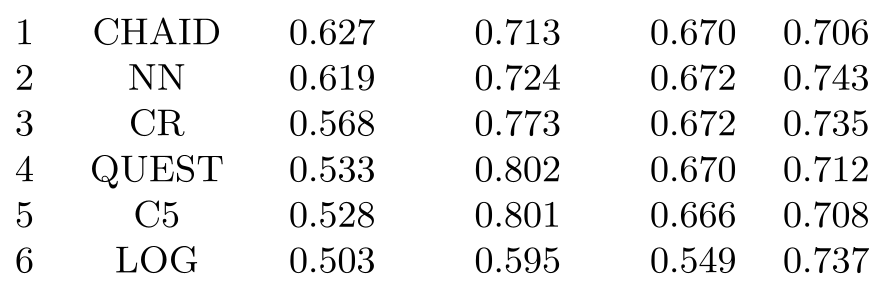
Table 2: Initial results show CHAID and Neural Networks (NN) leading, but struggling with sensitivity (recognition of class 1).
Key Insight 1: Why Metalearning Fails the Weak Class
One of the most striking findings is that adding more models to a "voting" ensemble actually decreased sensitivity. While a 2-model ensemble (CHAID + NN) showed a temporary boost, adding 3 or more models caused the ensemble to regress toward the majority consensus. In biological data where signals are faint, "wisdom of the crowd" tends to drown out the nuanced signals of the weak class.
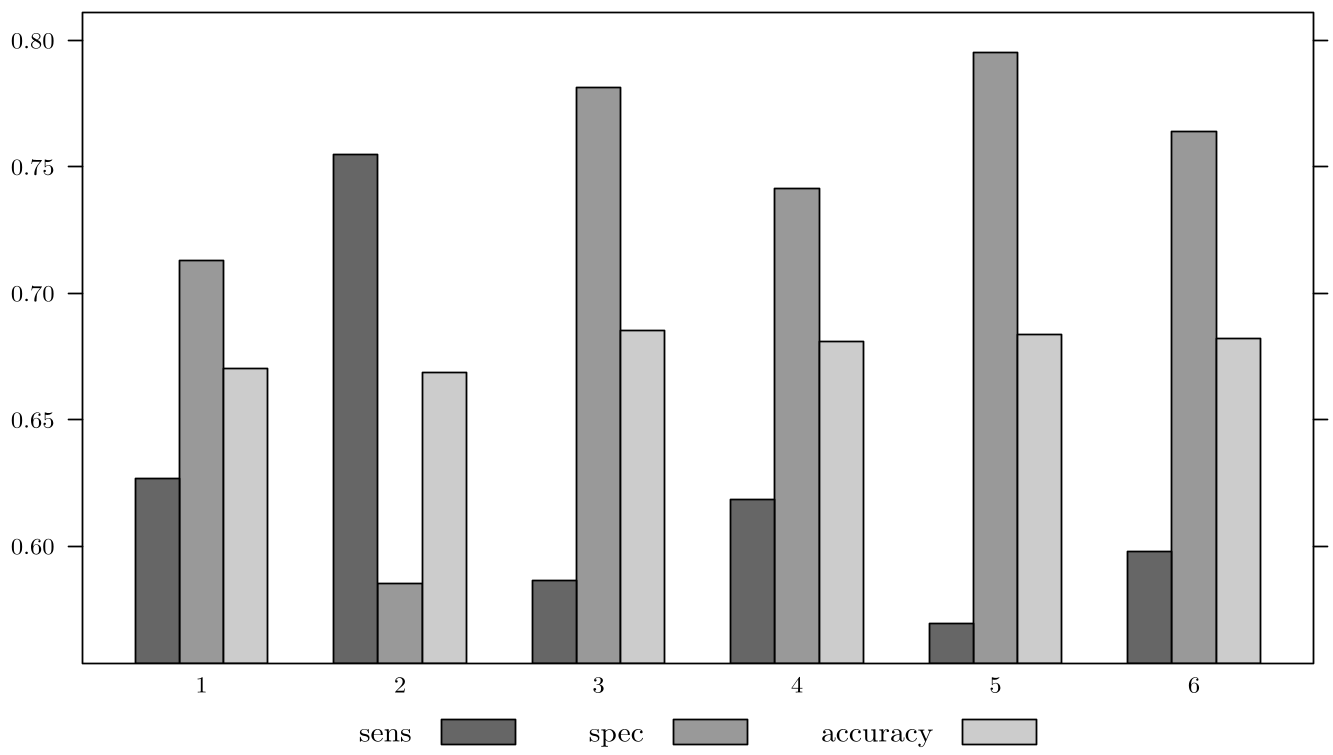
Fig 5: As the number of models increases, Sensitivity (Weak Class recognition) drops sharply.
Key Insight 2: The "Sweet Spot" of Boosting
The authors found that the common industry practice of using 10 boosting iterations is non-optimal for this data. Sensitivity peaked at 5 models and then deteriorated. This suggests that over-boosting leads the model to overfit the noise inherent in biological zoometric data, rather than refining the class boundary.
The Winning Strategy: Hybrid Cost-Boosting
The most effective balance was achieved by using C5.0 Boosting and introducing a non-symmetric cost factor (approx. 1.3 to 1.4) for misclassifying the weak class. This "nudges" the decision boundary in the latent space, forcing the booster to prioritize the under-represented signal.
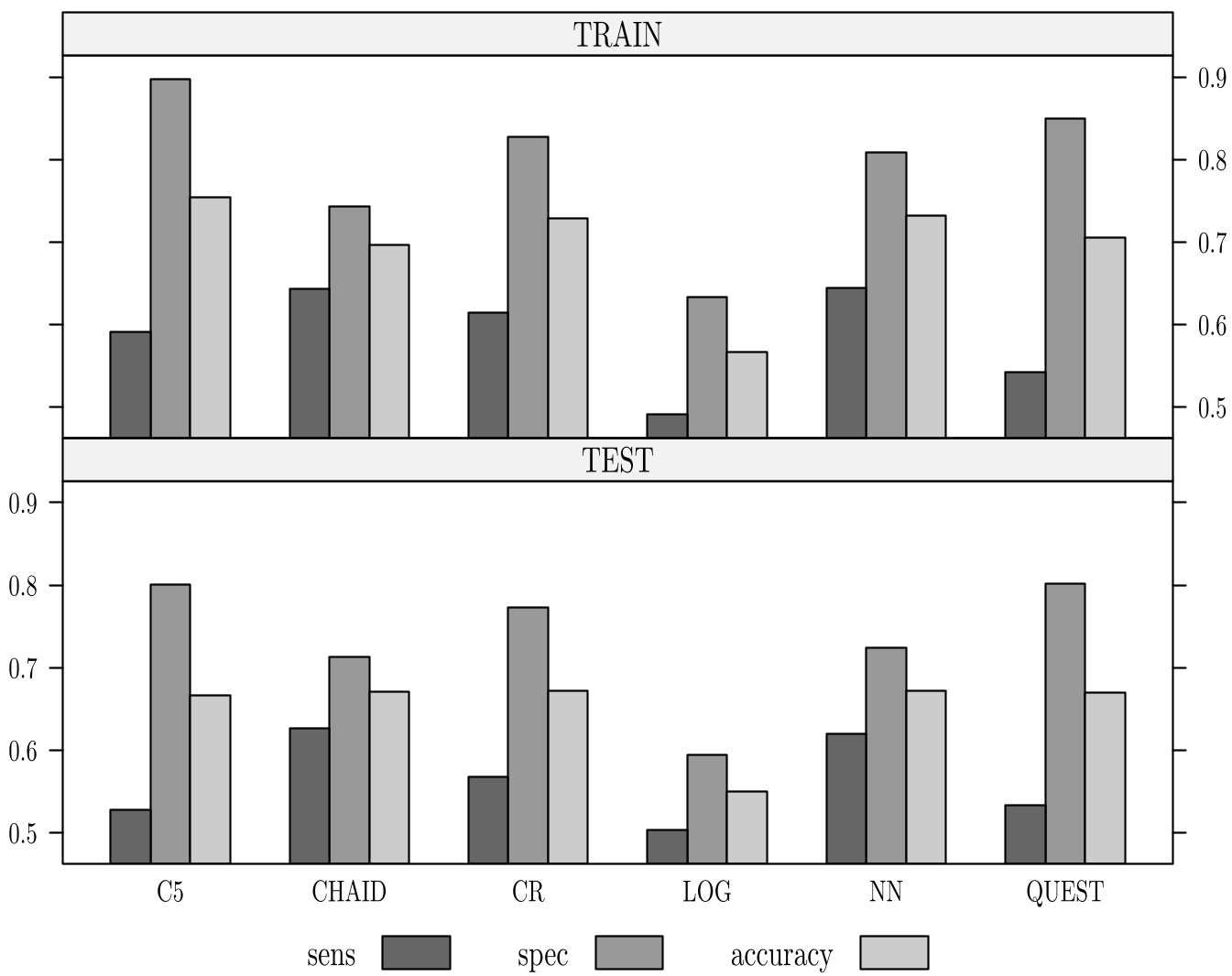
Fig 4: By combining boosting with a cost factor of 1.3, the model finally reaches a point where Sensitivity and Specificity are balanced.
Conclusion & Critical Analysis
Takeaway
For practitioners in life sciences, this paper serves as a warning against "Black Box Ensembling." In the presence of missing values (~23%) and noisy biological traits, the most effective tool is Cost-Sensitive Boosting with manually tuned iterations.
Limitations
While the study provides a robust empirical roadmap, it is limited to traditional tree-based methods and shallow NNs. Modern Gradient Boosting Machines (like LightGBM or CatBoost) which have native handling for missing values and categorical data might offer even higher performance without as much manual hyperparameter "tipping."
Future Outlook
The move toward "Physiology-informed Machine Learning" might eventually replace these statistical cost-weighting tricks by embedding biological constraints directly into the loss function, rather than relying on empirical cost trial-and-error.