
Automatic Social Bridging: Empowering Users with Motor Disabilities through Automated OSN Messages
Enhancing social connections through automatically-generated online social network messages
The paper proposes an assistive technology framework that automatically generates and posts online social network (OSN) messages based on a user's digital activities. Primarily targeting individuals with severe motor disabilities, the system integrates with the "Camera Mouse" interface to bridge the communication gap between users, their families, and caregivers.
TL;DR
This research tackles the social isolation of individuals with severe motor disabilities by automating the creation of social media updates. By logging software activities and performance, the system allows users to "post" their daily achievements and thoughts to networks like Facebook or Twitter without the exhaustive manual effort of traditional text entry.
Problem & Motivation: The "Communicative Tax" of Disability
For most of us, posting a status update takes seconds. For a person using a head-tracker or a single-switch interface, typing "I just finished my homework" can take several minutes of intense physical concentration. This "communicative tax" means that people with disabilities often stay silent on social media, missing out on the vital social feedback that motivates learning and reduces loneliness.
Prior work often focused on making the interface easier to use, but these authors realized that the content generation itself is the bottleneck. They identified a need for "Autonomy without Exhaustion"—letting the software tell the story of the user's day automatically.
Methodology: From Activity Logs to Social Signals
The core of the proposed system is a bridge between Assistive Software (like the Camera Mouse) and Social Network APIs.
The Workflow Architecture
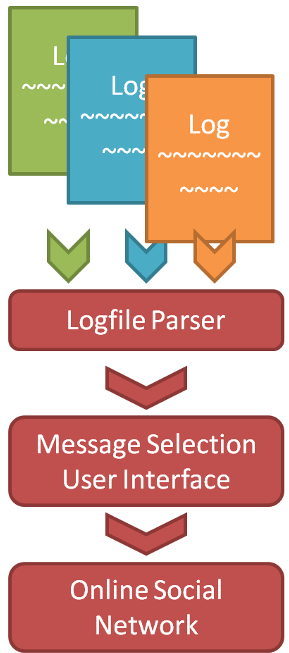
The system follows a three-step pipeline:
- Passive Logging: The software monitors what the user is doing (e.g., "Playing EagleAliens for 20 minutes" or "Researching history on Wikipedia").
- Active Annotation: The user can provide a quick "Like" or "Dislike" rating using a simple click or dwell-timer.
- Automated Transformation: At the end of a session, the software aggregates this data into a human-readable message: "I achieved a high score of 500 in EagleAliens today!"
 Caption: The flow architectural design showing how user activities are logged, processed through a UI, and pushed to social network APIs.
Case Studies: The Psychology of "Being Seen"
The authors conducted 5-month field visits with students with Cerebral Palsy. The findings were not just about technical feasibility, but psychological impact:
- The Incentive to Work: One student, L, noted that sharing her schoolwork scores would be "cool" because then her family would know "how much work I did."
- Competitive Motivation: Seeing a classmate's achievements online (like a "Points Economy") inspired others to use their assistive tools more frequently.
- Maintaining Connections: For homebound students, these automated updates acted as a digital lifeline to their classroom peers.
 Caption: A mock-up of the automated message interface. Users can choose to send or discard the message, preserving a layer of agency.
Critical Analysis & Future Outlook
While this work was published in 2011, its core insight—Log-to-Message—is more relevant than ever in the age of AI.
SOTA Comparison: Compared to manual AAC (Augmentative and Alternative Communication) devices, this method drastically increases "Social Throughput." However, as one participant, C (16 years old), pointed out, Privacy is a major concern. If every session is logged, do we risk creating a "Digital Panopticon" for the disabled user where caregivers see everything?
The LLM Evolution: Today, we could replace the static templates of 2011 with LLMs to create varied, expressive, and nuanced social posts from the same raw logs, further humanizing the automated presence.
Conclusion
This paper serves as a vital reminder that "Accessibility" isn't just about big buttons and high-contrast text; it's about reducing the cognitive and physical friction of human connection. By automating the mundane, we leave more room for the meaningful.
Main Citation: Magee, J. J., Kwan, C., Betke, M., & Hietpas, F. (2011). Enhancing social connections through automatically-generated online social network messages. ASSETS '11.