
From Brainwaves to Better Tweets: Enhancing Social Media with EEG-Powered AI
Enhancing Text Using Emotion Detected from EEG Signals
This paper introduces an end-to-end BCI-integrated text enhancement system that detects a user's emotional state via EEG signals and automatically injects emotive adjectives and adverbs into user-input text. The system achieves a 74.95% accuracy in classifying five emotions (Joy, Sadness, Anger, Fear, Surprise) and uses a CNN-LSTM language model to ensure the grammatical flow of enhanced sentences.
TL;DR
Have you ever been so frustrated that "I'm tired" didn't quite cover it? This paper presents a first-of-its-kind system that reads your brainwaves (EEG) to understand your mood and automatically suggests words like "ridiculous" or "miserable" to make your text more expressive. By combining Random Forest classifiers for brain data and CNN-LSTM models for natural language, the researchers achieved 74.95% emotion detection accuracy and high user satisfaction.
Background: The Gap Between Feeling and Typing
Most research in "Sentiment Analysis" focuses on teaching computers to understand what we wrote. But this paper flips the script: What if the computer could help you write what you feel?
The authors identify a common social media pain point: users often lack the vocabulary to match their emotional intensity. By leveraging Electroencephalography (EEG), the system taps into the "psychological component" of emotion—direct signals from the cerebral cortex—to provide a more authentic ground truth than mere text can provide.
Methodology: The Two-Pillar System
The architecture is split into two distinct modules: the EEG Recognition Module and the Text Transformation Module.
1. Decoding the Brain
The system uses the Emotiv EPOC, a 14-channel headset. After signal cleaning via the Savitzky-Golay filter, the authors extract 308 features per second, covering:
- Statistical Features: Variance, Mean, Standard Deviation.
- Frequency Power: Monitoring Theta, Alpha, Beta, and Gamma bands.
- Entropy & Fractals: SVD Entropy and Petrosian Fractal Dimension.
These features feed into a Random Forest classifier (100 trees), which sorts the user's state into one of five categories: Joy, Sadness, Anger, Fear, or Surprise.
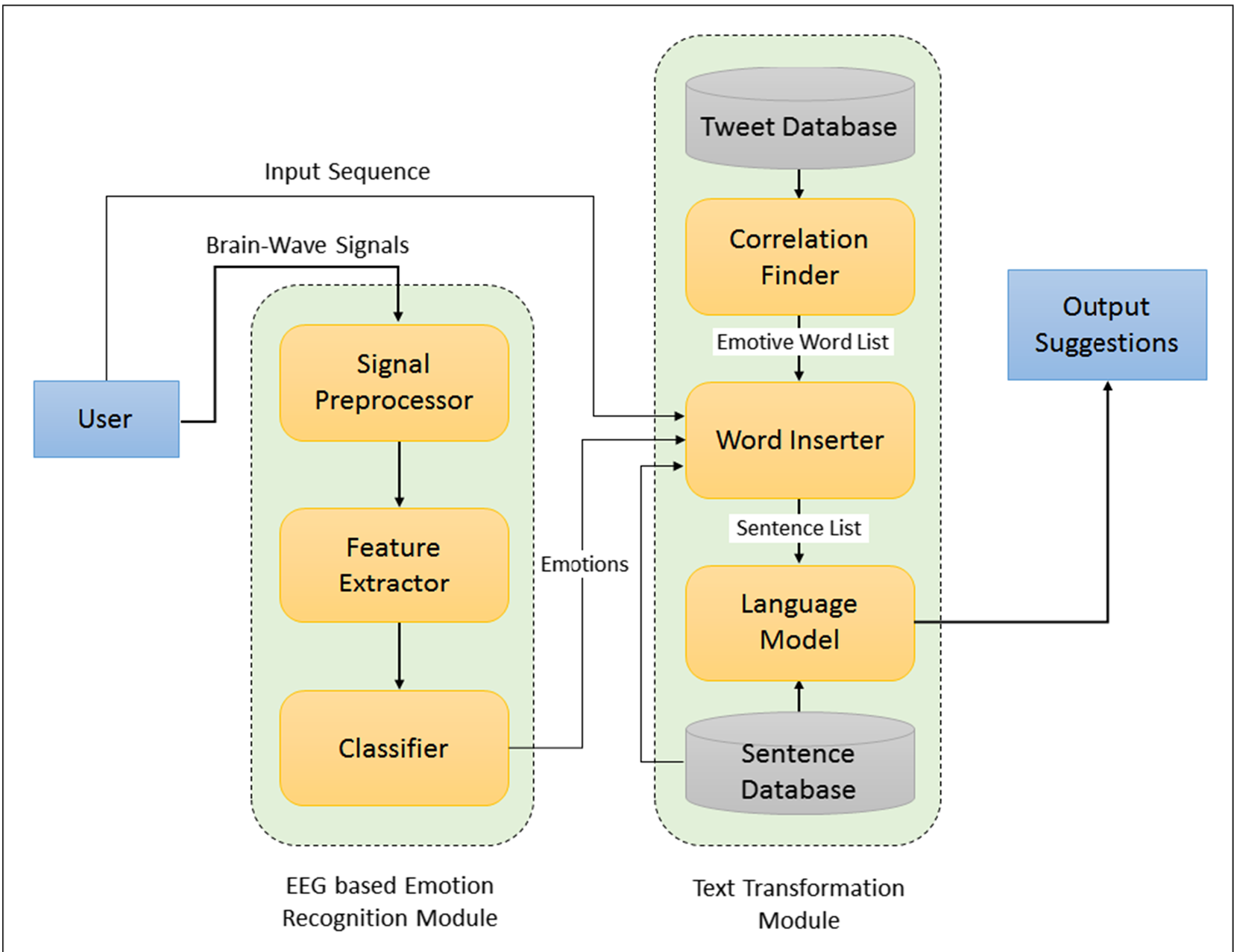 Figure 1: The data flow from EEG capture to final text suggestion.
2. The Text Enhancement Engine
Once the emotion is known (e.g., "Sadness"), the text module goes to work:
- Correlation Finder: Using Logistic Regression and PMI (Point-wise Mutual Information), the system selects adjectives and adverbs highly associated with the detected emotion.
- Word Inserter: It identifies nouns and verbs in the user's sentence to attach these new emotive words.
- Consistency Check: A BIG LSTM+CNN language model (trained on the One Billion Word Benchmark) ranks the suggestions. It ensures that "I am tired with my ridiculous job" is prioritized over ungrammatical or nonsensical placements.
Experiments & Results
The researchers tested the system on 25 participants using video stimuli to evoke emotions.
- EEG Accuracy: The system hit a 74.95% average accuracy. "Joy" was the easiest to detect (nearly 90% recall), while "Anger" and "Sadness" proved more difficult, often being confused with one another.
- User Preference: In an end-to-end test, users rated the quality of suggestions at 3.95/5.
| Emotion | Original Sentence | Enhanced Suggestion |
|---|---|---|
| Anger | I am tired with my job. | I am tired with my ridiculous job. |
| Surprise | That was awesome. | That unexpectedly was awesome. |
| Fear | I have an infection. | I have a fatal infection. |
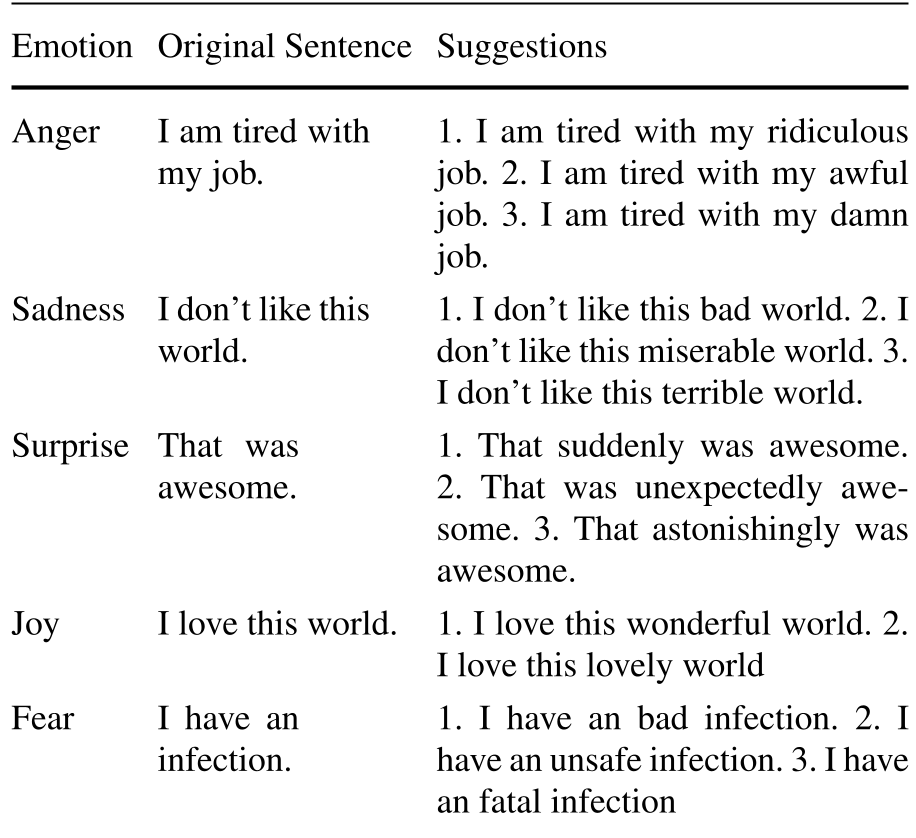
Critical Insight: The "Bad Daughter" Problem
The authors candidly discuss a major limitation: Semantic structure. In one test, the sentence "My daughter was killed by a gangster" combined with the emotion "Sadness" produced the suggestion "My bad daughter was killed by a gangster."
This happens because the system identifies "daughter" as a noun and "bad" as a sad-correlated adjective, but it lacks the deep semantic reasoning to understand that "bad" shouldn't modify "daughter" in this tragic context. This highlights the "Inductive Bias" of the word-insertion method—it prioritizes local grammatical correctness over global narrative logic.
Future Outlook
This paper is a significant milestone for Affective Computing. While we are now in the era of Transformers and LLMs (which could solve the semantic issues mentioned above), this work pioneered the use of raw physiological feedback to drive creative text generation. The future of communication may well involve a wearable device that helps us find the "perfect words" before we even realize we're looking for them.
Takeaway: This isn't just about social media; it's about building a digital bridge for emotional intelligence.