
Enhancing Twitter Topic Detection: Bridging the Gap Between Machine Logic and Human Intuition
Enhancing Topic Detection in Twitter Using the Crowdsourcing Process
The paper introduces a hybrid framework that enhances "Exemplar-based Topic Detection" in Twitter by integrating a human-in-the-loop crowdsourcing process. By leveraging the wisdom of reliable experts to adjust the weights of the cosine similarity function, the method significantly improves the semantic relevance and interpretability of detected social media topics.
TL;DR
Researchers from the University of Waterloo have developed a methodology to improve how we detect trending topics on Twitter. By using a "Crowdsourcing" process to fine-tune the mathematical weights used in similarity calculations, they increased topic recall by 15%. This proves that a small amount of "expert" human wisdom can drastically improve the performance of automated social media analysis.
Background & Motivation: The Problem with Machine "Similarity"
In the world of Twitter, topic detection is usually handled by algorithms that group similar tweets together. The Exemplar-based approach is particularly popular because it represents a topic using a real tweet (an exemplar) rather than just a bag of keywords, making it easier for humans to read.
However, there is a fundamental flaw: Cosine Similarity, the math used to compute how "close" two tweets are, is often blind to context. A machine might think two tweets are similar because they share common words like "the" or "game," whereas a human knows that "goal" and "score" carry much more weight when discussing a football match.
The Insight: Crowdsourcing as a Calibration Tool
The authors realized that instead of building a completely new algorithm, they could use the "wisdom of the crowd" to fix the weights of the existing one. Their workflow follows a refined crowdsourcing pipeline:
- Expert Discovery: Selecting reliable, English-speaking users with domain knowledge (e.g., football fans for an FA Cup dataset).
- Task Design: Asking these experts to rank which terms (keywords) are most important in determining if two tweets are about the same thing.
- Weight Adjustment: Converting that human feedback into a mathematical formula to "nudge" the algorithm.
Methodology: The Core Mechanism
The heart of the paper is the translation of human ranking into a new term weight ().
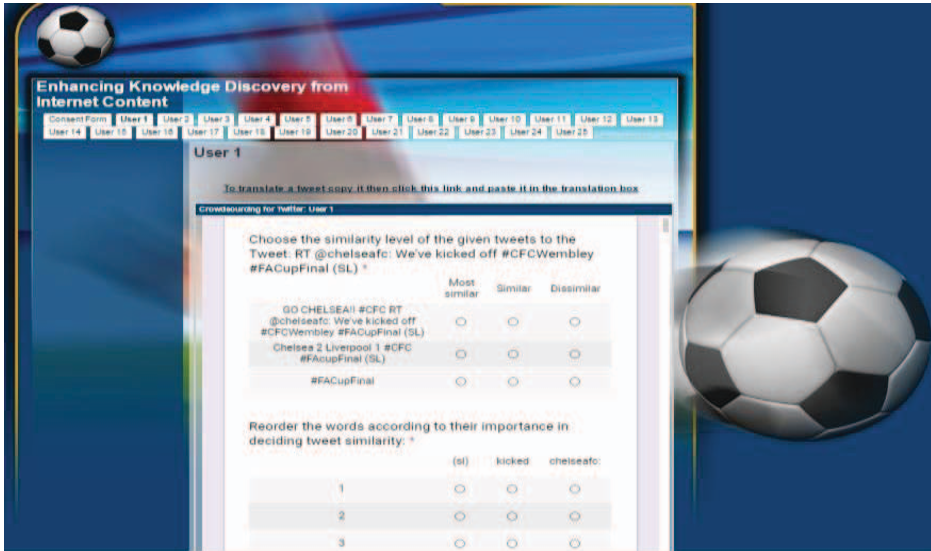 Figure 1: The interface used to collect expert feedback on tweet similarity and term importance.
The algorithm calculates a "crowdsourced weight" () based on how frequently experts ranked a specific term as 1st, 2nd, or 3rd in importance. This is then blended with the traditional TF-IDF weight ():
This hybrid approach ensures the model doesn't lose the statistical power of the large dataset (the ) while benefiting from the surgical precision of human intuition (the ).
Experimental Results: Better Recall, Clearer Topics
The team tested their method on the FA Cup 2012 dataset (nearly 20,000 tweets). The results were striking:
- Topic Recall: Increased by 15%.
- Term Precision: Increased by 4%.
- Qualitative Leap: Topics became much more "human-readable."
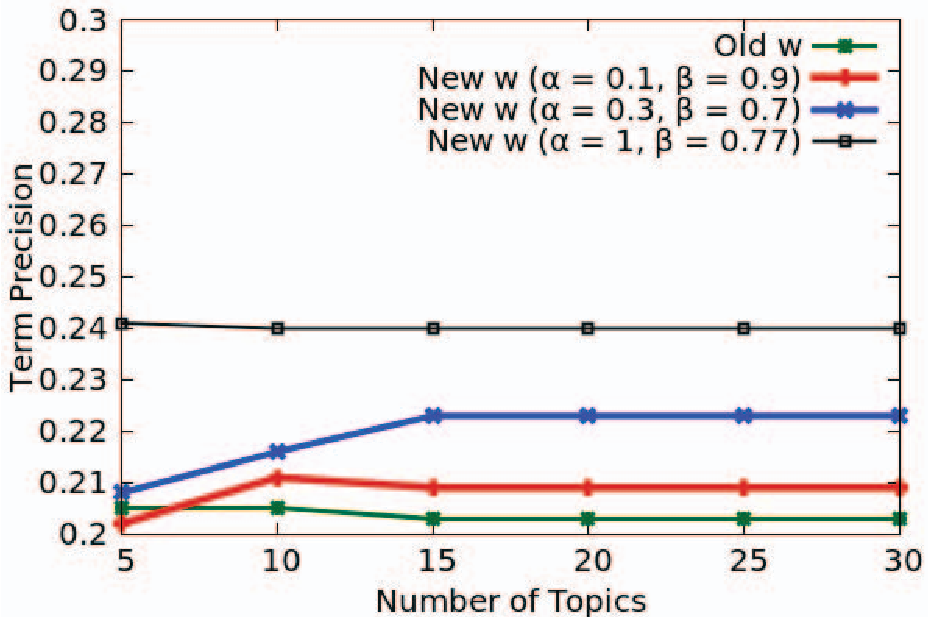 Figure 2: Performance gains in Term Precision after applying crowdsourced weights.
For instance, where the old algorithm might output a garbled mess of punctuation and general words, the crowdsourced version successfully identified Andy Carroll’s goal in the final, capturing specific entities and events that the base algorithm overlooked.
Critical Analysis & Conclusion
Why it Works
The "Expert Discovery" phase is the unsung hero of this paper. By choosing "trustworthy researchers and students," the authors bypassed the messy aggregation/verification steps (like majority voting) usually required in crowdsourcing, which often introduces its own noise.
Limitations
- Scalability: The current method relies on 25 experts. Scaling this to thousands of diverse topics (Politics, Tech, Entertainment) would require a more automated "Incentive Design" or a way to generalize weights across domains.
- Static Weights: The weights are adjusted as a preprocessing step. A dynamic, real-time reinforcement learning loop could potentially yield even better results.
Final Takeaway
This paper serves as a blueprint for "Human-Centric AI." It shows that we don't always need bigger models or more GPUs; sometimes, we just need to listen to the "village" (the crowd) to help our algorithms understand the nuances of human communication.