
From Tweets to Trends: Enhancing Flu Surveillance with Semantic Intelligence
Enhancing Twitter Data Analysis with Simple Semantic Filtering: Example in Tracking Influenza-Like Illnesses
This paper introduces a semantic filtering framework for tracking Influenza-Like Illnesses (ILI) using Twitter data. By combining a knowledge-based approach using the BioCaster Ontology with natural language processing (NLP) filters for negation, hashtags, and emoticons, the system achieved a record-breaking Pearson correlation of 98.46% with official CDC data.
TL;DR
Public health tracking is moving from the clinic to the cloud. This study demonstrates that by applying Simple Semantic Filtering to Twitter's chaotic "Gardenhose" stream, researchers can track Influenza-Like Illness (ILI) with 98.46% accuracy compared to official CDC data. The secret sauce? Moving beyond simple keywords to understand the context and semantics of how people talk about being sick.
The Motivation: Why Keyword Matching Isn't Enough
For years, digital epidemiology relied on "try-and-test" keyword lists. If someone tweeted "flu," they were counted. However, this produces massive false positives.
- Metaphors: "Bieber fever" or "the flu" as a metaphor for a bad day.
- Context: News reports ("7-year-old dies of flu") vs. personal experience ("I've got the flu").
- Negation: "I don't have the flu" is a negative signal, yet simple counters treat it as positive.
The authors recognized that to bridge the gap between social media and clinical reality, the system needed to understand the intent of the user.
Methodology: The Two-Step Semantic Filter
The researchers processed 587 million tweets from the 2009-2010 season using a sophisticated pipeline.
1. Knowledge-Based Filtering
Instead of guessing keywords, they leveraged the BioCaster Ontology (BCO). This provided a structured list of 37 respiratory syndrome terms (e.g., "bronchitis," "stuffy nose," "shortness of breath"). They also mapped informal "Twitter-speak" (extra terms like "achy chest") back to these professional concepts.
2. Semantic-Based Refinement
This is where the RASP (Robust Accurate Statistical Parser) comes in. The system didn't just look for words; it looked for relationships.
- Negation Detection: If a negation tag ("XX" in CLAWS) had a grammatical relationship with "flu" in the sentence, the tweet was discarded.
- Feature Filtering:
- Emoticons: Happy faces usually imply the user isn't the one suffering.
- Humor/Sarcasm: Phrases like "cough... cough" used for irony were removed.
- Geography (Geo): Using Google Maps API to filter for US-only tweets to align with CDC data.
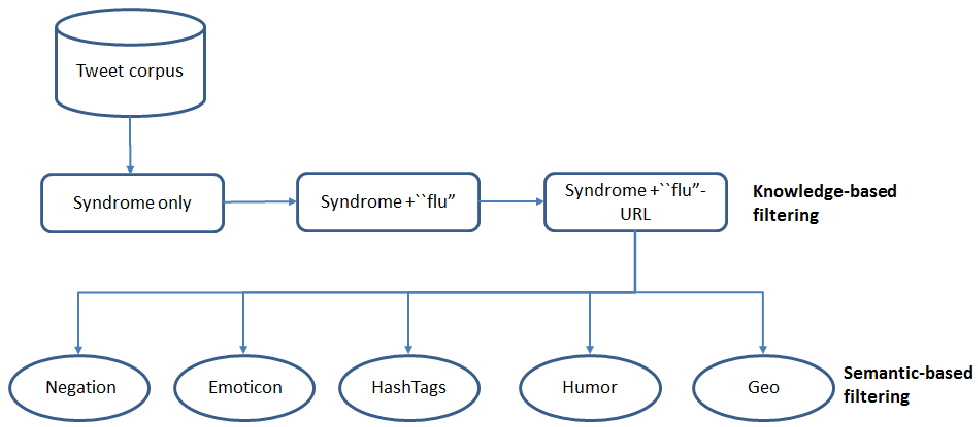 Figure: The multi-stage pipeline from raw Twitter stream to refined ILI tracking signal.
Experiments: Chasing the Gold Standard
The "Gold Standard" in this field is the CDC ILINet data. While previous work by Culotta (2010) achieved high correlation (95%), it still missed the mark on precision.
By applying the Best Combination filter (Negation + Humor + Emoticons + Hashtags + Geo), the authors boosted the correlation to 98.46%.
Precision vs. Volume
A fascinating takeaway from the results is the trade-off between the number of tweets and the accuracy. The "Syndromes only" method used ~386k tweets but had lower correlation. The "Best Combination" used only ~2,000 highly filtered, high-quality tweets but achieved the highest accuracy. This proves that quality of data beats quantity in digital biosurveillance.
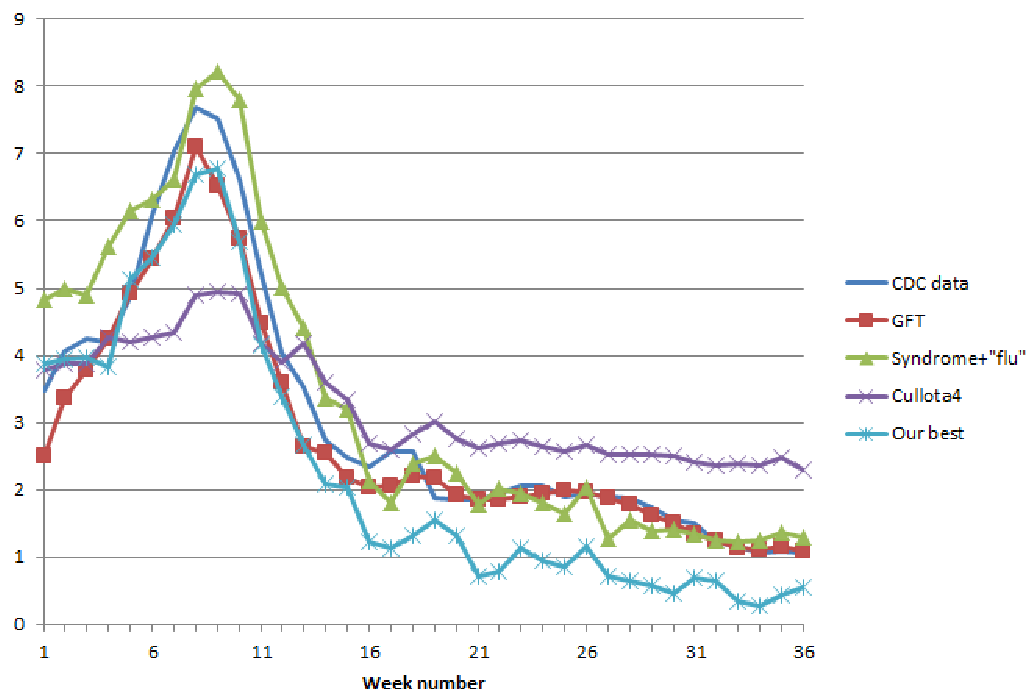 Figure: The Best Combination (Purple) closely tracks the CDC Gold Standard (Blue), effectively smoothing out the noise seen in earlier baseline methods.
Critical Analysis & Future Outlook
While this method is a massive step forward, the authors acknowledge several "hard cases." Factive vs. Modal beliefs (e.g., "I think I have the flu") and complex sentiment (reacting to news vs. being sick) still present challenges.
The Insight: This work suggests that "simple" NLP (parsers and lists) is incredibly powerful when directed by a formal ontology. As we look toward the future, integrating these semantic filters with real-time geolocation and demographic analysis (age/gender from profiles) could provide public health officials with a high-resolution, zero-latency map of disease spread.
Takeaway for Researchers
If you are mining social media, stop counting words and start parsing trees. Semantic context is the difference between a noisy signal and a clinical-grade insight.