
Time is Relative: Using Cognitive Psychology to Hack the Waiting Experience in HCI
2548_Enhancing User eXperience during waiting time in HCI contributions of cognitive psychology.
This paper explores the psychological mechanisms of time perception in Human-Computer Interaction (HCI). It proposes applying the "Attentional Gate Model" to analyze how feedback interfaces and cognitive load influence user satisfaction during waiting periods, demonstrating that informational richness significantly alters perceived duration and UX.
TL;DR
Why does a 10-second wait feel like an eternity on one website but a breeze on another? This paper moves beyond objective "stopwatch" metrics to explore the Attentional Gate Model. It reveals a fascinating paradox: giving users more detailed information about a process makes them feel like they've waited longer, but they end up happier because the wait feels justified.
The Problem: The Myth of the 10-Second Rule
Since the early days of HCI, experts like Jakob Nielsen have cited the "10-second rule" as the limit for keeping a user's attention. However, this is a "What" metric, not a "Why" metric. It doesn't account for the subjective construction of time by the human brain. The pain of waiting isn't just about the clock; it's about how much attention we are paying to the clock.
The Methodology: The Internal Pulse Counter
The authors lean on the Attentional Gate Model (AGM) to explain our internal timing mechanism:
- Pacemaker: Produces regular pulses.
- Gate/Switch: Controlled by attention. If you focus on time, the gate opens wider, and more pulses reach the accumulator.
- Accumulator: The pulse counter. More pulses = "Time is passing slowly."
Experimental Design
The researchers created a memory game with forced delays of 5, 10, and 15 seconds. They manipulated the Informational Level of the feedback:
- Low Info: A simple "Loading... please wait" message.
- High Info: A progress bar showing % completion plus specific status text (e.g., "Loading images...").
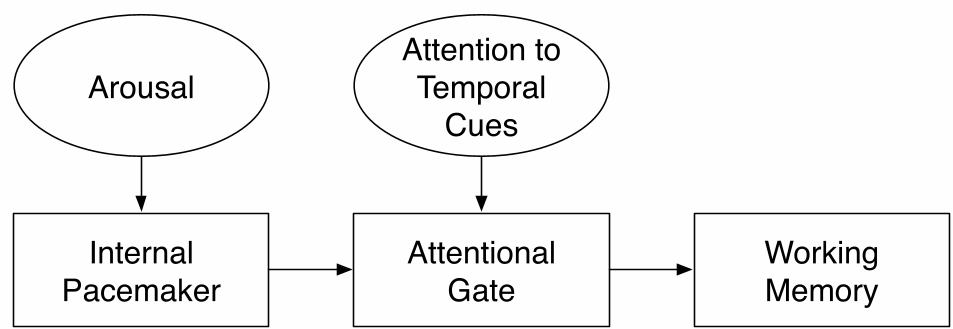 Figure 1: The theoretical model where non-temporal tasks compete with time signals for the "gate."
Key Insights: The Information Paradox
The study produced two counter-intuitive results that every developer should know:
1. Information Dilates Time
Usually, we think "keeping the user busy" makes time fly. However, providing a detailed progress bar (High Info) actually increased the perceived duration. Because the user was monitoring the progress bar, they were essentially paying more attention to the passing of time.
2. Longer Time, Higher Satisfaction
Even though the High Info group felt they waited longer, their Global Satisfaction was significantly higher than the Low Info group.
- Reasoning: Detailed feedback provides "Justification." A user who knows why they are waiting (e.g., "Optimizing database queries") is more tolerant than a user staring at a spinning wheel.
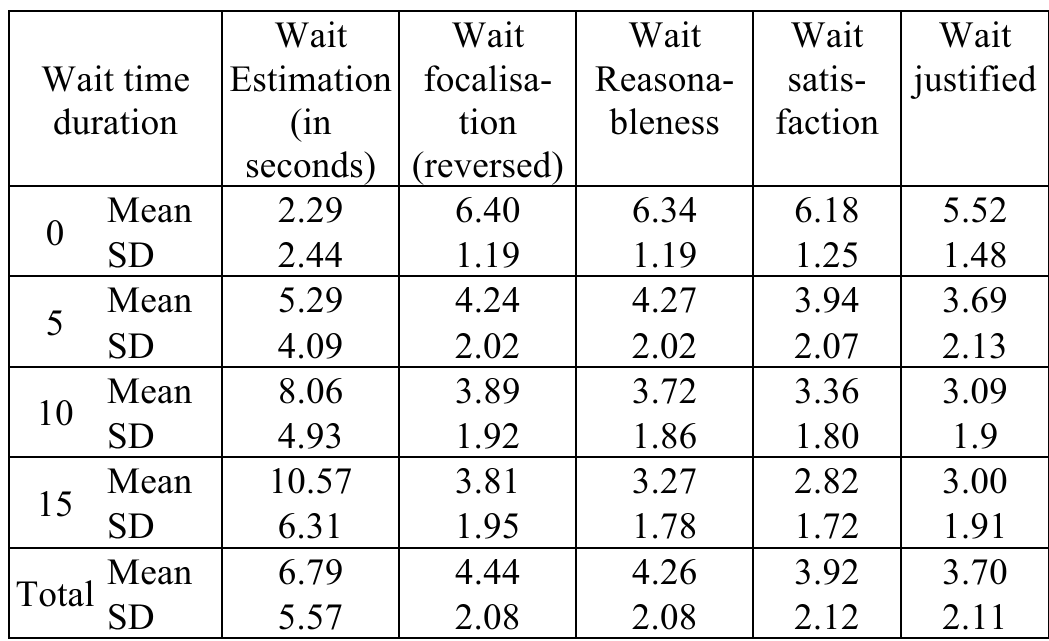 Figure 2: Note how satisfaction (Wait satisfaction) drops as duration increases, but is mitigated by info levels.
Designing for Cognitive Load
The paper measured cognitive load using NASA-TLX and SMEQ. They found that:
- High Cognitive Load = Higher Time Estimation: If the interface is confusing or requires too much effort during the wait, the "gate" stays wide open, and time drags.
- The Gender Variable: Interestingly, the study noted slight differences in subjective cognitive load between genders during the task, though both followed the same general trends regarding feedback.
Critical Analysis & Takeaways
The core contribution of this work is the bridge between Cognitive Psychology and Interface Design. It proves that the "User Experience" of waiting is a trade-off between Perception and Satisfaction.
- UX Takeaway: Don't just show a spinner. Show a progress bar with descriptive steps. You might make the wait feel 1 second longer, but you'll gain 20% in user trust and satisfaction.
- Limitations: The study used a memory game. In real-world scenarios, users might "multitask" (check their phone) during a wait, which would drastically change the attentional gate dynamics.
Conclusion
Waiting is inevitable in computing. This paper teaches us that while we cannot always speed up our code, we can always "hack" the user's brain to make the wait feel reasonable. Information is the best cure for the anxiety of the unknown.