
ASG Framework: Simplifying Digital Life through Social Prioritization
Enriching and Simplifying Communication by Social Prioritization
This paper introduces the ASG (Aggregated Social Graphs) Framework, a system designed to consolidate user interaction data from disparate platforms—such as social media (Facebook, Twitter) and telecom logs (SMS, Calls). It utilizes a novel social strength algorithm to prioritize information flows and recommend contacts for collaborative group tasks based on historical communication patterns.
TL;DR
The Aggregated Social Graph (ASG) framework is a strategic response to the modern "information overload" caused by fragmented social platforms. By harvesting interaction logs from both telecom (calls/SMS) and web-based social networks (Facebook/Twitter), ASG calculates a "social strength" score for every contact. This score allows applications to automatically prioritize important messages, filter out irrelevant "noise," and intelligently suggest participants for dynamic group collaborations.
Problem & Motivation: The Fragmentation of Connection
In the current digital ecosystem, our social identities are scattered. You might call your mother on a mobile phone, message a colleague on Slack, and interact with an old friend on Facebook. This fragmentation leads to a significant pain point: Cognitive Overload.
Previous research in community discovery has largely focused on static data—where you live or what your job title is. However, the authors argue that communication history is the truest reflection of "social strength." The challenge lies in the heterogeneity of this data; how do you compare three Facebook likes to one 20-minute phone call?
Methodology: Quantifying the "Strength" of a Relationship
The heart of the ASG framework is its analytical engine, which processes a user's global contact list through a multi-tiered utility function.
1. The Conceptual Architecture
The system acts as a middleware between third-party communication services and the end-user application.
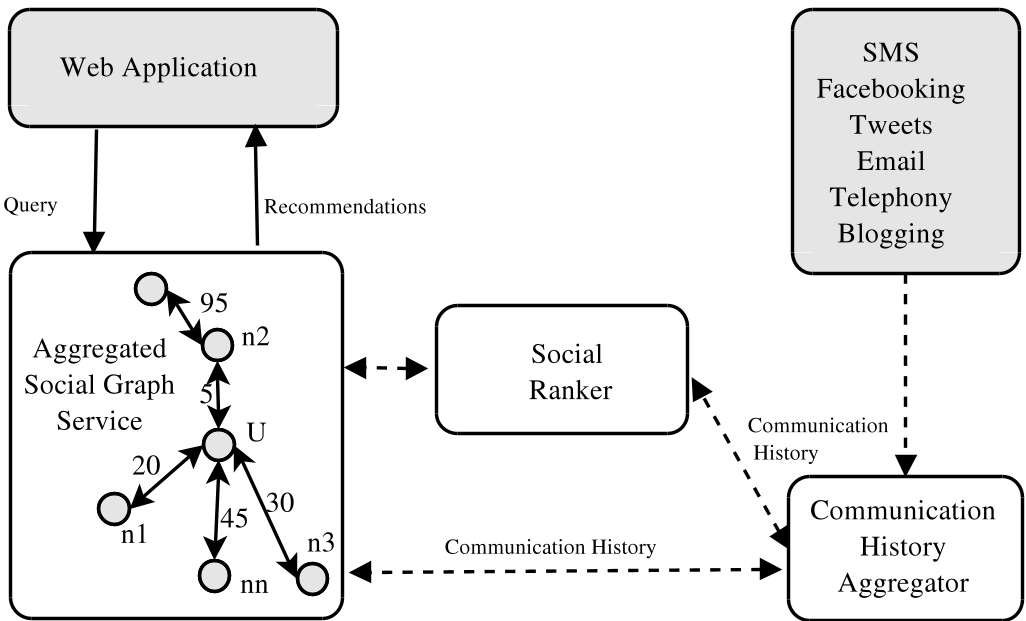
2. The Social Strength Algorithm
The framework calculates strength using two primary equations:
- Service-Specific Strength: Measures the intensity of interaction within a single platform (e.g., how important is Andrea on Facebook?).
- Global Social Rank: Aggregates scores across all platforms to give a "normalized" rank.
The mathematical intuition here is thresholding. Not all communication tools are created equal. If a user spends 80% of their time on mobile calls and only 20% on Twitter, the system dynamically weights phone call interactions more heavily when calculating the final social rank.
Experiments & Results: Turning Logs into Insights
To illustrate the efficacy, the authors provide a sample interaction frequency table. By applying the ASG algorithm to users like "Johan" and "Andrea," the system can determine that while Andrea has more Facebook interactions, Johan’s mix of mobile calls suggests a higher social priority in a "Smart Dialer" context.

The framework allows for Granular Ranking. A contact might be ranked #1 for a "Social Search" regarding cooking interests but only #10 for "Emergency Priority Call List," depending on the context of their historical interactions.
Critical Analysis & Conclusion
Takeaway
The ASG Framework provides a valuable blueprint for Context-Aware Recommendations. By moving beyond the "Friend/Not Friend" binary of early social networks, it introduces a spectrum of connectivity that mirrors real-world human relationships.
Limitations
- Privacy Concerns: Aggregating call logs, Facebook messages, and Twitter feeds into a single framework creates a "Privacy Pot of Gold" that is highly vulnerable to misuse.
- Data Accuracy: The current model treats frequency as the primary proxy for strength. However, a short "I'm here" text is vastly different from a 1,000-word emotional email, a nuance the current frequency-based algorithm might miss.
Future Outlook
As we move toward 2026 and beyond, the integration of location-based services and semantic analysis (understanding the meaning of messages) will likely be the next frontier for ASG. The framework lays the groundwork for truly "Proactive Communication Tools" that know who you want to talk to before you even reach for your device.