
Trust Prediction: Beyond Topology via User Rating Similarity
Enriching Trust Prediction Model in Social Network with User Rating Similarity
This paper presents a machine-learning approach to trust prediction in social networks using the Epinions dataset. It introduces a binary classifier (C4.5/J48) that combines trust-network topology features with user rating similarity to determine the existence of trust between users.
TL;DR
In the world of social networks, trust is the currency of interaction. This paper explores how to automate the prediction of trust between strangers by combining the geometry of the social graph with the similarity of user behavior (ratings). Using the C4.5 decision tree algorithm on Epinions data, the authors demonstrate that while simple graph metrics help, adding "contextual" rating similarity significantly boosts accuracy—provided the data isn't too sparse.
Background & Motivation: The Cold Start of Trust
Trust management systems are essential for filtering noise in massive datasets. Traditionally, trust is extended via Transitive Propagation ("I trust my friend's friend"). However, for new users (the "Cold Start" problem), there are no friends to transition from.
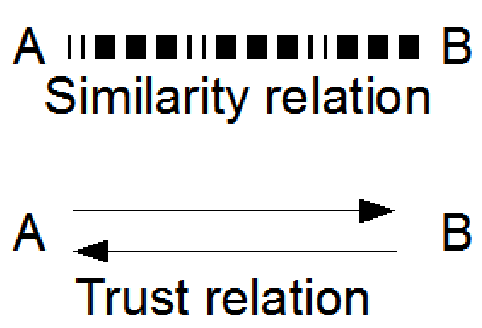
The authors pivot to Similarity Propagation: the idea that if two people rate products similarly, they are likely to trust one another. While social science has long suggested this correlation, this paper moves from mere "observation" to "prediction" using a machine learning framework.
Methodology: The Hybrid Feature Set
The authors treat trust prediction as a binary classification task (Trust vs. No-Trust). They categorize features into two buckets:
1. Graph-Topology Attributes
These look at the "shape" of the network around two users (a and b):
- In-degree/Out-degree: Popularity and activity levels.
- Common Interests: The number of users both and trust, or the number of users who trust both of them.
2. Contextual Similarity Attributes
This is the core innovation. The authors defined a similarity metric based on shared ratings:
- Agreement Count: The number of items reviewed by both users where the absolute difference in their ratings is less than 2.
The Sparsity Paradox
Initially, the experiment failed. Adding rating similarity to a random sample of users showed almost zero improvement. Why? Sparsity. Most users in a large network haven't rated the same items, making the "Similarity" attribute equal to zero for almost everyone.
To prove their hypothesis, the authors created a "Biased" Dataset featuring active users with overlapping rating histories.
Experimental Results
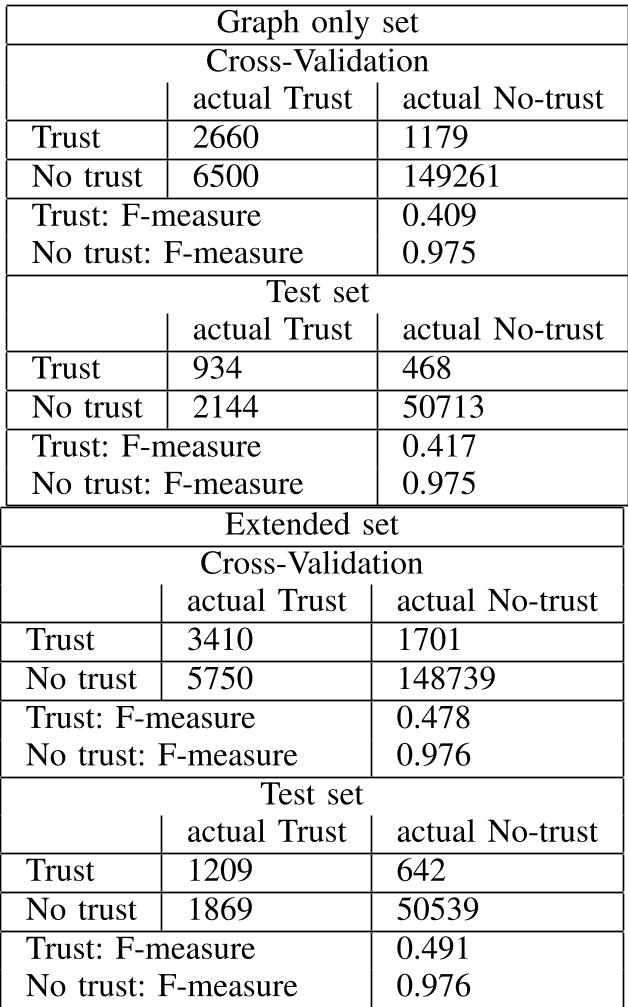
In the dense dataset, the results were striking. The inclusion of rating similarity moved the needle significantly:
| Model Type | Correct Classification | Trust-Class F-Measure |
|---|---|---|
| Graph Only | 95.19% | 0.409 |
| Enriched (Graph + Similarity) | 95.33% | 0.478 |
Note: While the overall "Correct" percentage seems high (97%+ in some sets), this is due to the massive "No-Trust" class. The real victory is the improvement in predicting the rare "Trust" edges.
Critical Insight: Why Interpretability Matters
The authors specifically chose Decision Trees (J48) over "Black Box" models like Neural Networks. They argued that for trust, we need to understand the rules. By analyzing the resulting trees, they could see exactly which thresholds of similarity or graph connectivity trigger a "Trust" prediction.
Future Outlook and Limitations
- Item Hierarchies: To solve the sparsity problem, we shouldn't just look for matches on the exact same item. If User A likes Sci-Fi books and User B likes Sci-Fi movies, they are similar. Integrating item categories is the next frontier.
- User Clustering: Instead of one global model, we should build "cluster-level" predictors. People trust each other for different reasons in different sub-communities.
Conclusion
This work validates that Similarity Propagation is not just a sociological theory but a viable engineering feature. While data sparsity remains a formidable foe, the marriage of network topology and behavioral similarity provides a clear path forward for building automated, trustworthy recommender systems.