
Harmonizing Tradition and Social Data: Enriching Handicraft Ontologies with FOAF
Enriching User d
The paper introduces a hybrid approach to enrich a specialized Handicraft User Model ontology with the social-network-oriented FOAF (Friend Of A Friend) ontology. It utilizes custom algorithms for string-based matching and semantic merging, supported by bridge axioms to maintain structural integrity while enhancing personalized information retrieval.
TL;DR
To help handicraft women in emerging countries improve their socio-economic status, this paper proposes an automated method to link specialized domain ontologies with the FOAF (Friend Of A Friend) standard. By using a combination of string-matching algorithms and bridge axioms, the researchers created a personalized information retrieval system that understands both the craft context and the social profile of the user.
The "Isolation" Problem in Specialized Domains
In the BWEC project (Business for Women of Emerging Countries), researchers faced a technical hurdle: their meticulously crafted ontology for Tunisian and Algerian handicrafts was a "semantic island." While it perfectly described products, raw materials, and tools, it lacked the vocabulary to describe the users' social lives and online identities.
Existing solutions usually fail in two ways:
- Complete Merging: This often deletes or overwrites unique concepts from the source ontologies to fit a new schema.
- Pure Logic Mapping: Methods based entirely on Description Logic (DL) or SWRL are often too complex for non-experts to maintain or implement efficiently across large datasets.
Methodology: Bridging the Gap
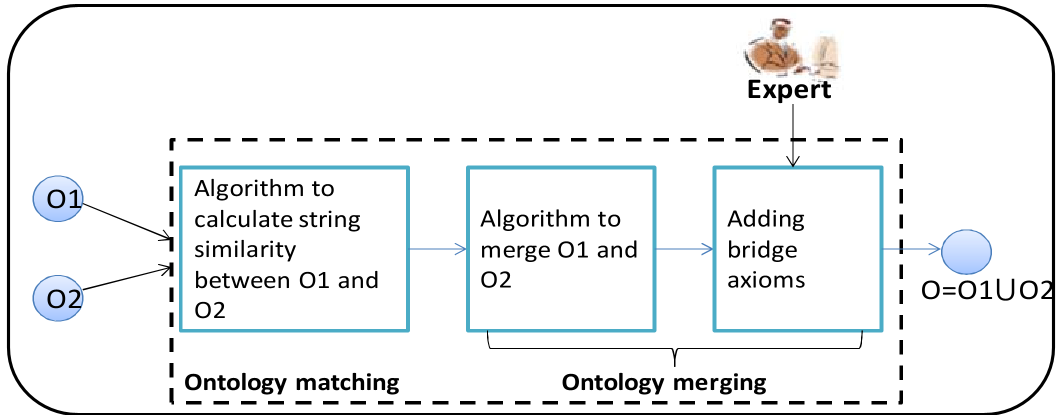
The authors resolve this by introducing a four-stage workflow: Elicitation, Preprocessing, Initial Construction, and FOAF Enrichment.
1. The Matching Algorithm
The core of the technical process is a similarity measure based on the Levenshtein Distance. It calculates the "edit distance" between concept names to determine if they are identical, equivalent, or disjoint.
Based on this, concepts are mapped into a relationship matrix using defined thresholds (e.g., a similarity suggests equivalence).
2. Bridge Axioms: The Structural "Glue"
Instead of rewriting the handicraft ontology, the authors use Bridge Axioms. This allows the two ontologies to coexist while defining a "is-a" (subsumption) relationship between them.
Key axioms defined include:
myonto:Handicraft_woman ⊑ FOAF:Personmyonto:Product ⊑ FOAF:Creative_workmyonto:Supplier ⊑ FOAF:Person
This logic ensures that any software understanding the FOAF standard automatically understands that a "Handicraft Woman" is a specific type of "Person."
Experimental Implementation & Results
The system was implemented using the Jena API and the Pellet reasoner. By processing the RDF and OWL files through their custom algorithms, the authors demonstrated that domain-specific identities could be automatically injected into the FOAF hierarchy.
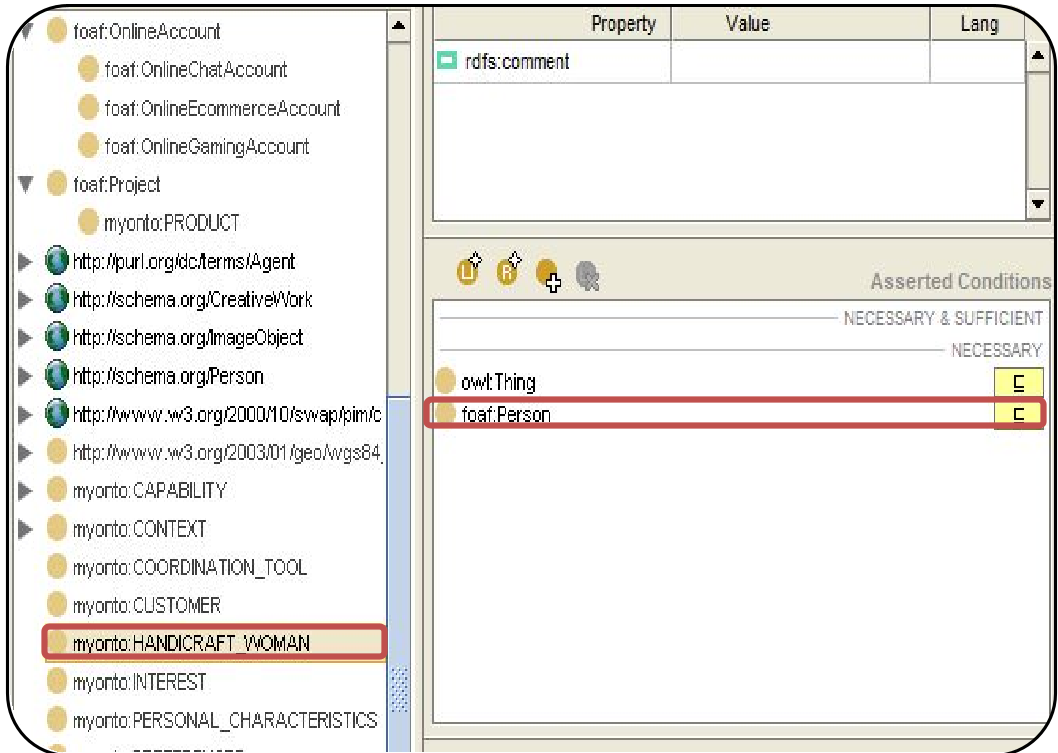
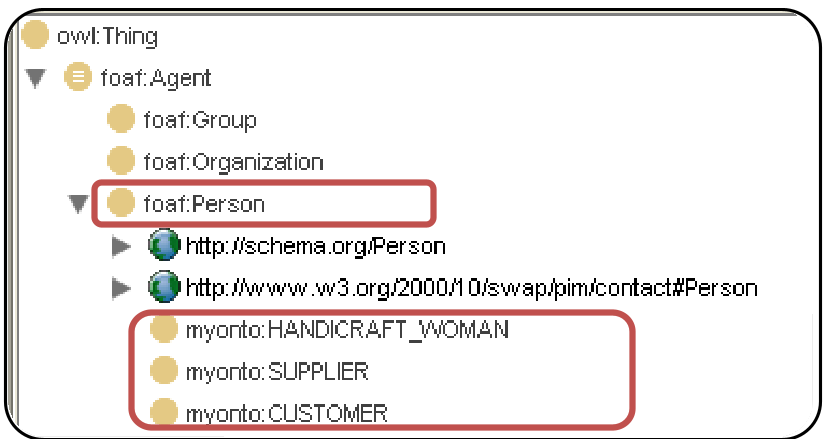
In the final enriched ontology, the Protégé framework visualized the successful transition where Handicraft_Woman, Supplier, and Customer appear as specialized subclasses of the global foaf:Person category.
Critical Insight & Future Outlook
The primary value of this research lies in its pragmatic hybridity. By combining simple string metrics (efficiency) with formal bridge axioms (accuracy), it provides a blueprint for small-scale domain ontologies to join the "Global Graph."
However, a limitation remains: the algorithm relies heavily on lexical similarity. If a domain ontology uses a synonym that is morphologically different (e.g., "Artisan" vs "Person"), the Levenshtein distance might fail. Future iterations utilizing semantic embeddings (Word2Vec or BERT) would likely improve the "Matching" phase to handle such linguistic nuances.
As personal data continues to move toward decentralized social networks (Web3 / Mastodon), this type of ontological bridging will be essential for creating truly personalized "User Models" that respect local knowledge while connecting to the global web.