
Beyond Flat Data: Leveraging OWL2 Property Chains for Smarter Healthcare Mining
Enrichment of Association Rules through Exploitation of Ontology Properties – Healthcare Case Study
This paper presents a framework to enhance Association Rule Mining (ARM) in healthcare by leveraging OWL2 ontology properties, specifically "property chains." By enriching raw healthcare data with semantic relations, the authors improved rule quality and discovered novel clinical insights using the Apriori algorithm.
TL;DR
Researchers have successfully demonstrated that Association Rule Mining (ARM) — the tech behind "customers who bought X also bought Y" — becomes significantly more potent when merged with Semantic Web technologies. By using OWL2 property chains, the team transformed raw heartbeat and blood pressure data into a rich semantic graph, leading to the discovery of high-confidence medical rules that traditional data mining misses entirely.
Background: The Limits of Raw Data
In the healthcare domain, data is often siloed and "flat." A database might show a patient has high blood pressure, but it doesn't inherently "understand" the relationship between a stage-2 hypertension diagnosis and the specific specialist required for treatment.
Standard algorithms like Apriori are limited by what is explicitly recorded in the columns. If the connection isn't there, the rule isn't found. This paper argues that we shouldn't just mine the data we have; we should mine the data we can infer.
Methodology: The Power of Property Chains
The core innovation lies in the transition from raw data to OWL2 (Web Ontology Language). While older versions of OWL allowed for basic hierarchies, OWL2 introduces Property Chains.
The "Physiological Intuition"
Think of it as a logical "shortcut" created by the system:
- Property A: Patient isSickOf Disease.
- Property B: Disease isTreatedBy Doctor.
- The Chain (mayVisit): Patient isSickOf isTreatedBy Doctor.
By defining these chains in the ontology, the researchers "materialize" new attributes for every patient record. When the Apriori algorithm runs on this enriched dataset, it sees these new connections as fresh "items" in the transaction, allowing it to generate rules like:
[Condition: Tachycardia] AND [Symptom: Dizziness] => [Action: mayVisit Doctor_X]
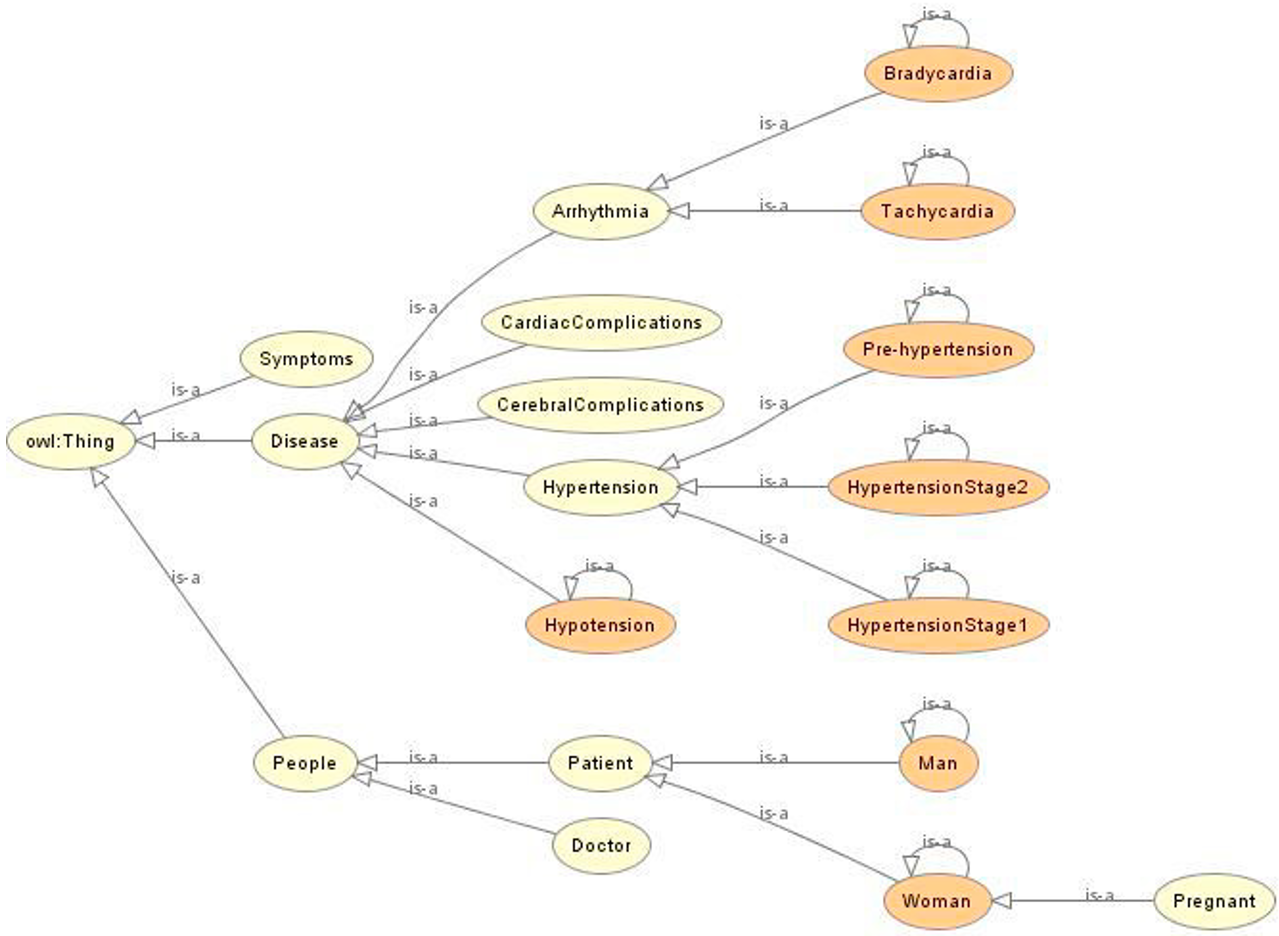 Figure 1: The Heart Condition Ontology used to map patient vitals to formal medical classifications.
Experimental Showdown: 100% Confidence
The authors compared three scenarios using a dataset of 4,000 simulated patients:
- Raw Data: Rules were noisy and weak (Max confidence ~55%).
- Standard Ontology (OWL1): Rules improved as data was binned into meaningful categories (e.g., "High Pulse" instead of "106 bpm").
- Advanced Ontology (OWL2 with Chains): Discovered entirely new "recommendation" rules with 100% confidence.
Key Result Comparison
The difference in rule quality is stark. In the raw data, the strongest link found was a weak correlation between pulse rate and gender. In the enriched data, the system identified absolute clinical certainties and logistical recommendations.
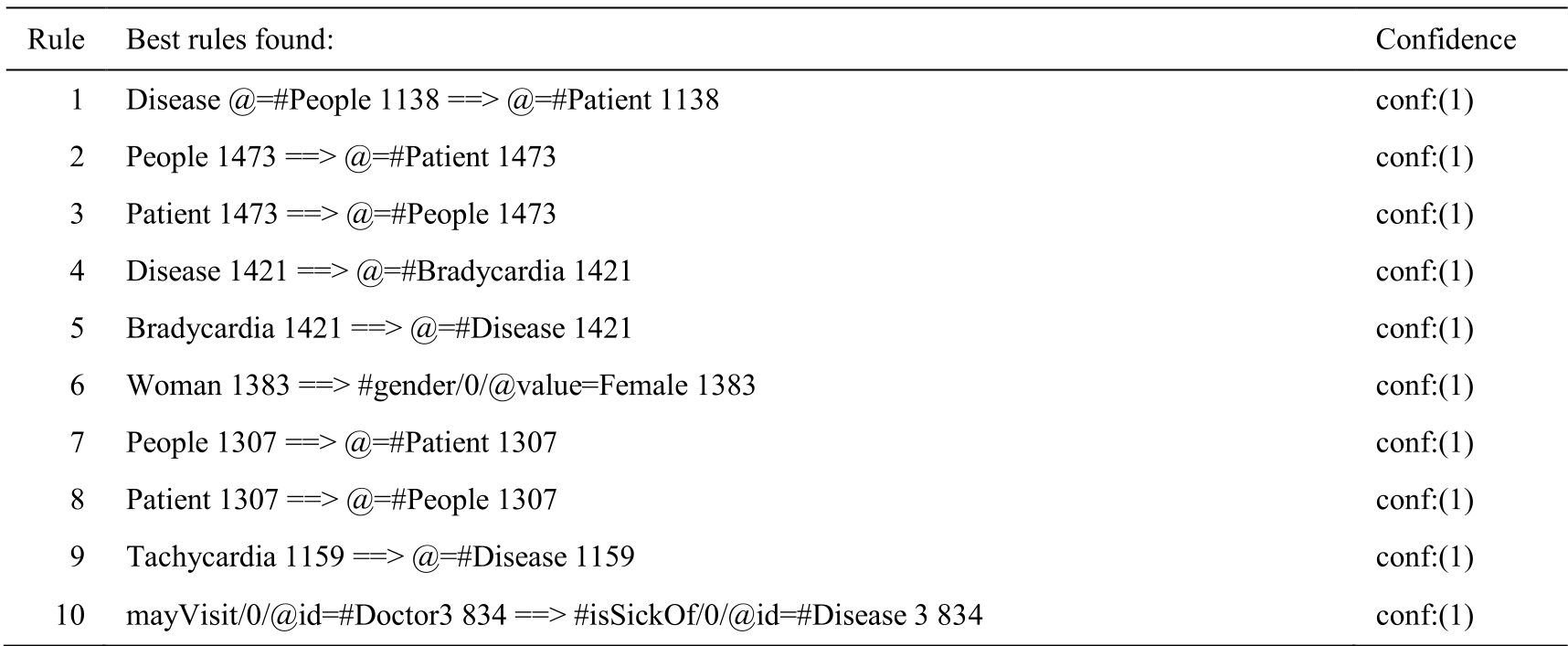 Table 3: High-confidence rules generated after OWL2 enrichment, showing the "mayVisit" chain in Rule 10.
Critical Insight: Inductive Bias through Semantics
What this paper effectively does is inject domain knowledge as an inductive bias into the mining process.
- Why it works: By limiting the search space to semantically valid relations, we avoid "spurious correlations" (e.g., finding a rule that links a patient's ID number to their disease).
- The Trade-off: The authors noted that using
inverseOfproperties (e.g., "Doctor treats Disease" vs "Disease is treated by Doctor") increased computational load without adding new rules. The lesson? Not all semantic properties are created equal—Property Chains provide the highest ROI for data mining.
Conclusion & Future Outlook
This research proves that "Semantic ARM" is more than just a theoretical exercise; it is a vital tool for making sense of complex healthcare environments. As we move toward OWL2 adoption, the ability to automatically "chain" properties will allow hospital systems to discover not just what is happening, but what should happen next (e.g., automated doctor referrals).
Future Directions: The next frontier is combining these semantic rules with Conditional Functional Dependencies (CFDs) to further clean healthcare data and identify inconsistencies in real-time.