
Ensemble Classifiers: Boosting Precision in Physiological Emotion Recognition
An Ensemble Classifiers Approach for Emotion Classification
This paper introduces an Ensemble Classifier approach for emotion recognition using physiological signals, targeting the classification of eight distinct emotions based on the Clynes sentograph protocol. By combining five decision-tree-based models, the approach achieves a State-of-the-Art (SOTA) accuracy of 90.8% on the MIT Eight-Emotion Sentics dataset.
TL;DR
Understanding human emotion is a cornerstone of next-generation Human-Computer Interaction (HCI). This paper presents a robust ensemble learning framework that integrates multiple physiological signals—Muscle Activity (EMG), Skin Conductance (GSR), Heart Rate (BVP), and Respiration—to classify eight complex emotions. By leveraging the complementary strengths of various decision-tree algorithms, the author achieves a high-precision performance of 91%.
Background & Motivation: Moving Beyond Single Classifiers
In the landscape of Affective Science, emotions are the "hidden variables" of human behavior. While facial expressions and speech analysis are common, they are social shells that can be manipulated. Physiological signals, however, offer a "window into the soul" as they are governed by the autonomic nervous system.
The author identifies a critical gap: Single-classifier systems often reach a performance ceiling. A model that is excellent at identifying "Anger" might fail at "Reverence." The motivation here is to build a "Committee of Experts" where the final decision is delegated to the classifier most "expert" in a specific emotional domain.
Methodology: The Architecture of Cooperation
The proposed approach utilizes four main physiological modalities:
- EMG: Measures muscle tension.
- GSR: Captures skin conductance/arousal.
- BVP: Tracks heart rate activity.
- Respiration: Correlates deeply with emotional intensity.
The Ensemble Core
The author selected a diverse set of classifiers to ensure structural complementarity:
- Random Tree: Handles subspace bagging.
- J48 (C4.5): Provides clear attribute discrimination.
- NBTree: A hybrid of Naive Bayes and Decision Trees.
- PART: Uses a neural network-like architecture for clustering.
- BFTree: A best-first decision tree for impurity reduction.
Selection Algorithm
The "Secret Sauce" is the selection logic:
- Priority per Emotion: If a specific classifier is known to have the highest PCC for "Joy," its output is given priority when it signals that emotion.
- Priority Overall: If no specific assignment matches, the system defaults to the classifier with the highest average cross-validation score.
Note: The system coordinates five base classifiers in a parallel architecture to synthesize a final emotional state prediction.
Experimental Analysis: SOTA Comparison
The model was validated using the MIT Eight-Emotion Sentics Data. The experimentation used 10-fold cross-validation in the Weka environment.
Performance Metrics
The results confirm the "Ensemble Advantage":
- Weighted Average PCC: 0.908 (90.8%)
- Precision: 0.91
- Best Performance: "No-emotion" (97.6% accuracy) and "Joy" (96.3% accuracy).
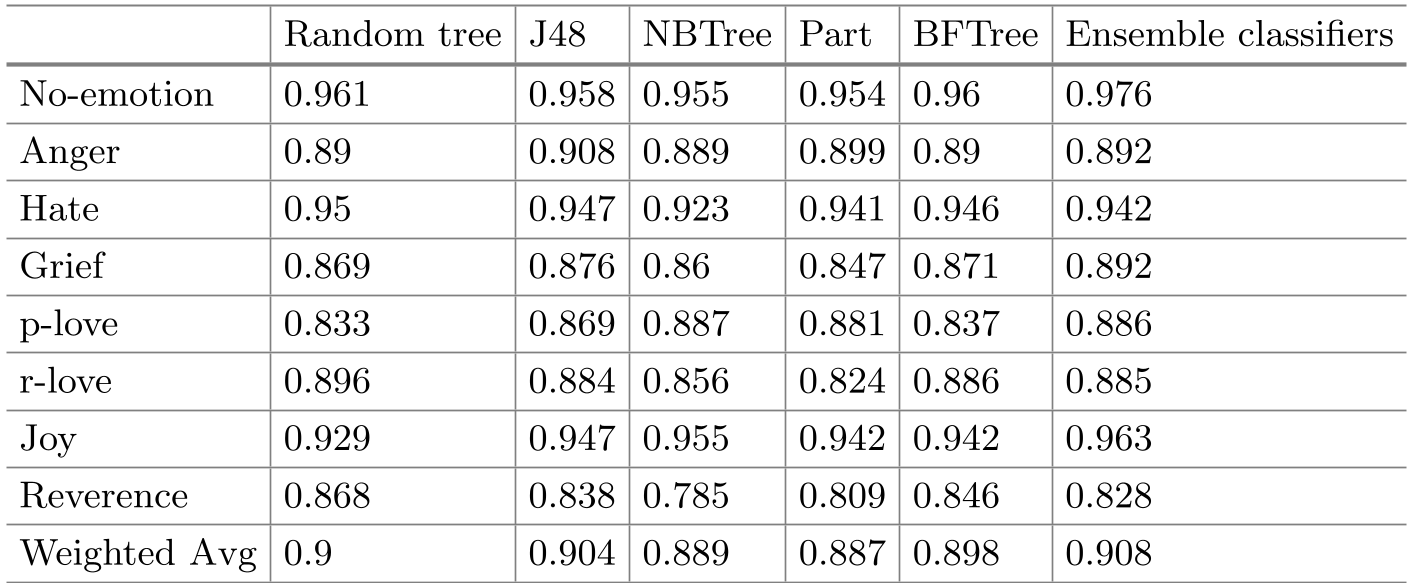 Table 1: The Ensemble Classifier consistently outperforms Random Tree, J48, and others in weighted averages.
The data suggests that decision trees are particularly effective for this dataset structure, likely due to their ability to handle the non-linear, high-dimensional nature of raw physiological signals.
Critical Insight & Conclusion
Takeaway
The core contribution is the shift from "finding the best model" to "finding the best combination of models." By assigning specific emotions to specific classifiers based on historical performance (PCC), the author successfully navigates the trade-offs inherent in individual machine-learning algorithms.
Limitations & Future Work
- Subject Specificity: The dataset used was from a single individual over 20 days. Future research must address generalizability across different subjects and demographics.
- Algorithm Complexity: While accuracy is high, the overhead of running five classifiers might be a bottleneck for real-time mobile applications.
- Deeper Architectures: With the rise of Deep Learning, replacing these "shallow" decision trees with LSTM or Transformer-based ensembles could further unlock temporal patterns in physiological data.
In summary, this work provides a solid mathematical and experimental foundation for using ensemble methods to close the gap between human feeling and machine understanding.