
Ensemble SOMs: A Strategic Fusion for IGBT Degradation Monitoring
An Ensemble of Component-Based and Population-Based Self-Organizing Maps for the Identification of the Degradation State of Insulated-Gate Bipolar Transistors
This paper introduces a Self-Organizing Map (SOM) ensemble framework for detecting degradation states in Insulated-Gate Bipolar Transistors (IGBTs). The method leverages a Dynamic Weight Proportional (DWP) strategy to aggregate "component-based" models (tailored to specific units) and "population-based" models (generalizing across a fleet) to achieve superior diagnostic accuracy.
Executive Summary
In the high-stakes world of Power Electronics and Fully Electric Vehicles (FEVs), the Insulated-Gate Bipolar Transistor (IGBT) is a critical point of failure, accounting for nearly 34% of power electronic faults. This paper presents a sophisticated diagnostic framework that moves beyond single-model limitations by employing an Ensemble of Self-Organizing Maps (SOMs). By blending "Component-Based" (specific) and "Population-Based" (general) perspectives through Dynamic Weight Proportional (DWP) aggregation, the researchers achieved a significant boost in classification accuracy and reliability. This work marks a transition from simple anomaly detection to robust, context-aware health state identification.
Problem & Motivation: The Specificity-Generality Tradeoff
Traditional data-driven fault diagnosis faces a recurring dilemma:
- Component-Based Models: These are highly specialized but suffer from "data poverty." It is rare to have comprehensive healthy-state data for every single unit across all operating environments.
- Population-Based Models: These benefit from fleet-wide data ("Big Data") but often ignore the subtle manufacturing variances and noise profiles unique to a single component, leading to blurred diagnostic thresholds.
The authors' insight is that these two approaches are not mutually exclusive but complementary. The errors made by a fleet-wide model are often different from those made by a unit-specific model. An ensemble can exploit this diversity to "cancel out" individual weaknesses.
Methodology: The SOM Ensemble Architecture
The core of the methodology lies in how the SOMs are structured and aggregated.
1. The Dual-Perspective Training
The system develops individual classification models (where is the number of operating conditions).
- Component-Based SOM: Trained only on pristine data from the specific unit under test.
- Population-Based SOM: Trained on data from a fleet of similar components.
2. Dynamic Weight Proportional (DWP) Aggregation
Unlike static voting (where every model has a fixed "say"), DWP evaluates which model is currently most "trustworthy." When a new test vector arrives, the system identifies the most similar vectors in a validation set. It checks which models correctly classified these neighbors and assigns weights accordingly.
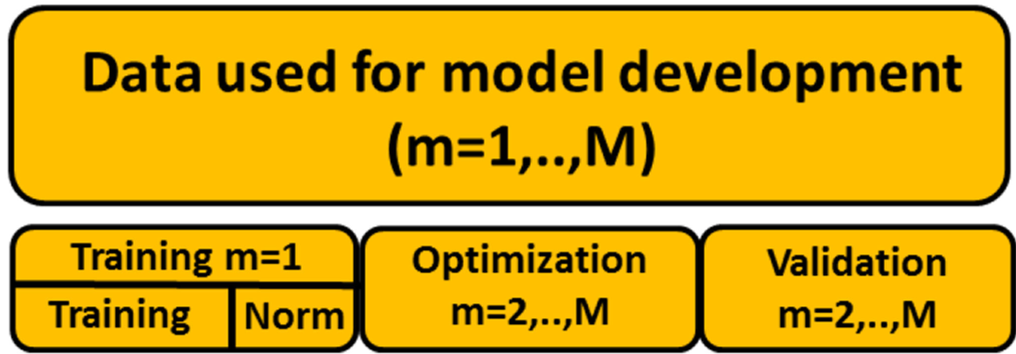 Figure 1: Schematic of the data partitioning strategy for training, optimization, and validation.
3. Degradation Indicators
The system uses Normalized Mean Quantization Error (NMQE) as the primary health index. By measuring the Euclidean distance between the current signal vector and the SOM's Best Matching Unit (BMU), the model quantifies how far the component has drifted from its "healthy" manifold.
Experiments & Results
The framework was validated using accelerated aging tests on six IGBTs. The signals monitored were Case Temperature (), Collector Current (), and Collector-Emitter Voltage ().
Performance Comparison
The DWP ensemble significantly outperformed single models and static ensembles:
- Proposed Ensemble (DWP): Lowest misclassification rate (~19%).
- Population-Based (2A): Closest competitor (~23%).
- Static Aggregation (FWP/FPP): Showed higher error rates, proving that dynamic weighting based on local performance is superior.
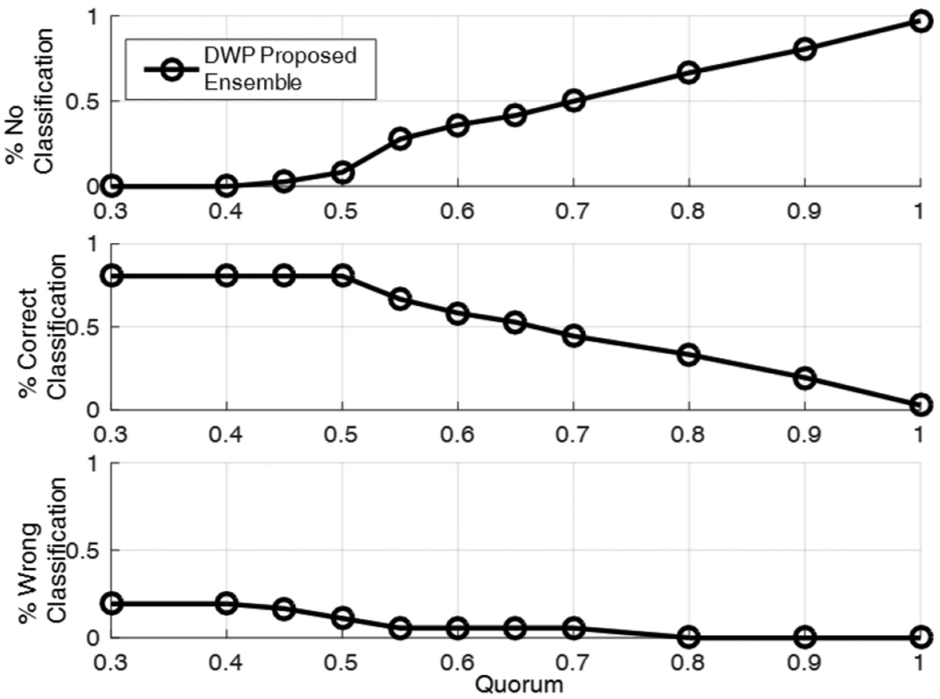 Figure 2: Misclassification rates across different approaches. The DWP ensemble (far right) achieves the best performance.
The "Quorum" Insight
A key contribution is the introduction of a Quorum threshold. By setting a minimum confidence level (relative membership), the system can choose not to classify ambiguous patterns. With a quorum of 0.5, the misclassification rate dropped from 19% to 11%, demonstrating a clear path for safety-critical applications where "no decision" is better than a "wrong decision."
Critical Analysis & Conclusion
Takeaway
The integration of local and global data via dynamic ensembles solves the persistent problem of unit-to-unit variability in power electronics. The SOM’s ability to map high-dimensional sensor data into a 2D interpretable space, combined with dynamic weighting, provides a robust "health-meter" for IGBTs.
Limitations & Future Work
- Label Reliance: The method currently relies on discretized degradation classes (Healthy, Partial, Severe). Moving toward a continuous Remaining Useful Life (RUL) estimation would be the natural next step.
- Operational Shifts: While the model handles different current levels, extreme transient states in real-world EV driving cycles might require more complex feature engineering or recurrent SOM architectures to capture temporal dynamics.
In conclusion, this ensemble approach provides a scalable and highly accurate solution for the next generation of predictive maintenance systems in electric transportation.