
Beyond Classification: Leveraging Ensemble Learning for Fine-Grained Emotion Intensity in Tweets
An Ensemble Based Method for Predicting Emotion Intensity of Tweets
The paper introduces a heterogenous ensemble framework for predicting the continuous intensity of emotions (anger, fear, joy, sadness) in tweets. By combining CNNs, XGBoost, and SVR into a single predictive model, it achieved state-of-the-art results on the WASSA-2017 shared task dataset.
Executive Summary
TL;DR: While most sentiment analysis systems simply classify tweets as "Happy" or "Angry," this paper focuses on the magnitude of that emotion on a scale from 0 to 1. By ensembling Convolutional Neural Networks (CNN), XGBoost, and Support Vector Regression (SVR), the authors successfully captured the complexity of human expression, outperforming existing SOTA models on the WASSA-2017 benchmark.
Positioning: This work is a robust methodological integration. It bridges the gap between deep learning-based representation and traditional feature engineering (lexicons), proving that in the domain of social media, "diversity of features" is still king.
The "Intensity" Gap: Why Classification Isn't Enough
Traditional emotion detection is often treated as a multi-class classification problem. However, for applications like crisis management or customer feedback analytics, knowing that someone is "angry" is less useful than knowing they are "fuming" (0.9 intensity) versus merely "annoyed" (0.4 intensity).
The challenge lies in the noise of Twitter: slang, hashtags like #fuming, and the limited 140-character context make it difficult for a single model to capture the nuanced gradient of human feelings.
Methodology: The Power of Three
The authors propose a "Tri-model Ensemble" strategy, where each model tackles a different facet of the data:
- The Deep Learner (CNN): Uses 200-dimensional GloVe embeddings to extract local semantic features. It looks for "shapes" of word sequences that signify intensity.
- The Gradient Booster (XGBoost): Focuses on word and character N-grams. It is particularly effective at picking up on structural patterns and specific substrings.
- The Expert (SVR): A Support Vector Regressor that ingests 11 different affective lexicons (like NRC Affect Intensity and SentiWordNet). This gives the model "prior knowledge" about the emotional weight of specific words.
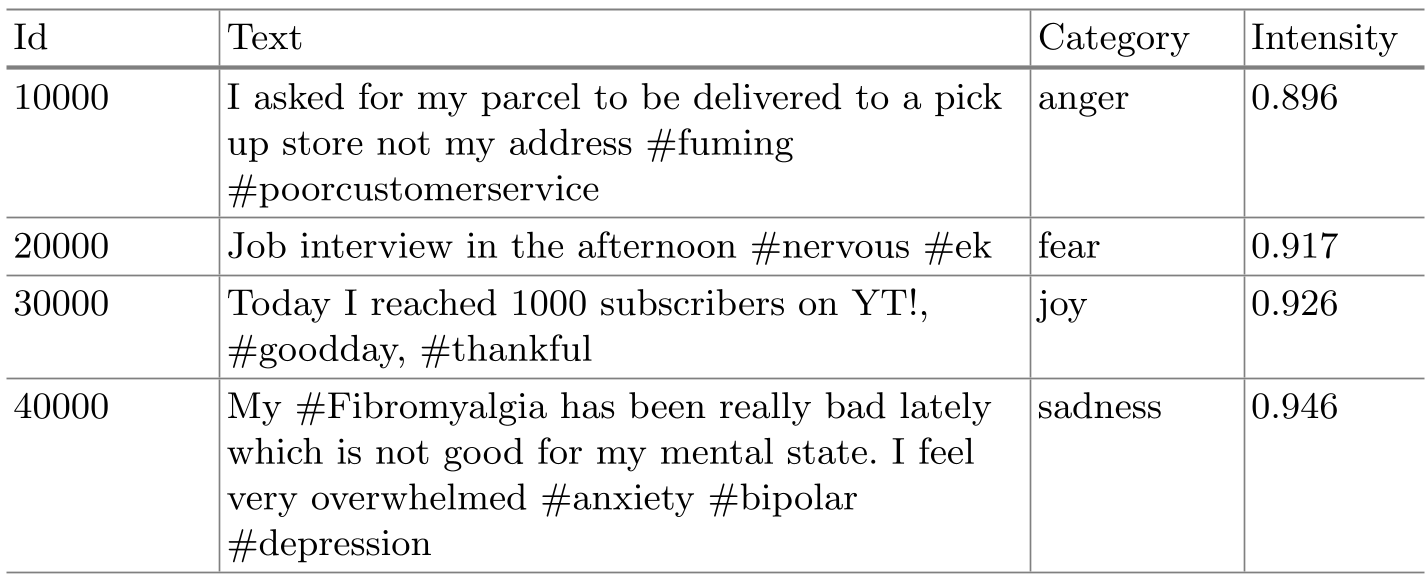 Table 1: Examples of tweets showing emotion categories and their respective continuous intensity scores.
The Ensemble Mechanism
The final intensity score is a simple average of the outputs from CNN, XGBoost, and SVR. This approach mitigates the individual biases of each model—for instance, if a CNN misses a specific slang word, the SVR's lexicon-based approach might catch it.
Experimental Results and SOTA Comparison
The authors evaluated their model using Pearson () and Spearman () correlations. The results show a clear hierarchy:
- CNN Scaling: Increasing word embedding dimensions from 25D to 200D consistently improved performance (PC improved from 0.570 to 0.683).
- Ensemble Superiority: The final ensemble achieved a Pearson score of 0.734, significantly higher than the baseline SVR (0.658) or individual model performances.
- High-Intensity Accuracy: The model excels at identifying the most intense tweets (), which are often the most critical in real-world scenarios.
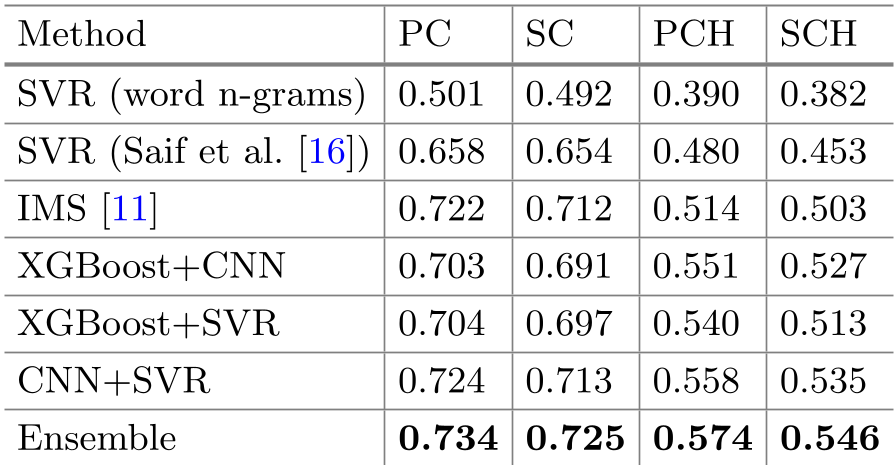 Table 10: Comparative analysis showing the Ensemble outperforming SVR and IMS baselines.
Critical Insights & Future Outlook
Takeaway: The success of this model lies in "Feature Diversity." Deep learning handles the implicit semantics, while SVR with lexicons handles the explicit emotional markers.
Limitations:
- The model relies on specific Twitter lexicons which may become outdated as internet slang evolves.
- Simple averaging is used; a more advanced "Stacking" approach (using another model to learn the weights of the ensemble) might yield even higher gains.
Future Work: Transitioning this ensemble approach to Transformer-based architectures like BERT or RoBERTa could potentially capture even deeper contextual dependencies, further refining the "thermometer" of digital human emotion.