
The paper derives analytical expressions for the average bipartite entanglement entropy and variance in one-dimensional anyon chains with Hilbert spaces constrained by fusion rules. By analyzing Haar-random states in unitary pre-modular categories, the authors establish an "anyonic Page curve" that serves as a universal benchmark for quantum chaos in topological many-body systems.
TL;DR
Researchers have finally mapped the "Page curve"—the gold standard for understanding typical quantum entanglement—onto the exotic world of anyon chains. Unlike standard particles, anyons are constrained by "fusion rules," yet this study proves that their entanglement remains nearly maximal. This discovery provides a new mathematical benchmark for identifying quantum chaos in topological quantum computers.
Background: Why Anyons Defy Standard Rules
In a standard quantum system, the Hilbert space is a simple tensor product: add a particle, and the space multiplies. Anyons (quasiparticles in 2D topological phases) are different. Their existence is governed by fusion rules (e.g., two "Fibonacci" anyons $ au$ can fuse into either a vacuum $0$ or another $ au$).
This creates a constrained Hilbert space that isn't a simple product. Previously, scientists knew how global symmetries (like spin or particle number) changed entanglement statistics, but the "topological" constraints of anyons remained a mystery.
The Problem: The Missing Symmetry Corrections
When you calculate the average entanglement of a random state (the Page curve), systems with Lie group symmetries (like $SU(2)$) usually show specific subleading corrections of order $O(\sqrt{L})$ or $O(1)$. The authors of this paper asked: Do anyonic constraints act like symmetries, or something else entirely?
Methodology: Graphical Calculus & Quantum Groups
The authors used a combination of:
- Anyonic Entanglement Entropy (AEE): A version of entropy that uses the "quantum trace" to stay consistent with the topology of the system.
- Modular S-matrices: To calculate the dimensions of these constrained spaces in the limit of many anyons.
- Numerical Validation: Solving the "Golden Chain" Hamiltonian—a model of interacting Fibonacci anyons—using Exact Diagonalization.
The Anyonic Architecture
The anyonic chain can be visualized as a fusion tree. The entanglement is measured by bipartitioning this tree into segments $A$ and $B$.
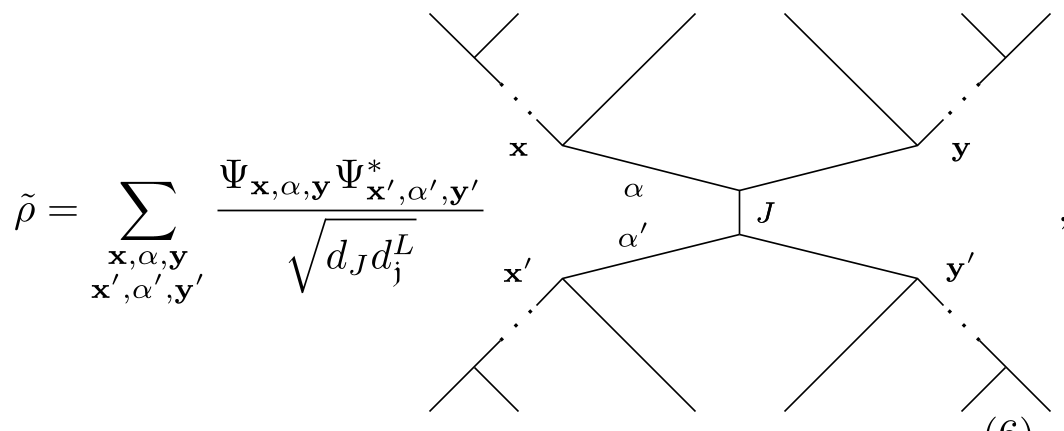 Figure: The diagrammatic representation of the anyonic density matrix and the partial trace operation.
Core Results: Surviving Universality
The most surprising finding is that the anyonic Page curve is cleaner than the symmetric one.
- Leading Order: The entropy grows linearly ($fL \log d_j$), where $d_j$ is the quantum dimension.
- No Symmetry Corrections: The $O(\sqrt{L})$ terms found in $U(1)$ or $SU(2)$ systems are absent here.
- Asymmetry: If the total charge $J$ is non-abelian (like a $ au$ charge), the Page curve becomes asymmetric—the entropy of part $A$ is not the same as part $B$!
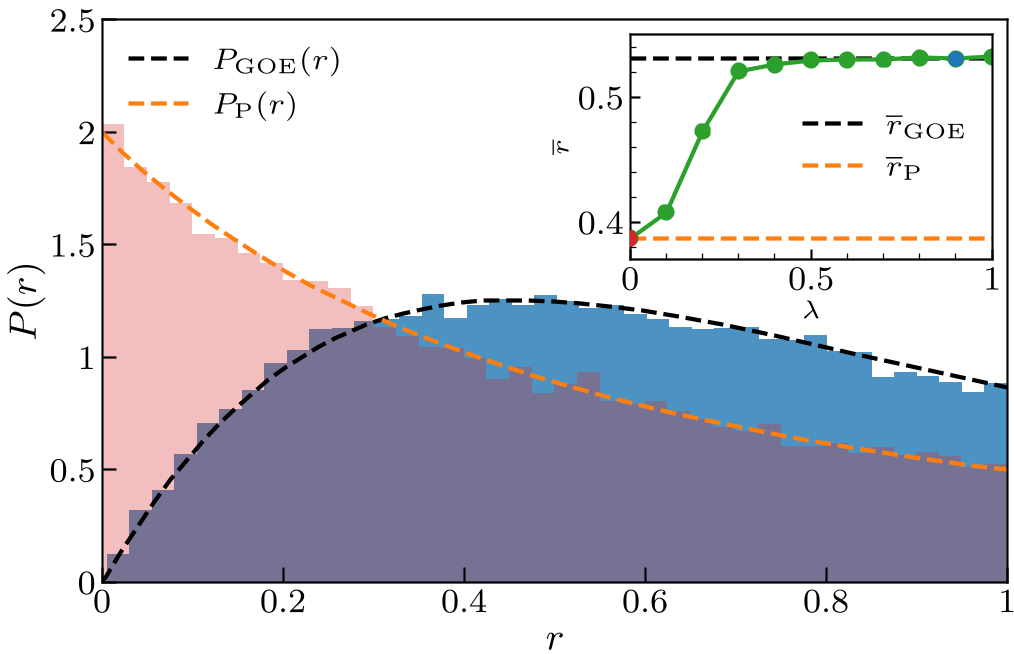 Figure: The average AEE of eigenstates in the golden chain. Note how the chaotic regime (dots) perfectly tracks the Haar-random prediction (dashed line), while the integrable regime deviates.
Identifying Quantum Chaos
By testing the "Golden Chain" (a 1D anyon model), the authors showed that when the system is integrable, entanglement is sub-maximal. However, when they added interactions to make it chaotic, the eigenstates immediately jumped to the Page curve. This confirms that entanglement is a powerful "smoke detector" for chaos even in topological systems.
Critical Insight & Future Work
This work demonstrates that topological constraints are not just "symmetries" in another name. They represent a fundamental restructuring of Hilbert space. While Lie group symmetries reduce "typical" entanglement, anyonic fusion rules allow the system to remain maximally entangled at the leading order.
This opens the door to:
- Studying thermalization in topological quantum computers.
- Exploring 2D topological phases on complex surfaces (like the Torus).
- Developing new benchmarks for "non-invertible" symmetries in high-energy physics.
Conclusion: Even in a world of restricted fusion and braided paths, quantum chaos finds a way to maximize its complexity.